


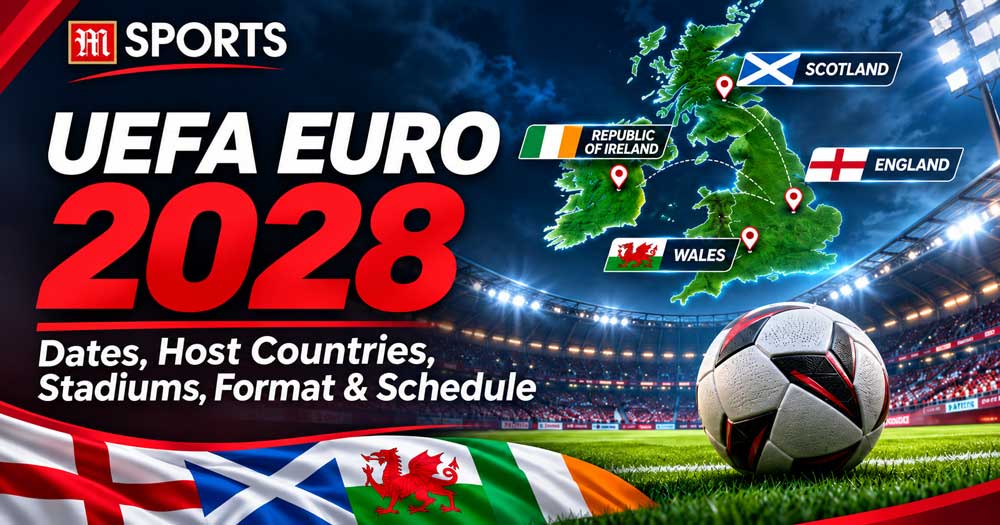
UEFA Euro 2028 is scheduled for 9 June to 9 July 2028, with 24 national teams competing in 51 matches across nine stadiums in England, Scotland, Wales and the Republic of Ireland. The opening match is set for Cardiff; Wembley Stadium in London will stage both semi-finals and the final.
The useful distinction for fans planning ahead is that UEFA has confirmed which cities and stadiums will host each fixture slot, but the national teams in those fixtures are not yet known. This M88Sports guide separates confirmed tournament arrangements from information that will only become clear through qualification and the 2027 final draw.
Fact-checked 10 November 2026 against UEFA’s official EURO 2028 overview and tournament schedule announcement.
Jump to: Quick facts · Stadiums · Match schedule · Qualifying · FAQs
UEFA Euro 2028 quick facts
| Competition | UEFA European Football Championship (men’s senior national teams) |
|---|---|
| Tournament dates | 9 June – 9 July 2028 |
| Match-hosting countries | England, Scotland, Wales and Republic of Ireland |
| Host cities / venues | 8 cities / 9 stadiums |
| National teams | 24 |
| Total matches | 51 |
| Opening match | 9 June 2028, National Stadium of Wales, Cardiff |
| Semi-finals | 4 and 5 July 2028, Wembley Stadium, London |
| Final | 9 July 2028, Wembley Stadium, London |
| Qualifying draw | 6 December 2026, Belfast, Northern Ireland |
| Qualifying matches | March–November 2027, with play-offs in March 2028 |
Confirmed by UEFA. This table will be updated as the teams, groups and individual kick-off assignments are announced.
Where is UEFA Euro 2028 being held?
Euro 2028 is being played in four match-hosting countries: England, Scotland, Wales and the Republic of Ireland. That is not quite the same as the five football associations involved in the successful UK and Ireland hosting bid, which also included Northern Ireland.
Does Northern Ireland host any Euro 2028 matches? Not under UEFA’s confirmed nine-stadium schedule. Belfast will, however, host the qualifying draw on 6 December 2026. This matters because older bid documents mention a proposed Belfast match venue, but the confirmed fixture plan does not include it.
The eight host cities are Birmingham, Cardiff, Dublin, Glasgow, Liverpool, London, Manchester and Newcastle. London is the only city with two stadiums.
All nine Euro 2028 stadiums and the matches they will host
UEFA has allocated the tournament’s 51 fixtures to the nine venues below. Match totals include group-stage and knockout fixtures; the teams filling each numbered group position will be decided later.
| Host city | UEFA stadium name | Match count | Highest scheduled round |
|---|---|---|---|
| Cardiff, Wales | National Stadium of Wales (Principality Stadium) | 6 | Quarter-final; also opening match |
| London, England | Wembley Stadium | 8 | Final; both semi-finals |
| Dublin, Republic of Ireland | Dublin Arena (Aviva Stadium) | 7 | Quarter-final |
| Glasgow, Scotland | Hampden Park | 6 | Quarter-final |
| Manchester, England | Manchester City Stadium (Etihad Stadium) | 5 | Round of 16 |
| Liverpool, England | Everton Stadium (Hill Dickinson Stadium) | 5 | Round of 16 |
| Newcastle, England | St James’ Park | 5 | Round of 16 |
| London, England | Tottenham Hotspur Stadium | 5 | Round of 16 |
| Birmingham, England | Villa Park | 4 | Round of 16 |
How to use this table: If you want to attend the final, only Wembley is relevant. If you want a quarter-final, Cardiff, Dublin, Glasgow and Wembley are the confirmed cities. For a chance to see several national teams before the knockouts, each stadium’s group-stage allocation matters more than its total number of games.
For individual dates and fixture codes at each ground, consult UEFA’s official fixtures-by-venue breakdown. We will cover facilities, transport and match dates in a dedicated stadium guide rather than duplicate that detail here.
Euro 2028 schedule: What is confirmed and what is still to come?
The stadium-based schedule is confirmed. What has not yet been finalised is the identity of the teams occupying group positions such as A1 and B2. Those positions are placeholders in a published fixture structure, not evidence that a specific country has already qualified.
| Stage / milestone | Confirmed date(s) | Location or status |
|---|---|---|
| Opening group match | 9 June 2028 | Cardiff, National Stadium of Wales |
| Other group matches | 9–21 June 2028 | Across all nine venues |
| Round of 16 | 24–27 June 2028 | Eight venues, excluding Wembley |
| Quarter-finals | 30 June–1 July 2028 | Dublin, Wembley, Cardiff and Glasgow |
| Semi-final 1 | 4 July 2028 | Wembley Stadium |
| Semi-final 2 | 5 July 2028 | Wembley Stadium |
| Final | 9 July 2028 | Wembley Stadium |
UEFA lists the tournament’s kick-off slots as 15:00, 18:00 and 21:00 Central European Summer Time (CEST). The final is set for 18:00 CEST (17:00 local UK time). Individual fixture kick-off details will be completed after the final tournament draw in 2027.
Do not confuse a fixture slot with a confirmed matchup: for example, the Cardiff opener is listed as Group A’s A1 versus A2, not as Wales against a named opponent. UEFA’s published fixture plan is the authoritative source until participating sides are determined.
How the Euro 2028 tournament format works
The men’s European Championship retains the 24-team format used since Euro 2016. The first phase has six groups of four national teams, with each side playing three group matches.
- The top two in each group qualify for the round of 16 (12 teams).
- The four best third-placed teams also reach the round of 16 (four more teams).
- The remaining 16 teams play single-elimination knockout matches through the round of 16, quarter-finals and semi-finals to the final.
This creates an important feature for readers watching the group phase: third place does not necessarily mean elimination. Points, goal difference and other applicable tiebreakers can affect whether a third-placed team advances. The knockout bracket and venue pathways are prearranged, but national teams will be assigned to them only after the final draw.
Once teams are revealed, player roles and tactical setups will be part of the story. Historical national-team selection examples from previous European Championships include England’s Euro 2024 squad featuring Jude Bellingham and Harry Kane and Belgium’s Euro 2024 squad decisions involving Kevin De Bruyne and Thibaut Courtois.
How teams qualify for Euro 2028
The Euro 2028 qualification process is different from assuming every home nation gets a place automatically. Teams will be drawn into 12 qualifying groups of four or five and play their group opponents home and away.
- 12 group winners qualify directly.
- Eight highest-ranked runners-up also qualify directly, giving 20 direct places.
- Up to two reserved host places may go to the highest-ranked of England, Scotland, Wales and Republic of Ireland that did not qualify directly.
- Play-offs award the remaining two to four places, depending on whether zero, one or two reserved host places are used. The play-off field also depends on 2026/27 UEFA Nations League results.
In practice, the host nations must compete in qualifying; their participation in the final tournament is not guaranteed individually. The host allocation protects at most two qualifying places, not all four countries.
This is worth separating from older qualifying news. For a historical comparison, see our coverage of the Euro 2024 play-offs and Ukraine’s qualification—the 2028 rules should be assessed against UEFA’s new system, not simply assumed to be identical.
Primary reference: UEFA’s Euro 2028 qualification system. We will publish the detailed qualifying-group draw and pathways separately so this page remains a reliable overview.
When is the Euro 2028 qualifying draw?
The qualifying draw takes place on Sunday 6 December 2026 at 17:00 GMT (18:00 CET) at the International Convention Centre in Belfast, Northern Ireland. The group-stage qualifying matches run from March through November 2027, with the play-off round in March 2028.
As of 10 November 2026, the qualifying groups have not been drawn. Any article displaying definitive 2028 qualifying groups before that draw should be treated cautiously. The December draw will be the first major update milestone for this guide.
Do England, Scotland, Wales and Ireland qualify automatically?
No—not all four are automatically in the finals. All four match-hosting countries enter the qualifiers. They can secure a spot by winning a group or becoming one of the eight best runners-up. After qualifying, UEFA can assign up to two reserved places to the highest-ranked host associations that have not already qualified directly.
If all four qualify directly, the reserved places instead become available through the play-offs. If more than two hosts fail to qualify directly, the other hosts are not guaranteed a finals place just because they are co-hosts. Northern Ireland, although a partner in the original hosting bid, is not among the four associations eligible for the two reserved host places.
A separate issue is stadium assignment: UEFA has prepared preferred group-stage locations for the four hosts and Northern Ireland if they qualify directly, but those prospective arrangements are not proof that the teams will appear at the tournament.
Where would the host nations play if they qualify?
UEFA uses a system of six group heads to manage travel and venue assignments. Most national teams will play their three group games at three different stadiums, but group heads have preselected patterns.
| Team (if directly qualified) | Allocated group-stage venues |
|---|---|
| England | 1 game at Manchester City Stadium; 2 at Wembley |
| Scotland | 3 games at Hampden Park |
| Wales | 3 games at National Stadium of Wales |
| Republic of Ireland | 3 games at Dublin Arena |
| Northern Ireland | 1 game at Tottenham Hotspur Stadium; 1 at Villa Park; 1 at Wembley |
Conditional assignments, not confirmed appearances. If any of those teams do not qualify directly, the relevant group-head slots can be allocated through the final-draw process. See UEFA’s explanation of group heads for the conditions.
Euro 2028 tickets: what can fans do now?
Ordinary match tickets were not yet on general sale as of 10 November 2026. UEFA says standard ticket sales will be run exclusively through UEFA.com closer to the tournament. It has indicated that ticket prices and the full sales plan will be announced in autumn 2027, with sales expected after the final tournament draw in December 2027.
There is an important distinction: official hospitality packages are a separate product, and UEFA lists its hospitality programme through the official provider BEYOND Hospitality. Hospitality availability should not be confused with ordinary public ticket sales.
For now, fans can prepare a myUEFA account and subscribe to ticket notifications via UEFA’s official ticketing page. Avoid unofficial websites claiming to guarantee ordinary match tickets long before UEFA opens its public ticketing process.
Why Euro 2028’s fixed venues matter for supporters
Euro 2028 already offers more planning information than a simple country-and-date announcement. Fans know the opening city, knockout-stage host cities and the exact stadium hosting the final—even though they cannot yet know whether their own national team will reach those matches.
The venue distribution creates different travel considerations. Supporters seeking a final-week experience should focus on London, while fans wanting the possibility of group-stage action in one city can compare Cardiff, Dublin, Glasgow and the other venues. But do not book a non-refundable trip around a specific team’s proposed match location until qualification and the draw have confirmed it.
UEFA says it aims to reduce unnecessary travel where feasible. The exact route each team takes is still linked to group placement and progress through the knockouts, so a final-draw update will be essential for detailed fan itineraries.
What is confirmed, and what should readers check again?
| Already confirmed | Not yet determined (10 Nov 2026) |
|---|---|
| 9 June–9 July 2028 tournament dates | 24 competing national teams |
| Nine stadiums and their fixture slots | Euro 2028 qualifying groups |
| Cardiff opener; Wembley semi-finals and final | Which teams occupy A1, B2 and other slots |
| 24-team, six-group tournament structure | Most specific team-versus-team fixtures |
| Belfast qualifying draw date | Standard ticket prices and public sale windows |
Editorial update checkpoints: (1) the 6 December 2026 qualifying draw; (2) qualification results throughout 2027; (3) the final tournament draw in late 2027; and (4) UEFA’s public ticket announcements. These updates can be added without changing this guide’s URL.
Frequently asked questions about Euro 2028
The tournament runs from 9 June to 9 July 2028.
Final-tournament matches are scheduled in England, Scotland, Wales and the Republic of Ireland. Northern Ireland was part of the five-association hosting bid and will stage the qualifying draw in Belfast, but it has no venue in UEFA’s confirmed nine-stadium finals list.
Wembley Stadium in London will host the final on Sunday 9 July 2028, as well as both semi-finals on 4 and 5 July.
At the National Stadium of Wales in Cardiff on Friday 9 June 2028. UEFA currently identifies it as the Group A fixture A1 against A2 rather than a confirmed matchup between named countries.
Twenty-four teams will contest the finals, divided into six groups of four, with 16 progressing to the knockout stage.
No. As of 10 November 2026, the draw is still scheduled for 6 December 2026 in Belfast.
No. England, Scotland, Wales and the Republic of Ireland all take part in qualifying. UEFA reserves up to two places for the highest-ranked host teams that do not qualify directly; there is no blanket automatic berth for all four.
Standard tournament tickets were not yet on general sale on 10 November 2026. UEFA plans to release details in autumn 2027, with sales expected after the final draw. Official hospitality is a separate offering already advertised by UEFA.
No Belfast stadium is listed among UEFA’s nine confirmed final-tournament venues. Belfast is scheduled to host the qualifying draw.
The stadium fixture slots and tournament dates are published. The final list of national-team matchups will only be known once qualification and the final tournament draw determine the participants and groups.
