


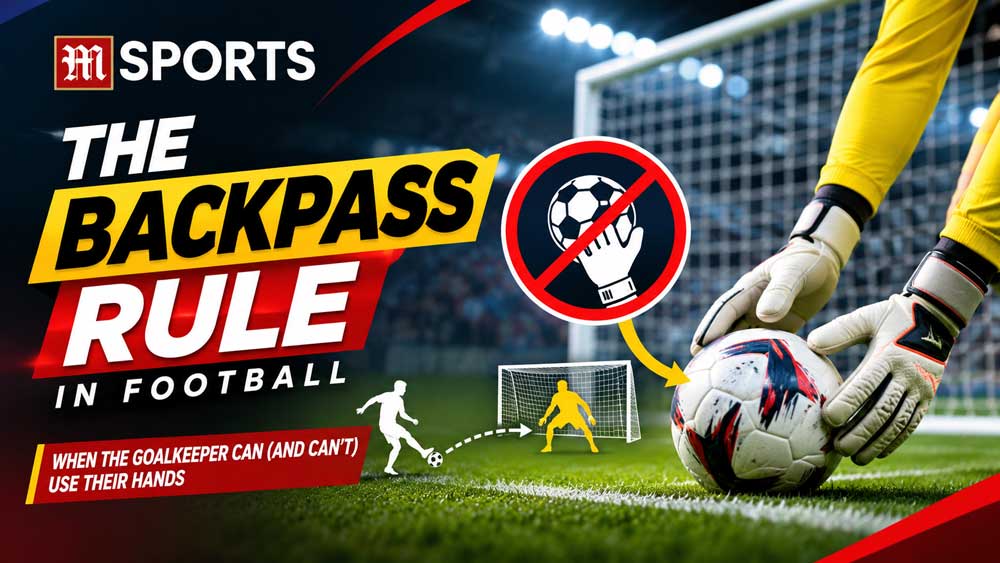
Can a goalkeeper pick up a backpass? Usually not when the ball has been deliberately kicked to them by a teammate. But a normal backpass is not itself a foul: the goalkeeper can receive it, control it with their feet and pass it onward. The restriction concerns handling the ball with the hand or arm inside their own penalty area.
The important word is deliberately. A genuine header, a ricochet and an attempted clearance are not all treated the same. This guide uses the 2026/27 IFAB Laws of the Game to explain the backpass rule, eight common match situations, the penalty for an offence and the exceptions that often confuse supporters.
Rule checked: 10 November 2026. Primary references: IFAB Law 12 and IFAB Law 13.
Backpass rule: the 20-second answer
Usually allowed
- A defender passes back and the goalkeeper uses their feet.
- The ball reaches the keeper after a genuine teammate header or chest pass.
- A teammate’s unintended deflection or a kick not intended for the goalkeeper reaches them.
Not allowed
- The goalkeeper picks up a deliberate kick from a teammate.
- The goalkeeper handles a ball received directly from a teammate’s throw-in.
- A player manufactures a head or chest pass to dodge the restriction.
Normal sanction: an indirect free kick for the opposition where the goalkeeper handles the ball, with a special positioning rule if the offence is inside the goal area. A routine goalkeeper backpass-handling offence inside their penalty area is not a penalty kick and does not automatically earn a yellow or red card.
What is the backpass rule in football?
The backpass rule is the common name for part of IFAB Law 12. A goalkeeper in their own penalty area cannot normally use their hand or arm to play the ball after a teammate has deliberately kicked it to the goalkeeper. They also cannot handle the ball if they receive it directly from a throw-in taken by a teammate.
The word backpass is informal. The Laws do not ban passing towards your own goal. A defender can make a safe pass backwards to a goalkeeper at any time. The keeper must generally play that deliberate pass with their feet, head or another legal outfield body part rather than picking it up.
This distinction is central to the modern goalkeeper’s role. Teams often deliberately draw pressure towards their own box before playing through it. That makes calm distribution as important as shot-stopping, as we explored in our profile of Ederson’s evolution as a modern goalkeeper.
What counts as a deliberate kick to the goalkeeper?
Two questions help explain the decision:
- Did the teammate deliberately kick the ball? A controlled pass is different from a ball merely rebounding off a foot during a block.
- Was the kick directed to the goalkeeper? A deliberate kick intended for another teammate can travel through to the keeper without automatically becoming a prohibited backpass.
The goalkeeper’s eventual handling is what completes the normal offence. If they use their feet to clear the intentional pass, play continues. A mishit pass still counts if the teammate intended to kick it to the goalkeeper; being under pressure does not create an exemption.
Example: A defender looks towards the goalkeeper and passes with their foot. The ball travels awkwardly, and the keeper dives to catch it before a striker arrives. That is an indirect-free-kick offence even if the pass was too short or off target.
Different example: A defender tries to clear an opponent’s shot, and it deflects off another defender before the goalkeeper gathers it. This is not automatically a backpass offence, because there was no deliberate kick to the goalkeeper.
Can a goalkeeper pick up a header or chest pass?
Yes, ordinarily. If a teammate genuinely heads or chests the ball to their goalkeeper during play, the keeper is generally allowed to catch it inside their penalty area. Law 12’s standard restriction concerns a deliberate kick to the keeper, not every pass made with every part of the body.
There is an important anti-trick exception. A player cannot intentionally create a header, chest pass or knee pass as a device to get around the rule. For example, a defender who deliberately flicks the ball up with a foot and then heads it to the keeper has used an illegal trick. The player who initiates that trick is cautioned and the opponents receive an indirect free kick. Under the Law, the trick is an offence even if the goalkeeper never actually catches the ball.
In other words, genuine header = usually legal; contrived trick to evade the law = offence. Referees judge what happened, not just the body part that touched the ball last.
Eight backpass situations explained
These short cases reflect the distinctions in IFAB’s Law 12 examples and help separate a legal pass from a handling offence.
| Match situation | Can the goalkeeper use their hands inside the area? | Why? |
|---|---|---|
| Defender deliberately kicks the ball to the keeper | No | Directly covered by the backpass restriction |
| Defender deliberately kicks to the keeper but mishits the pass | No | An inaccurate intentional backpass still counts |
| Teammate takes a throw-in straight to the keeper | No | Direct teammate throw-ins are separately restricted |
| Teammate genuinely heads a cross back to the keeper | Yes | A genuine header is not a deliberately kicked backpass |
| Defender flicks the ball up and heads it to the keeper as a trick | No legal workaround | The trick itself is an indirect-free-kick offence |
| Shot rebounds off a defender to the keeper | Usually yes | A rebound/block is not necessarily a kick deliberately aimed at the keeper |
| A kick intended for another teammate goes past them to the keeper | Yes, if not deliberately kicked to the keeper | Referees distinguish the intended recipient |
| Keeper clearly attempts to kick a deliberate backpass into play, misses, then handles it | Yes, in the stated exception | Law 12 expressly allows handling after a clear attempt to kick it into play |
Important nuance: The final case does not cover a keeper who merely traps or controls the ball with a foot and then picks it up. The goalkeeper must have clearly kicked or attempted to kick the ball to release it into play. IFAB distinguishes an attempted clearance from an ordinary first touch.
What is the punishment for a goalkeeper backpass offence?
The opposition gets an indirect free kick, not a penalty kick. An indirect free kick cannot score a goal directly: before a goal counts, the ball must touch another player from either team. The referee signals this restart by raising an arm.
Where is the indirect free kick taken?
Ordinarily it is taken where the goalkeeper illegally handled the ball. If that position is inside the goal area (the six-yard box), Law 13 moves the attacking team’s indirect free kick to the nearest point on the goal-area line parallel to the goal line. This is why television sometimes shows an attacking team placing the ball on the six-yard line rather than at the exact spot of the catch.
Is the goalkeeper booked or sent off?
For the ordinary offence of handling a teammate’s deliberate kick inside the goalkeeper’s own penalty area, there is no automatic card, even if it prevented an attacker from reaching the ball. Different offences can bring a card, including the deliberate trick described above, or a goalkeeper handling the ball outside their own penalty area and stopping a promising attack or denying an obvious goal-scoring opportunity.
What if the goalkeeper uses their hands outside the penalty area?
Outside the penalty area, a goalkeeper is treated like any other player for handball. A punishable handball there is a direct free kick offence, with disciplinary consequences depending on circumstances. That is different from the indirect-free-kick backpass offence inside the box.
Does the backpass rule apply after a throw-in?
Yes, but the wording matters. Even though a throw-in is not a kick, a goalkeeper cannot handle a ball received directly from a teammate’s throw-in. It does not matter whether the goalkeeper first controls it with their feet outside the box, dribbles back inside and then tries to pick it up: IFAB’s example still produces an indirect free kick.
If the ball is genuinely played or touched by someone else in the meantime, the direct-receipt condition may no longer apply; the referee assesses the actual sequence. The safest option for teams under pressure is usually for the goalkeeper to continue with their feet.
Backpass vs the goalkeeper eight-second rule: not the same offence
These are often confused because both concern goalkeepers and ball handling. Under the current Laws, the distinction is important:
| Rule | What the keeper does | Normal restart |
|---|---|---|
| Backpass restriction | Handles a deliberate teammate kick or direct teammate throw-in inside their area | Indirect free kick |
| Eight-second possession limit | Controls the ball with hands/arms for more than eight seconds inside their area | Corner kick to opponents |
The eight-second sanction is a corner kick, introduced before the 2026/27 season, not the indirect free kick used for a backpass handling offence. Related time-wasting and restart provisions are covered in our Premier League 2026/27 rule changes guide. Be careful not to confuse the keeper’s eight-second possession count with the five-second countdown for delayed throw-ins and goal-kicks.
Why the backpass rule changes how teams play
Without the handling restriction, a defender under pressure could simply kick the ball to the goalkeeper, who could pick it up and end the attack. Today’s law encourages teams to keep the ball moving and to solve pressure with controlled passing rather than repeated catches.
For goalkeepers, that raises the technical bar: a poor first touch can turn a safe possession phase into a dangerous challenge. For pressing teams, it creates a reason to chase defenders and keepers aggressively, hoping to force a rushed clearance. For coaches, it makes passing angles, support positions and clear communication during build-up play essential.
Fans can watch for one simple pattern: when a defender deliberately passes to a goalkeeper, an opponent often accelerates towards the keeper because the keeper is unlikely to be able to escape by picking up the ball. Modern build-up battles in the Brighton vs Arsenal analysis make a useful tactical companion to understanding that pressure.
Frequently asked questions about the backpass rule
No. Passing backwards is legal. The offence usually occurs only when the goalkeeper handles a ball deliberately kicked to them by a teammate while inside their own penalty area.
Usually yes, if it is a genuine header. A deliberate flick-up or similar trick designed to circumvent the law is penalised even if the keeper never handles the ball.
Not if the ball comes directly from the teammate’s throw-in. Controlling it with the feet and then dribbling into the penalty area does not remove that restriction.
Illegal handling of a deliberate teammate kick by the goalkeeper inside the penalty area results in an indirect free kick, not a penalty kick.
The referee must decide whether it was deliberately kicked to the goalkeeper. A genuine accidental ricochet, block or pass intended for someone else is not automatically a backpass offence.
Yes. The rule does not stop the keeper receiving, dribbling or clearing a teammate’s deliberate pass with their feet. It generally prevents them handling that pass.
Not ordinarily. A routine goalkeeper backpass-handling offence in their own penalty area produces an indirect free kick without a card. Deliberate tricks or separate misconduct can change the disciplinary outcome.
Illegal handling of a teammate’s deliberate kick leads to an indirect free kick; keeping legal possession in the hands for over eight seconds leads to a corner kick for the opponents.
The final decision
A backpass is legal. Picking up the wrong backpass is not. When judging a call, look for a deliberately kicked ball from a teammate (or a direct teammate throw-in), whether the keeper used the hands, and whether a genuine exemption or anti-trick offence applies. These details explain why two situations that look nearly identical can produce opposite refereeing decisions.
Official rules: IFAB Law 12 — Fouls and Misconduct and IFAB Law 13 — Free Kicks. The IFAB Laws take precedence over simplified summaries.
You Might Also Be Interested in Reading
- Premier League 2026/27 Rule Changes: 5 New Rules That Could Change Matches
- Ederson: A Brazilian Evolution from Man City to Fenerbahce
- Brighton vs Arsenal 2026/27: Can Brighton End Arsenal’s Perfect Start?
- Premier League 2026/27 Matchweek 4: 10 Moments That Mattered
- Liverpool vs Crystal Palace: A Look Back and What Lies Ahead
