


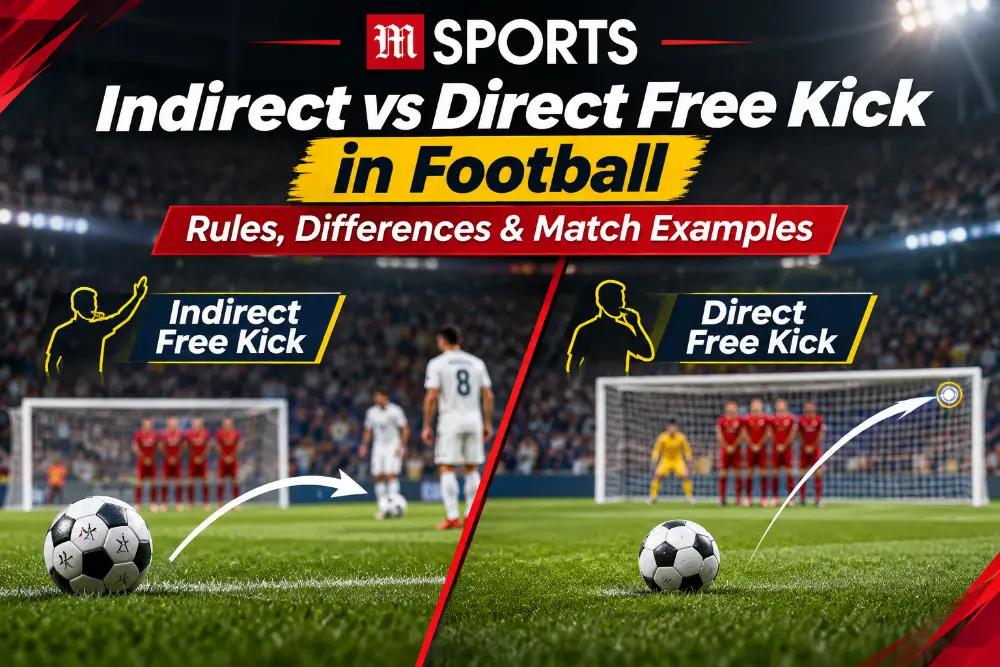
The difference between a direct and an indirect free kick is whether the kicker can score without another player touching the ball. A legal direct free kick can go straight into the opposition’s net. An indirect free kick needs a second player’s touch for a goal to count.
That simple distinction explains why referees sometimes raise an arm, why two attackers stand over the ball inside the penalty area, and why an apparent goal can be disallowed even when the ball crosses the line. This guide uses the current 2026/27 IFAB Laws of the Game and worked match situations to explain the restart, the wall, the goalkeeper and the scoring decision.
Rules checked 26 November 2026: IFAB Law 13, Law 12 and Law 11.
Direct vs indirect free kick: quick comparison
| Rule | Direct free kick | Indirect free kick |
|---|---|---|
| Can the kicker score directly against the opposition? | Yes | No |
| Second player’s touch needed to score? | No | Yes |
| Typical causes | Punishable tackling, holding, handball | Offside, dangerous play without contact, specified technical offences |
| Referee signal | No sustained raised-arm requirement | Arm held above head |
| Defensive penalty-area offence | Normally penalty kick if a direct-free-kick offence | Indirect free kick remains possible |
| Untouched ball enters opposing goal | Goal, if otherwise legal | Goal kick |
| Untouched ball enters own goal | Corner kick to opposition | Corner kick to opposition |
Think of the two restarts as different scoring permissions, not different levels of punishment. A verbal offence can bring a red card but still result in an indirect free kick. The disciplinary decision and the restart are separate.
What is a direct free kick in football?
A direct free kick allows the taker to attempt a goal immediately. Common examples are a defender tripping an attacker, a reckless tackle, a shirt pull, pushing an opponent or a punishable handball by an outfield player. A legal challenge is not automatically a foul simply because contact occurred.
When a defender commits a direct-free-kick offence inside their own penalty area while the ball is in play, the normal restart is a penalty kick. The location of the offence matters: a player tripped outside the box who falls inside it does not automatically win a penalty. A continuing holding offence that extends into the box can be different.
A direct kick can also be played short or crossed into the area. It does not require the taker to shoot. Teams choose the approach according to distance, angle, defensive organisation and the available takers.
What is an indirect free kick in football?
An indirect free kick permits normal passing and shooting, but the ball must make contact with a different player before a goal can be scored. The other player may be a teammate, defender or goalkeeper. There is no requirement that the ball travel a particular distance between touches.
Imagine a player shoots from an indirect free kick and a defender in the wall deflects it into the net. That can be a valid goal because another player touched it. If the same shot flies untouched into the net, it cannot count. This is why the referee’s raised arm is important to both teams.
Common reasons for an indirect free kick
| Incident | Why the restart is indirect |
|---|---|
| Offside offence | The offside player becomes involved in play |
| Dangerous high foot without contact | An opponent cannot safely challenge for the ball |
| Obstruction without contact | A player unlawfully blocks an opponent’s movement |
| Dissent or verbal offence during play | The referee stops play for the verbal infringement |
| Goalkeeper handles a prohibited teammate pass | A specific goalkeeper handling restriction |
| Goalkeeper releases and picks up the ball again before another player touches it | Unlawful handling after release |
| Free-kick taker touches the ball again before anyone else | Second-touch offence, assuming no separate handball offence |
For the goalkeeper-specific restrictions and exceptions, read our backpass rule in football guide. That article explains when headers, throw-ins and attempted clearances are treated differently.
How to recognise the referee’s free-kick signal
Watch the referee after the decision and again as the ball is played. An indirect restart has the distinctive overhead arm signal. A direct restart does not require that arm to remain raised. The signal for direction alone is not proof of an indirect kick.
Direct: one kick can score
TAKER → GOAL
No other touch required
Indirect: another touch required
TAKER → PLAYER → GOAL
Teammate or opponent
If the referee fails to give the indirect signal and the ball enters the opponents’ net without another player’s touch, Law 13 calls for the kick to be retaken rather than simply awarding the goal.
Can an indirect free kick happen inside the penalty area?
Yes. A penalty is not the answer to every infringement by a defending team inside its own box. The type of offence decides the restart. For example, a goalkeeper illegally gathering a teammate’s deliberate kick with the hands normally gives the opposition an indirect free kick.
If the attacking team’s indirect kick is awarded inside the smaller goal area, the ball is placed at the closest point on the goal-area boundary that is parallel to the goal line. This produces the familiar six-yard-line set piece, even when the offence occurred closer to the goal.
Defenders ordinarily keep the required distance. When the kick is very close to goal, they may stand on their own goal line between the posts even if it is less than that distance. A free kick awarded to the defending team within its own goal area can be taken anywhere inside that smaller area.
The following schematic is not to scale. The cross represents an infringement inside the goal area, with the arrow showing the ball’s new placement.
↓
● restart
Six-yard line · Penalty area
Free-kick procedure: distance, wall and quick restarts
For both types, the ball begins at rest and becomes live when kicked with a clear movement. The taker cannot play it again until another player touches it. An ordinary unlawful second kick gives the other team an indirect restart; a separate handball offence can instead produce the corresponding direct restart or penalty.
How far away must opponents stand?
The standard separation is 9.15 metres (10 yards) from the ball, with the goal-line exception described above. For a defending team’s free kick inside its own penalty area, opponents normally stay outside the area until the ball is in play. A quick restart can have specific exceptions for opponents who have not had time to retreat.
The one-metre wall rule
When at least three defenders form a wall, attackers must remain a metre or more from it until the kick is live. An attacker who violates this restriction at the restart gives the defending team an indirect free kick. Moving towards the wall after the ball becomes live is not itself a breach of that requirement.
Does every free kick need a whistle?
No. Quick free kicks may be permitted. If the referee is managing the wall or has instructed the taker to wait, the player must respect the required signal. An opponent who simply intercepts a quick kick while still retreating is treated differently from an opponent who deliberately prevents the restart. The latter can be cautioned.
Ten match scenarios: what should the referee award?
| Situation | Decision |
|---|---|
| Defender trips striker outside the box | Direct free kick |
| Defender trips striker inside own penalty area | Penalty kick |
| A dangerous high foot prevents a header without contact | Indirect free kick |
| A high-foot challenge makes punishable contact | Direct free kick or penalty, depending on location |
| Offside player plays a teammate’s pass | Indirect free kick |
| Indirect shot brushes a defender and goes in | Goal if otherwise legal |
| Indirect shot enters net untouched | Goal kick, assuming correct signal |
| Direct kick curls into opposition net untouched | Goal if otherwise legal |
| Either kind of kick goes untouched into taker’s own goal | Corner kick for opponents |
| Goalkeeper exceeds eight-second hand-possession limit | Corner kick for opponents |
For a real match example, see our coverage of Declan Rice’s two free kicks against Real Madrid in Arsenal’s 2025 Champions League run.
These are illustrative match situations rather than claims about specific historical incidents. Notice that a lack of contact is not a universal test for an indirect restart: attempted physical offences can fall under the direct-free-kick rules. The referee must identify the actual infringement.
Goalkeeper time-wasting: an important rule change
Older football guides may tell readers that a goalkeeper holding the ball too long gives away an indirect free kick. That description is outdated. Since the 2025/26 change, exceeding the eight-second limit for control of the ball with the hands or arms produces a corner for the opposing team. It is distinct from the prohibited backpass and from gathering the ball again after release.
The referee visually counts down the last five seconds of the possession limit. The corner is taken from the side closest to the goalkeeper’s position when penalised. Repetition may lead to a caution. See our Premier League rule changes guide for related restart and time-management rules.
How teams approach direct and indirect set pieces
For a direct kick near the box, a team can shoot around or over the wall, disguise a cross, or play a short pass to create a better angle. From wider positions, the delivery may be designed for a teammate to attack rather than for a direct shot.
For an indirect kick in a crowded penalty area, a simple legal first touch followed by a shot changes the scoring conditions. The defending team must respect the restart distances until the ball is live, but can then move to block. The attacking team needs to balance accuracy, timing and the risk of a defensive clearance. A stationary foot resting on the ball without clear movement is not enough to put it into play.
Goalkeepers need to organise their defenders and identify the restart type. Our profile of Ederson and the modern goalkeeper’s role provides additional context on decision-making and distribution.
Frequently asked questions
It is a restart from which the kicking team cannot score directly. The ball must touch another player from either team before entering the opponents’ goal.
Yes, into the opponents’ goal, provided the kick is taken legally and no other offence invalidates it.
If nobody else touches it and the referee has signalled correctly, the defending team gets a goal kick.
Yes. A goalkeeper’s actual touch counts as a second player’s touch, provided the goal is otherwise legal.
It identifies an indirect free kick. The signal continues until a subsequent player touches the ball or the chance of scoring directly has ended, or the ball is out of play.
Yes. Examples include certain goalkeeper handling offences and verbal misconduct. The special goal-area placement rule applies if the attacking team’s kick would be inside the six-yard box.
An offside offence produces an indirect free kick for the opposing team at the location of the offence.
If the kick enters the opponents’ goal directly without another touch, it is retaken.
No. Under the current goalkeeper possession rule, the opposing team receives a corner kick.
Neither type can produce a direct own goal; the opposing team receives a corner kick.
The final decision
When watching a free kick, identify the offence, check the referee’s arm signal and watch whether a second player touches the ball. A direct restart can produce an immediate goal against the opponents; an indirect restart cannot. The restart type, the place of the infringement and any disciplinary punishment must be assessed separately. These three checks explain most confusing free-kick decisions without memorising every possible scenario.
