


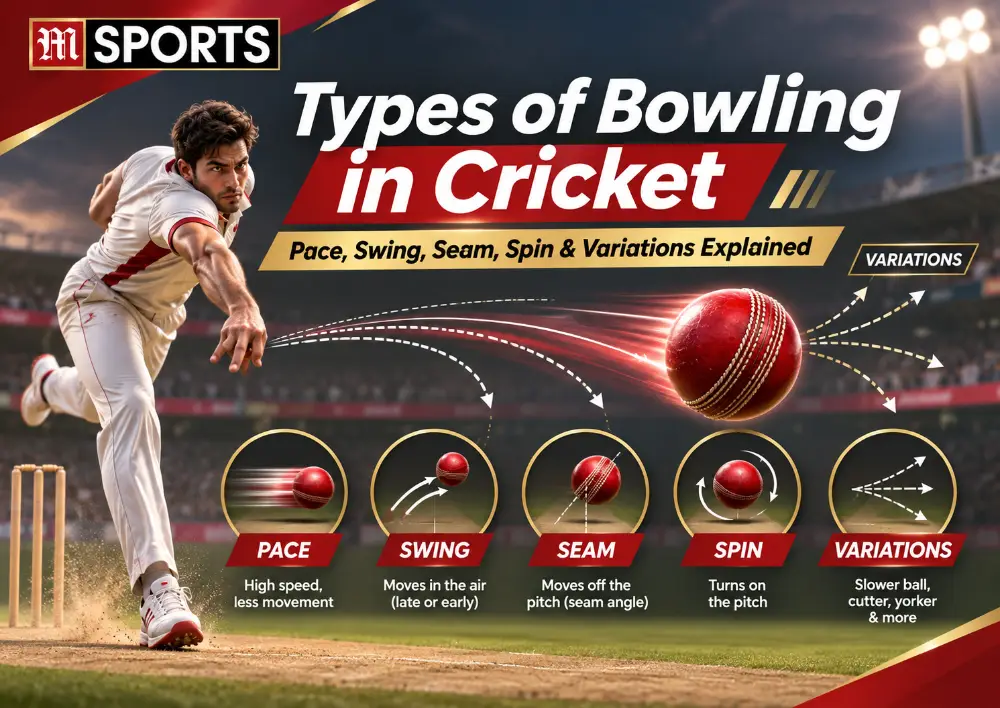
The two main types of bowling in cricket are pace bowling and spin bowling. Pace bowlers use speed, bounce and movement through the air or off the pitch; spin bowlers use rotation, flight and changes of pace to deceive the batter. Within these families are swing, seam, off-spin, leg-spin and deliveries such as yorkers, bouncers and googlies.
Understanding the differences makes cricket commentary much easier to follow. A single delivery can be fast, swing away in the air and land on a good length. These descriptions are complementary, not competing categories. This guide explains what happens to the ball, how to recognise each style on television, and why bowlers choose different deliveries in Tests, ODIs and T20s. The ICC’s bowling explainer introduces the same core skills.
Types of Bowling in Cricket at a Glance
Rather than memorising a numbered list, classify a delivery using four questions: how fast is it, how does it move, where does it land and is it different from the bowler’s usual ball?
| Type or feature | What it describes | Typical purpose |
|---|---|---|
| Fast or medium pace | Bowling approach using pace and control | Beat reaction time, draw errors or move the ball |
| Swing | Lateral movement before pitching | Find an edge or threaten pads and stumps |
| Seam | Deviation after contacting the surface | Make the batter misjudge the line |
| Finger spin | Rotation primarily imparted through the fingers | Control, turn and changes of trajectory |
| Wrist spin | Rotation primarily generated by wrist action | Turn, bounce and deceptive variations |
| Yorker, good length, bouncer | Where the ball pitches | Change the batter’s available shots |
| Slower ball, googly, cutter | Variation from a stock delivery | Disrupt timing or expected movement |
There are no universal speed cutoffs separating fast, fast-medium and medium-pace bowlers. These labels are conventional. The ball’s actual speed and behaviour matter more than the label.
Pace Bowling: Fast, Swing and Seam
Fast and medium-pace bowling
Fast bowlers create pressure by reducing the time a batter has to judge the ball. A short ball can force a back-foot response, while a fuller delivery may target the stumps or encourage a drive. Medium-pace bowlers can succeed through accuracy, cutters and movement even without exceptional speed. Both may exploit the same pitch conditions.
Swing bowling
Swing occurs when the ball curves sideways during flight. Its seam orientation, surface condition, speed and surrounding airflow influence the result. An outswinger moves away from the batter; an inswinger moves towards the batter. Reverse swing is a distinct aerodynamic behaviour often associated with an older, asymmetrically worn ball, and can move in a direction opposite to conventional swing for a comparable seam orientation. It is not simply another name for an inswinger.
Seam bowling
Seam movement happens at the bounce. The raised seam and the nature of the pitch can cause a delivery to deviate from its original course. An upright seam can help a bowler seek movement; a wobble-seam delivery can make deviation less predictable. Former England bowler Stuart Broad describes his approach in this ECB masterclass on swing and wobble seam.
Original diagram 1 — swing versus seam (schematic top view)
Release → bounce (●) → batter
The sideways curve begins before the ball lands.
Release → bounce (●) → batter
The ball changes direction at the bounce.
Arrows illustrate possible movement, not a measured trajectory. Both effects can occur during one delivery.
Watch the replay: an outside edge after early movement might come from swing, while a ball that holds its line until pitching and then nips away indicates seam. Camera angle and combined movement can make the two difficult to separate.
When a bowler attacks the outside edge, captains may place slips or a gully to catch it. The positioning is explained in our cricket field positions guide.
Pace Bowling Variations: Yorker, Bouncer, Cutter and Slower Ball
Speed alone is not enough. Varying the length, line or pace can prevent batters from setting themselves for a particular shot.
| Delivery | How it behaves | When it can help |
|---|---|---|
| Yorker | Pitches very full near the batter’s feet or blockhole | Late limited-overs overs; restricts a full swing of the bat |
| Full length | Pitches relatively close to the batter, but not necessarily under the bat | Encourages a drive or threatens stumps |
| Good length | Lands where the batter may be unsure whether to move forward or back | Builds pressure, especially in longer formats |
| Bouncer | Short-pitched ball that rises towards the upper body or head | Changes the batter’s footwork; subject to safety and competition rules |
| Slower ball | Arrives later than expected relative to the bowler’s usual speed | Disrupts timing when a batter attempts a big shot |
| Off-cutter | Typically deviates off to leg against a right-hander when bowled by a right-armer | Can grip on a used surface and induce a mistimed shot |
| Leg-cutter | Typically deviates leg to off against a right-hander when bowled by a right-armer | Can beat the outside edge or change timing |
| Knuckleball | A slower-ball variation released with a modified finger grip | Changes pace and often reduces rotation |
Original diagram 2 — where different lengths land
Bowler’s end → direction of delivery → striker’s crease
Illustrative pitch-length zones, not official distances. The effective length depends on bounce, speed and the batter’s position.
A yorker that misses too full can become a full toss. A slower ball that is too short may give the batter time to adjust. Effective variation is about execution, not simply choosing an unusual delivery.
Spin Bowling: Finger Spin and Wrist Spin
Spin bowlers use rotation to influence the ball’s flight and its behaviour after bouncing. They can vary trajectory, speed and the axis of rotation. Drift means lateral movement in flight; dip describes the ball dropping more sharply than a batter anticipates. Turn is the sideways deviation after pitching. Not every spin delivery turns sharply, and bounce can be just as important.
| Bowling style | Usual technique | Stock ball vs right-handed batter |
|---|---|---|
| Right-arm off-spin | Finger spin | Off side → leg side (into batter) |
| Right-arm leg-spin | Wrist spin | Leg side → off side (away from batter) |
| Slow left-arm orthodox | Finger spin | Leg side → off side (away from batter) |
| Left-arm wrist spin | Wrist spin | Off side → leg side (into batter) |
The directions above refer to the conventional stock deliveries against a right-handed batter; against a left-hander, the relationship reverses. Variations and surfaces can change the actual trajectory. Singapore’s ActiveSG cricket guide also distinguishes finger spin from wrist spin.
Original diagram 3 — conventional turn against a right-handed batter
Right-arm finger spin: turns in
Right-arm wrist spin: turns away
● represents the bounce; arrows describe the direction of turn, not the full path. A left-handed batter changes the off/leg reference.
Off-spin vs leg-spin: the practical difference
Against a right-handed batter, the standard off-break can threaten the inside edge, pads or stumps. The normal leg-break can threaten the outside edge and invite a catch behind. Neither style is inherently superior. A bowler who changes flight and length while retaining control can bring different dismissals into play. For the conditions under which hitting a pad can produce a wicket, read LBW in cricket explained.
Spin Bowling Variations: Googly, Doosra, Arm Ball and More
A stock ball is the bowler’s regular delivery. Variations work by making the batter anticipate that stock ball but receive a different trajectory, pace or bounce.
| Variation | Usual association | What to look for |
|---|---|---|
| Googly (wrong’un) | Right-arm wrist spin | Turns into a right-handed batter instead of away |
| Doosra | Right-arm finger spin | Turns away from a right-handed batter instead of in; action must be legal |
| Top-spinner | Finger or wrist spin | Forward rotation can cause extra dip and bounce, often with less sideways turn |
| Arm ball | Finger spin | Goes on with little turn compared with the stock ball; may swing or drift |
| Flipper | Wrist spin | Backspin can produce a lower, skidding bounce |
| Slider | Wrist spin | Generally goes straighter or turns less than the normal leg-break; execution varies |
| Carrom ball | Finger-spin variation | Flicked release; turn or skid depends on how it is delivered |
There is no official fixed list of named variations. Terminology differs among coaches and bowlers, and a commentator’s label does not guarantee the ball behaves as intended. The doosra, for example, names a variation rather than a blanket declaration that the action is legal or illegal.
Which Bowling Types Work Best in Test, ODI and T20 Cricket?
The right delivery depends on the pitch, ball condition, field and batting objective. The following are tactical tendencies rather than mandatory rules.
| Match situation | Common bowling options | Why |
|---|---|---|
| Test cricket, new ball | Swing, upright seam, good length | Attack edges and stumps when the ball and conditions allow movement |
| Test cricket, older ball | Reverse swing when available, spin, cutters | Exploit wear, changes in the pitch and long spells of pressure |
| ODI opening overs | Swing, seam, accurate pace | Seek early wickets while managing field restrictions |
| ODI middle overs | Finger spin, wrist spin, changes of pace | Control rotation of strike and attack vulnerable matchups |
| T20 powerplay | Swing, seam, pace, selected spin matchups | Challenge aggressive opening batters with limited boundary protection |
| T20 middle overs | Spin, cutters, hard lengths | Vary pace and restrict clean boundary hitting |
| T20 or ODI death overs | Yorkers, slower balls, hard lengths | Disrupt hitting at the end of an innings |
Field restrictions change during limited-overs games, so the bowler’s plan should match the available protection. Our T20 and ODI powerplay guide explains how the restrictions affect attacking and defensive fields.
How pitch conditions affect bowling
A grassy or uneven surface can favour seam movement; a dry, worn surface can help some spinners find grip. A slow pitch may reward cutters and changes of pace. A hard surface can produce higher bounce. None is guaranteed: preparation, ball condition and individual technique matter. A flat batting surface may demand tighter lines and carefully disguised changes rather than more turn or speed. In Tests, the bowlers’ workload and changing conditions also influence whether a captain chooses to enforce the follow-on or bat again.
How to Recognise Bowling Types While Watching Cricket
Use this simple sequence when you watch a replay. First look at the bowler’s usual pace and release style. Next follow the ball before it pitches. Finally watch its path after the bounce and where it lands relative to the batter.
| What you observe | Likely explanation | Important caveat |
|---|---|---|
| Curves away before pitching | Outswing or spin drift | The release and pace help distinguish them |
| Straight flight, sharp deviation at bounce | Seam or spin | Movement alone cannot identify the exact grip |
| Very full near the feet | Yorker length | It can also swing or arrive slowly |
| Pitches short and rises high | Bouncer or short ball | Not every short ball is a regulated bouncer |
| Wrist spinner’s ball turns into right-hander | Possible googly | Left-arm wrist spin may naturally turn in |
| Batter swings early at a familiar-looking pace action | Possible slower ball | Replay and speed display help confirm |
Worked match scenario (illustrative): A right-arm seamer bowls two outswingers to a right-hander, then delivers an inswinger on a fuller length. The batter anticipates the ball moving away and leaves a gap towards the stumps. The change of movement, rather than a new category of bowler, creates the opportunity.
Another example: A right-arm leg-spinner bowls two stock leg-breaks and then a googly at similar pace. A batter playing for turn away can be beaten on the inside edge if the variation turns in. These examples describe possible outcomes, not guaranteed wickets or historical match records.
Bowling Type Identification Quiz
Choose the delivery that best fits each example, then reveal the answer. This interactive self-check does not require JavaScript; the scenarios are hypothetical.
1. A fast ball curves away from a right-handed batter before pitching. Outswing, seam movement or yorker?
Answer: Outswing. The sideways motion occurs in the air and away from the batter.
2. A pace delivery holds its original line in the air, then nips sideways after pitching. Swing, seam or slower ball?
Answer: Seam movement is the best fit given a pace delivery and post-bounce deviation.
3. A right-arm wrist spinner’s variation turns into a right-handed batter. Googly or stock leg-break?
Answer: Googly is the likely variation; the stock leg-break normally turns away.
4. The ball pitches very close to the batter’s toes. Bouncer, yorker or top-spinner?
Answer: Yorker describes the very full length. It can overlap with other features.
5. A pace bowler keeps a similar action but the ball arrives noticeably later. Slower ball or reverse swing?
Answer: Slower ball. The main clue is the change in speed, not lateral movement.
6. A right-arm finger spinner’s stock delivery turns from off to leg against a right-hander. Off-break or leg-break?
Answer: Off-break. The conventional right-arm leg-break turns in the opposite direction.
Score yourself one point per correct answer. Six correct answers means you can distinguish the most common movement and length labels.
Bowling Laws and Common Misunderstandings
Named deliveries are cricket terminology; legality is governed by the MCC Laws and the competition’s playing conditions. A bowler must comply with the requirements for fair delivery, including the arm action and feet. Dangerous short-pitched or high full-pitched deliveries can be penalised, and the number of permitted short-pitched balls can vary by format and competition. Consult the MCC Laws of Cricket and ICC playing conditions for the applicable rules.
- Fast bowling is not synonymous with swing. A fast ball can travel straight, seam, swing or combine effects.
- All spin is not leg-spin. Finger spin and wrist spin include right- and left-arm styles.
- A yorker does not have to swing. Yorker is a length, not an aerodynamic effect.
- A wide yorker is not automatically a legal ball. Its line and the applicable judging criteria matter. Read our no ball vs wide ball guide.
- No style guarantees wickets. Accuracy, deception, field placement and the batter’s response remain crucial.
The best way to understand bowling is to separate speed, movement, length and variation. Once those concepts make sense, you can recognise most of the terms used by commentators and understand why a captain selects particular bowlers.
You Might Also Be Interested in Reading
- Cricket Field Positions Explained: Diagram, Roles & T20 vs Test Setups
- LBW in Cricket Explained: Full Form, Rules, DRS & Examples
- Powerplay in Cricket: T20 vs ODI Rules, Overs & Fielding Limits
- No Ball vs Wide Ball in Cricket: Rules, Free Hits & Scoring Explained
- Follow-On Rule in Cricket Explained: 200-Run Rule, Calculator & Examples
- Net Run Rate Calculator: Cricket NRR Formula & Examples
Types of Bowling in Cricket: Frequently Asked Questions
Pace bowling and spin bowling. Pace includes fast and medium-pace approaches, while spin includes finger spin and wrist spin. Swing, seam, length and variations describe how individual balls behave.
Swing is sideways movement in the air before the bounce. Seam movement is a change of direction after the ball contacts the pitch. A ball can do both.
For a right-handed batter, a conventional right-arm off-break turns from off to leg; a conventional right-arm leg-break turns from leg to off. Their usual methods of imparting rotation differ too.
A right-arm wrist spinner’s googly typically turns into a right-handed batter, the opposite direction to their normal leg-break.
A yorker describes a very full delivery that lands near the batter’s feet. It is commonly used by fast bowlers, but the term describes length rather than a distinct bowling family.
Yes, a bowler can change technique or bowl a slower cutter, provided the delivery complies with the Laws and applicable playing conditions. A cutter does not automatically make that bowler a specialist spinner.
There is no universal best style. Swing and seam can threaten early, spin can control the middle, and accurate yorkers, slower balls and other changes can be effective late. Conditions, field and the batter determine the choice.
There are two broad families and many overlapping delivery descriptions. No official fixed count covers all possible grips, lengths, movement and variations.
