


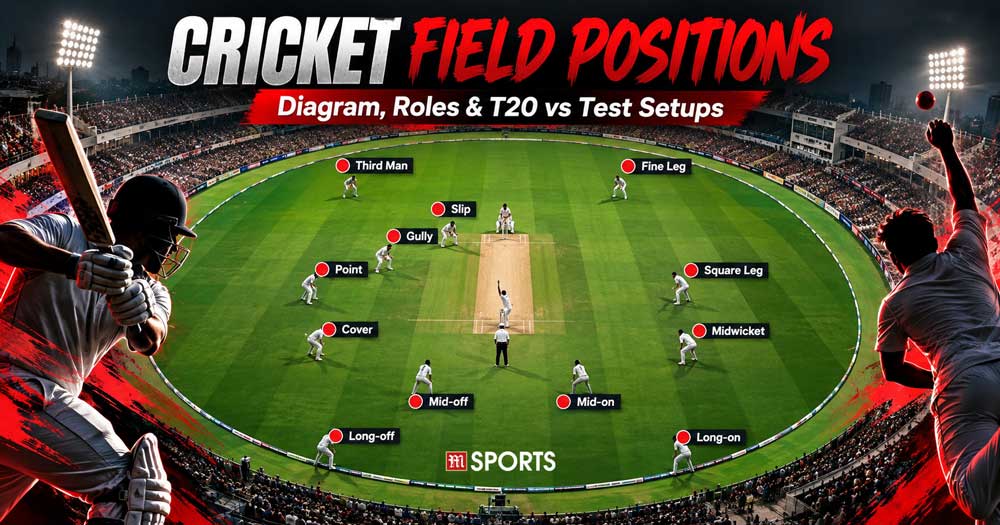
What are the field positions in cricket? A fielding captain places players at named spots such as slip, gully, point, cover, mid-off, mid-on, midwicket, square leg and fine leg. These names describe where a player stands relative to the batter; they are not fixed numbered positions. The best placement depends on the bowler, the batter’s likely shots and whether the team is trying to take a wicket or prevent runs.
This practical guide explains the field map, the job of each position and sample placements for Tests, ODIs and T20 cricket. The rules sections follow the ICC playing conditions effective October 2026 and distinguish international playing conditions from the underlying MCC Laws. Last fact-checked: 16 October 2026.
Cricket Field Positions: Quick Reference Map
The following schematic is illustrative, not to scale. Imagine a right-handed striker at the bottom facing the bowler at the top. Leg side is shown on the left and off side on the right. The names are possible locations, not a suggestion that every spot is occupied at once.
| Leg side / on side | Direction from striker | Off side |
|---|---|---|
| Long-on, deep midwicket | Deep / toward bowler’s end | Long-off, deep cover |
| Mid-on, midwicket | In front of square / infield | Mid-off, extra cover, cover |
| Square leg, short leg | At or near striker’s level | Point, silly point |
| Fine leg, leg slip | Behind the striker’s wicket | First slip, second slip, gully, third man |
Reading tip: Follow the diagram from the bowler’s end toward the striker: positions such as mid-off and mid-on lie ahead of the batter, point and square leg sit broadly sideways, while slips, gully, third man and fine leg are behind the striker. In a real field, captains choose a subset of these named positions; all of them are never occupied at once.
Off Side vs Leg Side: The First Thing to Understand
The names off side and leg side (on side) are relative to the batter’s stance. For a conventional right-handed striker, the off side is the side in front of their body when they stand sideways to face the bowler; the leg side is the side toward their legs. For a left-handed striker, the physical sides of the ground reverse.
- Off-side examples: slip, gully, point, cover, extra cover, mid-off, third man and long-off.
- Leg-side examples: square leg, short leg, midwicket, mid-on, fine leg and long-on.
- Square: roughly level with the striker’s wicket as viewed across the pitch.
- Fine: closer to the direction behind the batter or wicketkeeper than a square position.
- Deep / long: a fielder placed farther out, usually to cover a boundary region.
One important exception to oversimplified diagrams: slips and gully are generally behind the striker on the off side, while third man is usually deeper behind square on that same side. A ball travelling to third man is not heading toward mid-off, which lies ahead of the striker.
Cricket Field Positions and Their Main Roles
There are many variations on fielding names. This table covers the most useful positions for reading a score broadcast or setting a beginner-friendly field.
| Position | Usual area | Main tactical purpose |
|---|---|---|
| Wicketkeeper | Behind the striker’s stumps | Take edges and catches, stop balls and attempt stumpings. |
| First and second slip | Close behind batter, off side, beside keeper | Catch outside edges, especially against seam or swing bowling. |
| Gully | Behind square, wider than slips, off side | Catch thicker edges and cut-like aerial shots. |
| Silly point | Very close, in front of square, off side | Catch bat-pad chances against spin; helmet often used. |
| Short leg | Very close, in front of square, leg side | Catch bat-pad chances on the leg side. |
| Point / backward point | Around square on off side | Stop square cuts and hard shots through point. |
| Cover / extra cover | In front of square, off side | Cut off cover drives and save singles. |
| Mid-off | Fairly straight, off side, toward bowler | Stop straight/off-side drives; pressure running. |
| Mid-on | Fairly straight, leg side, toward bowler | Stop leg-side straight drives and quick singles. |
| Midwicket | In front of square on leg side | Intercept clips, pulls and across-the-line drives. |
| Square leg | Near square on leg side | Stop pulls, hooks, sweeps and leg-side singles. |
| Fine leg | Behind square on leg side | Stop glances and fine deflections; position may be short or deep. |
| Third man | Behind square on off side | Collect edges, guides and late cuts; often deep. |
| Long-off / long-on | Deep straight boundaries, either side of bowler | Protect aerial straight drives and take boundary catches. |
| Deep cover / deep point | Boundary on off side | Protect cut and drive boundaries. |
| Deep midwicket / deep square leg | Boundary on leg side | Protect powerful pulls, slog-sweeps and lofted leg-side shots. |
Fielding names describe regions rather than official fixed coordinates. A captain may stand a “point” noticeably finer or squarer than another captain, or move a “cover” deeper, without changing the ordinary name for the role.
Close Catching Positions: Slips, Gully, Silly Point and Short Leg
Slips and gully
Slip fielders normally stand on the off side behind the striker, close enough to catch balls edged off the outside of the bat. First slip is typically nearest the wicketkeeper; further slips fan out wider. Gully is wider and commonly squarer than the slip cordon. These positions are especially useful when seam or swing bowling makes edges likely.
Silly point and short leg
These positions are close to the striker—silly point on the off side, short leg on the leg side. Spinners may use them for close bat-pad catches. Because the reaction distance is short, protective helmets and other permitted close-fielding safety equipment can be important; competition safety regulations and the umpires’ instructions still apply.
Not every close catcher should appear in every field. A captain may choose two slips in an attacking Test spell but remove slips and send fielders to the boundary late in a T20 chase.
Infield Positions: How Captains Stop Singles
The familiar infield arc includes point, cover, extra cover, mid-off, mid-on, midwicket and square leg. These fielders are usually selected to intercept grounded shots, create pressure and force the striker to take more risk.
- Point and cover: good against cuts and drives that travel across the off side.
- Mid-off and mid-on: protect straighter scoring areas and can encourage or discourage a quick single.
- Midwicket and square leg: protect clips, pulls and sweeps on the leg side.
- Short fine leg or short third: can discourage easy deflections, especially when the captain keeps more players within the fielding circle.
The 30-yard restriction area used in international limited-overs cricket is made from two semicircles of 30 yards (27.43 m) radius centred on the middle stumps at the two ends, joined by parallel lines. It is commonly called “the 30-yard circle,” although its marked shape is not literally a single circle. The ICC sets limits on how many fielders can be outside it at the instant of delivery.
Boundary Fielders: Long-On, Long-Off, Deep Midwicket and More
Boundary riders give a bowler protection when a batter tries to hit the ball into the air or drive it hard through a gap. Long-off and long-on cover straighter lofted shots; deep midwicket and deep square leg cover popular leg-side hitting areas; deep cover, deep point, third man and deep fine leg guard other boundary sectors.
Captains face a trade-off: moving a fielder deep may turn an expected four into a one or two, but it can also leave an infield gap for easy singles. There are only nine ordinary fielding positions to allocate, so no field can guard every shot at the same time.
Official Fielding Restrictions in T20, ODI and Test Cricket
Scope: The table below follows the ICC men’s international playing conditions effective October 2026 for full-length innings. Domestic, junior, women’s, tournament-specific and rain-shortened games may apply adjusted conditions; check the rules used in the match you are watching.
| Format / phase | Maximum outside 30-yard area | Additional note |
|---|---|---|
| Men’s T20I, overs 1–6 | 2 | Powerplay. |
| Men’s T20I, overs 7–20 | 5 | Normal non-Powerplay limit; applicable slow-over-rate penalties can tighten it. |
| Men’s ODI, overs 1–10 | 2 | Powerplay 1. |
| Men’s ODI, overs 11–40 | 4 | Powerplay 2. |
| Men’s ODI, overs 41–50 | 5 | Powerplay 3; applicable slow-over-rate penalties can tighten it. |
| Men’s Test | No standard Powerplay-circle limit | Other Law and playing-condition restrictions still apply. |
Sources: ICC Men’s T20I Playing Conditions, October 2026 (clauses 28.4 and 28.7) · ICC Men’s ODI Playing Conditions, October 2026 (clauses 28.4 and 28.7) · ICC Men’s Test Playing Conditions, October 2026 (clause 28.4). For the baseline restrictions, see MCC Law 28 — The Fielder.
Example 1: An Attacking T20 Powerplay Field
Situation: A right-handed opener is facing a right-arm seam bowler early in a full men’s T20I innings. The captain wants an edge-catching option while protecting two possible scoring boundaries.
For a real tournament example of bowlers taking wickets in T20 cricket, see our India vs England 2024 T20 World Cup semi-final report, featuring Axar Patel and Kuldeep Yadav. The field below is a teaching example, not a reconstruction of that match.
| Position | Number of fielders | Purpose |
|---|---|---|
| First slip | 1 | Attacking catch off the edge. |
| Point and cover | 2 | Stop off-side cuts and drives. |
| Mid-off and mid-on | 2 | Save singles on straight drives. |
| Midwicket and square leg | 2 | Protect leg-side strokes inside the ring. |
| Deep third man and deep fine leg | 2 | The two boundary riders outside the restriction area. |
Count it: 1 + 2 + 2 + 2 + 2 = nine ordinary fielders, plus the bowler and wicketkeeper = eleven. With deep third man and deep fine leg outside the restriction area, the setup uses the Powerplay allowance of two outside fielders. Square leg and fine leg must also be stationed so the leg-side/behind-popping-crease restrictions are satisfied.
Why it is not “the correct field” for everyone: a batter who pulls exceptionally well might prompt a different leg-side boundary choice, while a bowler with little lateral movement might prefer an extra infield defender to a slip.
Example 2: A T20 Death-Overs Boundary-Protecting Field
Situation: Overs 18–20 of a full men’s T20I, with a right-handed striker targeting the straight and leg-side boundaries. This is one possible legal setup under normal non-Powerplay restrictions:
| Inside the restriction area (4) | Outside the restriction area (5) |
|---|---|
| Backward point | Third man |
| Cover | Long-off |
| Mid-off | Long-on |
| Short fine leg | Deep midwicket |
| — | Deep square leg |
That gives four inside + five outside = nine fielders, in addition to the bowler and wicketkeeper. The field has four players on the leg side (short fine leg, long-on, deep midwicket and deep square leg), so it stays within the five-on-leg-side ODI/T20I limit. Position short fine leg and deep square leg with care because the two-behind-the-popping-crease restriction still matters.
The captain might pull long-off into the ring, move cover deeper or change the balance altogether depending on the expected delivery. This example does not override any applicable over-rate penalty that requires an extra fielder inside.
Why late-innings plans matter: our Gujarat Titans vs Rajasthan Royals IPL report covers Sanju Samson’s comments on death-overs execution. It is an example of a captain discussing bowling plans, not a claim that the hypothetical field above was used.
Example 3: A Test Match Slip-Attacking Field
Situation: A new batter faces a moving red ball. There is no standard ODI/T20 Powerplay circle restriction, so a Test captain can prioritize catching positions when conditions justify the risk.
- Three close catchers: first slip, second slip and gully.
- Four infield defenders: point, cover, mid-off and mid-on.
- Two leg-side defenders: square leg and fine leg.
- Plus: the bowler and wicketkeeper.
This is nine ordinary fielders, with a catching-oriented off side. It is still subject to Test field-placement rules, including the restriction on more than two fielders on the leg side behind the striker’s popping crease at delivery. A spin bowler might instead take a slip out and add short leg or silly point.
For context on spin-friendly Test conditions, read our Pakistan vs West Indies Test report covering Sajid Khan and Abrar Ahmed. The report illustrates how important spin bowling can be; it does not specify the exact illustrative field placements above.
How ODI Captains Change Their Fields Across 50 Overs
A full men’s ODI has three stages of fielding restrictions, not a single Powerplay lasting the entire innings.
For an ODI match example, our Afghanistan vs England Champions Trophy report covers a close 50-over contest. The restrictions in the table below describe the October 2026 men’s ICC international conditions, not necessarily the conditions in force for that 2025 match.
| Phase | What the limit encourages | Example captain’s priority |
|---|---|---|
| Overs 1–10: maximum 2 outside | More players inside the ring. | Mix wicket-taking catchers and fielders to block early singles. |
| Overs 11–40: maximum 4 outside | More balance between deep and infield coverage. | Use a deep midwicket or long-off while keeping pressure in the ring. |
| Overs 41–50: maximum 5 outside | Greater boundary protection. | Defend the batter’s highest-value hitting directions while managing singles. |
A rain-reduced ODI uses the ICC’s revised-overs table, so the Powerplay stages do not always remain 10, 30 and 10 overs. The ICC’s October 2026 ODI clause 28.7 sets the applicable adjustments. Likewise, a reduced men’s T20I innings has a revised Powerplay duration; do not automatically assume six overs in a shortened match.
Five Field-Setting Decisions Explained Like a Captain
- New ball swinging away? Consider slip catching positions because outside edges are more likely; accept that another scoring area will be less protected.
- Batter cutting hard through point? Move point or deep point to their scoring region, then decide which other position can be sacrificed.
- Spinner creating bat-pad chances? Consider short leg or silly point when conditions, skill and safety support a close catcher.
- Batter targeting straight sixes? Place long-off and/or long-on deep where permitted, then bowl to the agreed plan.
- Only a few runs to defend? The right field depends on balls remaining, who is on strike, the type of bowler and the batter’s strengths—not simply whether the field looks defensive.
There is no universal perfect placement. A field is part of a coordinated bowling plan: cover a batter’s preferred scoring areas, encourage a less comfortable shot, and place catchers where that shot may travel.
Common Cricket Fielding Myths and Mistakes
| Common claim | What is more accurate |
|---|---|
| Every fielding position has a fixed coordinate. | Names identify approximate regions; captains adjust distances and angles. |
| There are only nine fielders on the entire field. | Usually 11 players field, including the bowler and wicketkeeper; nine others occupy fielding positions. |
| “Fine leg” must always stand on the boundary. | Fine leg can be short, standard or deep depending on the plan. |
| T20 allows five fielders outside the ring from ball one. | A full men’s T20I allows only two outside during the first six Powerplay overs. |
| All cricket has the same 30-yard Powerplay. | Standard Test matches do not use men’s ODI/T20I Powerplay circle limits. |
| The only leg-side restriction is “maximum two behind square”. | ICC men’s ODI/T20I also limit the total leg-side fielders to five; the behind-popping-crease limit is a separate rule. |
Official Sources, Definitions and Last Review
Method: Field-location definitions above are conventional coaching and commentary terms. They describe tactical regions rather than mandatory laws. The specific legal limits and Powerplay counts were checked against the official ICC documents applicable from October 2026 and the MCC’s Law 28. Examples are hypothetical setups, not reconstructions of actual matches.
- ICC — Playing Conditions index (current editions).
- ICC — Men’s Twenty20 International Playing Conditions, October 2026; clauses 28.4 and 28.7.
- ICC — Men’s One-Day International Playing Conditions, October 2026; clauses 28.4 and 28.7.
- ICC — Men’s Test Match Playing Conditions, October 2026; clause 28.4.
- MCC — The Laws of Cricket, Law 28: The Fielder.
Last reviewed: 16 October 2026. If an event uses custom competition conditions or rain shortens an innings, its official match regulations take precedence over the full-length examples here.
Cricket Field Positions FAQ
There is no single official fixed count of named positions. Captains use many conventional names and variations, but a normal XI has a bowler, a wicketkeeper and nine other fielders. Nine of the many possible locations can be occupied by the ordinary fielders at once.
Both are on the off side behind the striker. Slip fielders are beside the wicketkeeper in a catching cordon for outside edges; gully is commonly wider and more square, aimed at thicker edges and some cut-like aerial strokes.
The names remain the same relative to the striker’s stance, but the corresponding physical areas of the ground reverse. Captains may reposition fielders when right- and left-handed batters exchange strike.
For a full men’s T20 international under ICC October 2026 conditions, a maximum of two fielders may be outside the 30-yard restriction area in overs 1–6; the normal limit rises to five afterward. Reduced-overs games and over-rate penalties can change the applicable limits.
Not in men’s ODI or T20I cricket under the October 2026 ICC conditions: no more than five may be on the leg side at delivery. Test conditions have a different structure, but the rule against more than two fielders behind the popping crease on the leg side still applies.
Silly point is an extremely close catching location on the off side, usually in front of square. It is associated with bat-pad opportunities, particularly against spin bowling. The word “silly” describes the proximity and risk, not a mandatory fielding distance.
It can be, especially when a Test captain puts several catchers near the bat, but attacking and defensive setups depend on the match. T20 captains may take risks too; they also have Powerplay and boundary-fielding restrictions that influence placements.
You Might Also Be Interested in Reading
These M88Sports articles provide more context on cricket formats and how different sports use courts, boundaries and tactics:
- Cricket at the 2026 Asian Games — what the competition means for the sport
- India vs England T20I series — context for the game’s shortest international format
- India vs New Zealand at the 2025 Champions Trophy — Varun Chakravarthy’s five-wicket spell
- India vs England T20I — Abhishek Sharma’s big-hitting innings
- Australia vs India — 2023 ODI Cricket World Cup final report
