


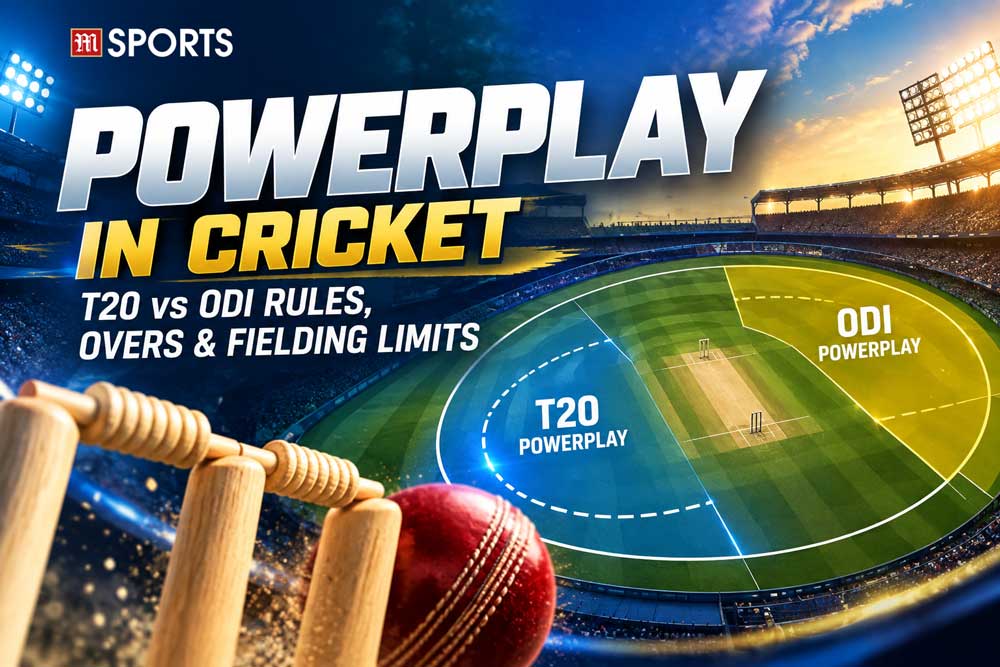
What is a Powerplay in cricket? A Powerplay is a period of limited-overs cricket when the fielding team is restricted in how many players it may position outside a marked fielding area. In a full men’s T20 international, overs 1–6 permit no more than two fielders outside the 30-yard area. In a full men’s 50-over ODI, the field restrictions change in three phases: overs 1–10: two outside; 11–40: four outside; 41–50: five outside.
This guide explains when each Powerplay starts and ends, why ODI restrictions differ from T20 rules, how rain-reduced games change the overs, what happens if a fielding team breaks the restriction, and how women’s international rules compare. The focus is Powerplay decisions and rule scenarios; for a map of slip, cover, fine leg and other named places, use our cricket field positions guide.
Rules verified: ICC men’s and women’s international playing conditions effective October 2026, primarily clause 28.7. Last fact-checked: 19 October 2026.
Powerplay Rules at a Glance: T20 vs ODI
The table below is based on the ICC October 2026 standard international playing conditions, not a claim that every domestic league follows identical rules. The limit is evaluated at the instant of delivery.
| Format and stage | Overs in a full innings | Maximum fielders outside marked area |
|---|---|---|
| Men’s T20I Powerplay | 1–6 | 2 |
| Men’s T20I remaining overs | 7–20 | 5 (normal limit) |
| Men’s ODI Powerplay 1 | 1–10 | 2 |
| Men’s ODI Powerplay 2 | 11–40 | 4 |
| Men’s ODI Powerplay 3 | 41–50 | 5 (normal limit) |
| Women’s T20I Powerplay | 1–6 | 2 |
| Women’s T20I remaining overs | 7–20 | 4 |
| Women’s ODI Powerplay | 1–10 | 2 |
| Women’s ODI remaining overs | 11–50 | 4 |
Important difference: the men’s limited-overs restriction area uses 30-yard (27.43 m) semicircles, while the October 2026 women’s ODI and T20I playing conditions use 25.15-yard (23 m) semicircles. They are joined by straight parallel lines, so the marked region is not literally one circular ring.
Source: ICC men’s T20I clause 28.7, ICC men’s ODI clause 28.7, ICC women’s T20I clause 28.7, and ICC women’s ODI clause 28.7.
How Does a Powerplay Work in T20 Cricket?
In an uninterrupted men’s Twenty20 international, the Powerplay is the first six overs of each innings. The fielding captain may station a maximum of two fielders outside the marked 30-yard area at the instant of delivery.
- Overs 1–6: at most two fielders outside the marked area.
- Overs 7–20: normally at most five outside in men’s T20 internationals, subject to any applicable over-rate penalty.
- Captains do not choose when to take the standard opening Powerplay. It happens at the beginning of the innings, including when a new team starts its chase.
- Wides and no-balls do not use up a legal ball, so a sixth over can contain extra deliveries before the Powerplay ends.
Worked scoreboard check: if the score reads 5.5 overs, the next valid delivery is still within the sixth over and the Powerplay limit remains two outside. Once six legal overs are complete, the score reads 6.0; the next delivery starts the seventh over, when the normal limit is five outside.
For an illustration of early-innings pressure and later hitting in an actual competition, read our India vs England T20 World Cup semi-final report. This guide uses the current international rulebook rather than assuming a particular historical match used today’s exact conditions.
ODI Powerplays Explained: Why Are There Three Phases?
A full men’s 50-over ODI uses three successive Powerplay phases. Unlike T20, the ICC formally refers to each field-restriction stage as Powerplay 1, Powerplay 2 and Powerplay 3.
For historical ODI context, our Afghanistan vs England 2025 Champions Trophy report describes Jofra Archer’s early-innings wickets. The phases below illustrate the October 2026 ICC international conditions, not a reconstruction of the 2025 match’s exact field.
| Phase | Overs | Outside-field limit | Typical tactical implication |
|---|---|---|---|
| Powerplay 1 | 1–10 | 2 | Captains cannot protect many deep boundaries; batting teams may seek fast starts. |
| Powerplay 2 | 11–40 | 4 | A mix of infield run-saving and protection for selected boundary areas. |
| Powerplay 3 | 41–50 | 5 | More boundary fielders can be deployed during the closing overs. |
A key clarification: the second and third stages are still called Powerplays in the men’s ODI playing conditions, even though the limits are less restrictive than in the opening ten overs. They are not optional blocks that the captain or batter can call at a preferred time.
In a reduced-overs ODI these three blocks are recalculated using the ICC schedule rather than retaining a fixed 10/30/10 split. See the examples below.
The Boundary-Circle Rule: Exactly Who Counts as Outside?
The Powerplay applies to the positions of fielders when the bowler releases the ball. It is not a limit on where a fielder may run after delivery. A fielder may sprint toward the boundary to stop a shot, even if they started legally inside.
- Inside: a fielder positioned within the marked restriction area counts as inside.
- Outside: a fielder positioned outside it uses one of the two, four or five permitted outside spots for that phase.
- The wicketkeeper and bowler remain part of the eleven-player side, but a normal field is not required to occupy every named fielding position.
- Watch the release: legality is assessed at the instant of delivery, not when television shows the field a moment later.
Our cricket fielding positions map explains where third man, long-off, deep square leg, cover and other names are located. This Powerplay article instead explains how many of those positions can be used outside the fielding-restriction area.
T20 Powerplay Scenario: Is a Third Boundary Fielder Legal?
Situation: the score is 35/0 after four overs in a full men’s T20I. The captain wants deep third man, deep square leg and long-on all outside the marked area for the next ball.
| Step | What the umpire would check |
|---|---|
| Current phase | Fifth over = T20 Powerplay; limit two outside. |
| Planned outside fielders | Deep third man + deep square leg + long-on = three outside. |
| Ruling at delivery | Illegal placement: No ball if all three remain outside when the ball is delivered. |
| Correction | Bring at least one of the three inside before the next legal delivery; comply with other field-placement rules too. |
In contrast, if the score were 6.0 overs and no separate fielding penalty applied, the seventh over would normally permit up to five outside in a men’s T20I. The issue is the phase at the time of the ball, not whether the captain is taking an aggressive or defensive approach.
ODI Powerplay Scenario: Reading 9.5, 10.0 and 40.0 Overs
Scoreboards can make phase changes look confusing. Use the number of completed legal overs:
| Score before next delivery | Men’s ODI stage | Maximum outside |
|---|---|---|
| 9.5 (one valid ball left in tenth over) | Powerplay 1 | 2 |
| 10.0 (eleventh over about to begin) | Powerplay 2 | 4 |
| 39.5 (final valid ball in fortieth over pending) | Powerplay 2 | 4 |
| 40.0 (forty-first over about to begin) | Powerplay 3 | 5 |
Overs notation reminder: 9.5 means nine completed overs and five valid balls of the tenth—not nine and a half mathematical overs. Because a no-ball or wide is not a valid delivery, it does not by itself complete an over or move the match to the next phase.
Rain-Reduced T20 Powerplays: 10, 12 and 15 Overs
In a men’s T20I shortened by rain, the Powerplay is not always six overs. ICC men’s T20I clause 28.7.6 provides a precise table for innings of 5–19 overs. The entries use standard cricket overs-and-balls notation: for example, 3.4 means 3 overs plus 4 legal balls.
| Allocated innings length | Powerplay duration | Valid Powerplay deliveries |
|---|---|---|
| 5 overs | 1.3 overs | 9 balls |
| 8 overs | 2.2 overs | 14 balls |
| 10 overs | 3.0 overs | 18 balls |
| 12 overs | 3.4 overs | 22 balls |
| 15 overs | 4.3 overs | 27 balls |
| 18 overs | 5.2 overs | 32 balls |
| 19 overs | 5.4 overs | 34 balls |
| 20 overs (normal) | 6.0 overs | 36 balls |
Worked example: A T20I is reduced to 12 overs per side before play. Its Powerplay lasts 3.4 overs (22 valid balls). This means the two-outside restriction is in place for the first three complete overs and the first four legal deliveries of over four; the ordinary non-Powerplay rule applies thereafter. The umpire governs any necessary adjustment when interruptions occur during play.
Important: In an already-started innings that is later shortened, the ICC rules address transitions during an over. Do not simply restart a Powerplay or assume six overs regardless of the revised length.
Rain-Reduced ODI Powerplays: Worked 30-Over and 40-Over Examples
A reduced men’s ODI still uses three phases, but their lengths come from the ICC’s schedule in clause 28.7.2.3. The normal 50-over breakdown of 10 + 30 + 10 becomes shorter in defined increments.
| Allocated overs | Powerplay 1: max 2 outside | Powerplay 2: max 4 outside | Powerplay 3: max 5 outside |
|---|---|---|---|
| 20 | 4 | 12 | 4 |
| 25 | 5 | 15 | 5 |
| 30 | 6 | 18 | 6 |
| 35 | 7 | 21 | 7 |
| 40 | 8 | 24 | 8 |
| 45 | 9 | 27 | 9 |
| 50 (normal) | 10 | 30 | 10 |
Example A — 30 overs: maximum two outside in overs 1–6, four in 7–24, and five in 25–30.
Example B — 40 overs: maximum two outside in overs 1–8, four in 9–32, and five in 33–40.
Innings shortened after a stoppage: the ICC says the recalculated phases can take effect immediately upon resumption, even in the middle of an over; the published playing-condition examples show how umpires apply that change. Always follow the official revised playing conditions rather than guessing a 20%/60%/20% split for non-round innings lengths.
What Happens If Too Many Fielders Are Outside?
Under ICC October 2026 men’s ODI and T20I rules, a breach of the Powerplay field-placement restriction is a No ball. The square-leg umpire is instructed to call and signal the infringement (ODI clause 28.7.2.7; T20I clause 28.7.8).
- The batting side receives the No-ball extra and the illegal delivery does not count as one of the six legal balls of the over.
- Under the limited-overs No-ball rules, the next delivery is normally a free hit for the batter, subject to the applicable playing conditions.
- The fielding captain must correct the placement so the next delivery also meets the permitted outside limit.
Separate issue: limits on leg-side fielders also apply regardless of which Powerplay is operating. The October 2026 men’s limited-overs rules separately restrict the total number of leg-side fielders and those behind the striker’s popping crease on that side. Staying within the ring count alone does not automatically make every arrangement legal.
Slow Over Rate: When the Normal Outside-Field Limit Gets Smaller
It is tempting to say that five fielders outside are always allowed after the T20 Powerplay. That is not true if a slow-over-rate fielding penalty applies.
For men’s T20Is under ICC October 2026 clause 13.8, a fielding side that misses the specified time requirement can be limited to four outside from the start of the prescribed following over for the remaining innings, rather than the normal five. The conditions contain exceptions, including certain very short innings.
In men’s ODIs, the analogous clause can reduce the Powerplay 3 allowance from five outside to four for the relevant remaining period, subject to its conditions and exceptions. These are penalties for slow bowling rate, not a fourth normal Powerplay phase.
When watching a match, check whether the broadcast has announced an in-innings over-rate sanction before assuming every late-over arrangement with five boundary riders is permitted.
Women's Cricket: T20I and ODI Powerplay Differences
The term Powerplay is used in women’s cricket too, but the October 2026 women’s playing conditions have notable differences from the men’s rules. Do not copy the men’s end-of-innings outside-field limit into women’s matches.
| Comparison | Women’s T20I | Women’s ODI |
|---|---|---|
| Marked-area semicircle radius | 25.15 yards (23 m) | 25.15 yards (23 m) |
| First Powerplay | Overs 1–6; 2 outside | Overs 1–10; 2 outside |
| Outside fielders after opening Powerplay | 4 normally | 4 normally |
| Standard ODI three-phase 2/4/5 model? | Not applicable | No: one opening Powerplay, then four-outside limit |
The women’s ODI playing conditions also publish their own reduced-overs Powerplay table. For example, a 30-over women’s ODI has a six-over opening Powerplay, with the regular four-outside limit afterward. A reduced-overs women’s T20I uses the T20I schedule rather than automatically keeping six overs.
Sources: ICC Women’s T20I Playing Conditions — October 2026 and ICC Women’s ODI Playing Conditions — October 2026.
Powerplay Strategy: Batting Aggression vs Wicket Protection
Powerplays create an interesting tactical trade-off: captains cannot place as many players deep, so ground shots can reach the boundary more easily. But pushing too aggressively can create catching chances. There is no official requirement for a batter to hit attacking shots during these overs.
| Game situation | Batting team’s choice | Fielding team’s response |
|---|---|---|
| Fresh ball, two outside | Seek scoring gaps while measuring swing and seam risk. | Keep attacking catchers or ring fielders in positions suited to the bowler. |
| Middle ODI, four outside | Rotate strike; target a particular unguarded boundary area. | Balance deep protection with infield pressure. |
| Late men’s ODI, five outside | Choose favorable match-ups for boundary hitting. | Guard likely boundaries while avoiding easy singles. |
| Wickets falling rapidly | Reassess risk; a low-scoring Powerplay may still be recoverable. | Use permitted catchers to increase pressure. |
The true measure of a Powerplay is not only runs in its opening overs. How teams use the remaining balls affects the final result and tournament tie-breakers. For a different measure of scoring efficiency across matches, use our Net Run Rate Calculator and official formula guide.
Common Powerplay Myths and Mistakes
| Mistake | More accurate explanation |
|---|---|
| “A T20 Powerplay always lasts six overs.” | Six overs is standard for a full innings. Reduced matches use the ICC’s shorter schedule. |
| “ODIs only have the first ten overs as a Powerplay.” | Men’s ODI conditions name all three restricted phases Powerplays 1, 2 and 3. |
| “A captain can call a Powerplay later.” | Under the modern standard men’s ICC ODI/T20I conditions, phases occur at prescribed times. |
| “Five outside is allowed after the Powerplay in every international match.” | The standard maximum differs in women’s cricket, and slow-over-rate penalties can tighten it. |
| “A fielder can never cross the circle during a Powerplay.” | The restriction is on positions at delivery; fielders may run to stop the ball afterward. |
| “Powerplay rules decide which player stands at slip or cover.” | They restrict how many may stand outside, not which named positions a captain must use. |
Official ICC Sources, Rule Scope and Review Date
Method: This guide uses the ICC’s men’s and women’s ODI/T20I playing conditions effective October 2026, relevant to international series starting on or after 1 October 2026. Series already underway at the changeover and individual international tournaments may follow their specifically published conditions. Domestic leagues and youth events may also apply different regulations. Worked examples are hypothetical, not reconstructions of actual field placements in historic matches.
- ICC — Playing Conditions index (all current formats)
- ICC — Men’s T20I Playing Conditions, October 2026: clauses 13.8 and 28.7
- ICC — Men’s ODI Playing Conditions, October 2026: clauses 13.8 and 28.7
- ICC — Women’s T20I Playing Conditions, October 2026: clause 28.7
- ICC — Women’s ODI Playing Conditions, October 2026: clause 28.7
- ICC — October 1, 2026 playing-condition update announcement
Last reviewed: 19 October 2026. For a specific match, the organizer’s official playing conditions and umpires’ rulings take precedence.
Powerplay in Cricket: Frequently Asked Questions
Six overs in a full 20-over T20 international innings. For a rain-reduced men’s T20I, the ICC table specifies a shorter opening Powerplay; for example, a ten-over innings has a three-over Powerplay and a twelve-over innings has three overs and four legal balls.
In a full men’s 50-over ODI, Powerplay 1 covers overs 1–10 with two outside, Powerplay 2 covers overs 11–40 with four outside, and Powerplay 3 covers overs 41–50 with five outside. Women’s ODI internationals use a different post-opening structure.
Two in both men’s and women’s full-length T20 international Powerplays. After the Powerplay, the standard maximum is five in men’s T20Is and four in women’s T20Is, subject to applicable penalties.
No. A wide is not a valid ball for completing an over. The Powerplay ends after the prescribed number of legal deliveries; additional wides and no-balls do not consume them.
Yes in a reduced-over innings with a fractional Powerplay duration, such as 3.4 overs in a 12-over men’s T20I. Also, an interruption and recalculated restrictions can cause an immediate transition, as provided by the ICC rules.
Standard Test cricket does not use the ODI/T20I scheduled Powerplay circle restrictions. Other field-placement rules still apply under the MCC Laws and the relevant Test playing conditions.
If three fielders are outside at the instant of delivery in a standard men’s T20I opening Powerplay, the side breaches the two-outside restriction and the square-leg umpire signals No ball.
Not under the modern ICC standard men’s 50-over ODI playing conditions. The three phases are fixed in sequence, with modified phase lengths if overs are reduced.
Yes, indirectly: runs made or conceded during Powerplay overs are included in the relevant innings totals that contribute to a team’s net run rate, subject to tournament-specific NRR rules. NRR itself is calculated from aggregate scoring rates, not as a separate Powerplay statistic.
You Might Also Be Interested in Reading
Continue with related M88Sports explainers and match coverage:
- Cricket Field Positions Explained: Diagram, Roles & T20 vs Test Setups
- Net Run Rate Calculator: Cricket NRR Formula & Examples
- Gujarat Titans vs Rajasthan Royals: Sai Sudharsan’s IPL 2025 innings
- India vs England: 2024 T20 World Cup semi-final analysis
- Australia vs India: 2023 ODI Cricket World Cup final report
- Cricket at the 2026 Asian Games
