


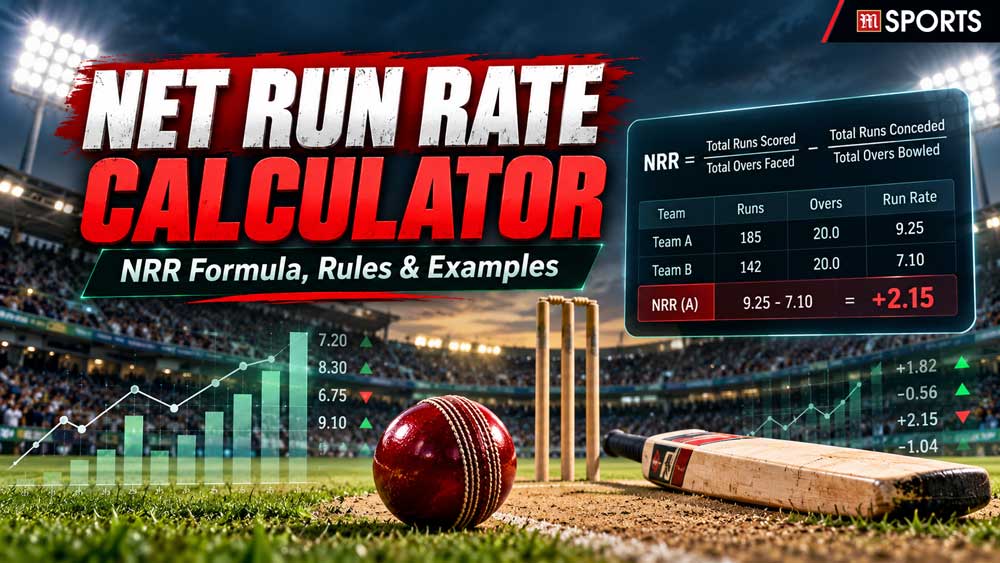
How do you calculate net run rate (NRR) in cricket? Divide a team’s total runs scored by its total overs faced, then subtract the opposition’s total runs per over against that team. The figures are accumulated across qualifying matches, and an all-out innings counts its full allotted overs for NRR even if fewer were bowled.
This practical cricket NRR guide combines the formula, a calculator, worked T20 examples, innings-length corrections and the special rules for DLS games. Rules checked against ICC men’s T20I and ODI playing conditions effective October 2026. All example scores below are fictional teaching scenarios, not live tournament data. Last reviewed: 19 October 2026.
Net Run Rate Calculator for T20, ODI and Tournaments
Use the match calculator for a normal completed T20/ODI game, or the tournament calculator if you have already added together the team’s NRR-eligible runs and corrected overs across matches. The widget reads overs in cricket notation (18.4 = 18 overs + 4 balls). It is not a DLS target calculator and does not automatically determine rain adjustments.
Important: For any DLS-affected match, do not paste ordinary scorecard totals into this standard-match calculator and assume the result is the official tournament NRR. Apply the competition’s required DLS adjustment first, or rely on the official standings.
What Is Net Run Rate in Cricket?
Net run rate (NRR) compares how quickly a team scores runs against how quickly opponents score runs against it, expressed in runs per over. A team with +0.750 has scored an average of 0.75 runs more per over than it has conceded, across the matches included in that calculation. −0.750 indicates the opposite.
Competition tables frequently use NRR as a tie-breaker after points and other criteria specified in their regulations. It is different from the simple current run rate shown during an innings, and it is not the winning margin written as a percentage. A team’s NRR can be negative despite winning a match, if earlier results were poor.
Official Net Run Rate Formula
For a single ordinary match, use each team’s eligible batting innings. For a multi-match group or league table, first sum all scored runs and all overs faced, and separately sum conceded runs and overs bowled, then divide. Do not take a simple average of the NRR figures from individual matches.
| Term | Meaning |
|---|---|
| Runs scored | Team’s total innings runs, including recorded extras, in matches counted for NRR. |
| Overs faced | Actual legal balls faced, expressed as overs; use full entitlement if dismissed all out. |
| Runs conceded | Total runs scored by the opposing sides against the team in counted matches. |
| Overs bowled | Eligible legal balls bowled to opponents; use the opponent’s full entitlement for an all-out innings. |
The ICC’s October 2026 men’s T20I and ODI clause 16.10.2 sets out these principles and separate DLS exceptions. The playing conditions for a specific tournament govern which games and stages belong in its NRR totals.
Example 1: A Simple T20 Match (No All-Out)
Suppose Team A makes 180/6 in 20 overs and Team B makes 150/9 in 20 overs. All overs have been completed; neither innings was all out.
| Step | Calculation | Result |
|---|---|---|
| Team A scoring rate | 180 ÷ 20 | 9.000 |
| Rate conceded by Team A | 150 ÷ 20 | 7.500 |
| Team A NRR | 9.000 − 7.500 | +1.500 |
| Team B NRR | 7.500 − 9.000 | −1.500 |
This is a single-match example. In a points table, each team’s NRR would reflect all of its qualifying games, not only this one result.
Example 2: An All-Out Innings Uses the Full Over Quota
Team A scores 180/7 in 20 overs. Team B is dismissed for 120 in 15.3 overs. In scorecard notation, 15.3 means 15 overs and three valid balls (15.5 mathematical overs), but Team B was entitled to 20 overs.
The ICC all-out rule therefore treats Team B as having faced 20 overs for NRR, not 15.3, 15.5 or any shorter time. Team A’s NRR for this match is (180 ÷ 20) − (120 ÷ 20) = +3.000. Team B gets −3.000.
Real match context: In our Gujarat Titans vs Rajasthan Royals IPL 2025 match report, Rajasthan were dismissed for 159 in 19.1 overs. For a standard uninterrupted 20-over NRR calculation, their batting denominator would be 20 overs, not 19.1. The figures above remain a separate hypothetical example.
Example 3: A Winning Chase Ends at 18.4 Overs
Team A makes 160/8 in 20 overs. Team B reaches 161/4 in 18.4 overs and wins. Because Team B was not all out, its actual 18 overs and four legal balls count.
- 18.4 scorecard overs = (18 × 6) + 4 = 112 legal balls = 18.6667 mathematical overs.
- Team B scoring rate = 161 ÷ (112/6) = 8.625 runs per over.
- Team B concession rate = 160 ÷ 20 = 8.000 runs per over.
- Team B single-match NRR = +0.625; Team A’s is −0.625.
Finishing a chase early normally helps the winning side’s NRR, but only the actual valid balls faced in that winning innings are used. A finished over such as 19.0 means 19 full overs, while 18.4 has four valid balls in the nineteenth over.
How to Convert Cricket Overs Into the Correct Decimal
Cricket scorecards use the digit after the point to count valid balls, not tenths of an over. Each standard over has six valid balls, so you divide the balls by six.
For an ODI scorecard example, see our New Zealand vs Pakistan 2025 Champions Trophy report, where Pakistan were bowled out in 47.2 overs. That notation means 47 overs and two valid balls—not 47.2 mathematical overs. All-out NRR rules still apply separately.
| Scorecard notation | Valid balls | Mathematical overs |
|---|---|---|
| 10.0 | 60 | 10.0000 |
| 15.3 | 93 | 15.5000 |
| 17.5 | 107 | 17.8333 |
| 18.4 | 112 | 18.6667 |
| 19.2 | 116 | 19.3333 |
Formula: mathematical overs = full overs + (valid balls ÷ 6). A notation such as 18.6 is invalid in ordinary six-ball-over notation: after the sixth valid ball, the score reads 19.0. Wides and no-balls add runs but do not count as one of the six valid deliveries under ICC clause 17.
Tournament NRR: Why You Must Aggregate, Not Average
Imagine Team A plays two fictional, uninterrupted T20 games. In Match 1 it scores 180 in 20 overs and concedes 150 in 20. In Match 2 it chases 161 in 18.4 overs after conceding 160 in 20 overs.
| NRR ingredient | Match 1 | Match 2 | Total |
|---|---|---|---|
| Runs scored | 180 | 161 | 341 |
| Overs faced | 20.0 | 18.4 | 38 overs 4 balls (232 balls) |
| Runs conceded | 150 | 160 | 310 |
| Overs bowled | 20.0 | 20.0 | 40 overs (240 balls) |
Correct combined NRR: (341 ÷ [232/6]) − (310 ÷ 40) = +1.069 (to three decimals). A simple average of the two match figures, (+1.500 + 0.625) ÷ 2, gives +1.063, which is not the tournament method.
Tip: To calculate a full group-stage total, add together all eligible runs and valid balls separately; convert the total valid balls into overs only at the end. Also replace any all-out innings’ actual overs with its allotted overs before accumulating.
What Happens to NRR in Rain-Affected or DLS Matches?
The ICC’s Duckworth–Lewis–Stern (DLS) system revises the target when rain or other interruptions change the resources available to a chasing side. That is separate from the NRR calculation. For NRR itself, the October 2026 men’s T20I/ODI clause 16.10.2 requires these particular adjustments for a DLS result:
- Rain stops the chase, but DLS declares a result: Team 1 (the side batting first) is credited with Team 2’s par score at abandonment, over the same overs faced by Team 2.
- DLS revised the target earlier, and play later concludes: Team 1 is credited with one run below Team 2’s final DLS target, over the full revised number of overs allotted to Team 2 to reach that target.
- No result: A match that produces no result does not contribute to NRR. Do not include the runs and overs of an abandoned no-result game.
These rules mean the batting-first score printed on a scorecard is not always the correct figure for NRR. The calculator on this page handles standard, uninterrupted games and user-entered corrected tournament totals; it does not compute a DLS par score or an official revised target. For DLS cases, use the published match data and relevant competition conditions.
Real no-result example: Our Delhi Capitals vs Sunrisers Hyderabad IPL 2025 rain-abandonment report describes a match where points were shared without a result. In that situation, the unfinished innings do not provide an NRR calculation; that differs from a DLS match for which a result is declared.
Does a Super Over or a Tied Match Affect NRR?
A completed tied match can contribute its normal innings to NRR when the competition regulations count that game as a result. The separate Super Over used to decide a tie is generally not added to those regulation-innings runs or overs for NRR. Competition and stage rules should be checked before calculating any official table.
NRR is usually a tie-breaker rather than the sole rule for ranking equal-points teams. Wins, head-to-head records and stage-specific criteria can come first. Always read the actual tournament table rules before predicting qualification using a calculator.
NRR vs Run Rate vs Required Run Rate
| Metric | What it answers | Example |
|---|---|---|
| Current run rate (CRR) | How quickly a batting side is scoring now | 90 in 10 overs = 9.00 |
| Required run rate (RRR) | How quickly a chasing side needs to score to win | 60 more from 5 overs = 12.00 |
| Net run rate (NRR) | Difference between team’s scoring and conceding rates over counted games | 9.00 scored − 7.50 conceded = +1.500 |
NRR is not a team’s batting average, strike rate or win percentage. It represents a net per-over scoring advantage or disadvantage. While Powerplay fielding restrictions in T20 and ODI cricket can influence how quickly teams score, the Powerplay has no separate NRR formula: its runs form part of the eligible innings totals.
Five Frequent Net Run Rate Mistakes
- Entering 18.4 as a decimal: interpret it as 18 overs plus four balls, not 18.4 overs.
- Using 15.3 as the denominator when all out: substitute the full 20- or 50-over entitlement for that innings.
- Averaging match-by-match NRR: aggregate totals first, then divide.
- Including abandoned no-result matches: exclude their figures unless competition rules establish an eligible result.
- Ignoring DLS adjustments: use official credited runs and overs, not blindly the two printed scorecard totals.
To understand how the fielding side tries to reduce an opponent’s scoring rate, read our Cricket Field Positions Explained guide, which also covers how T20 and ODI fields change with restrictions.
Official Sources and Methodology
Our calculations follow the ICC men’s T20I and ODI playing conditions effective October 2026, especially clause 16.10.2 (Net run rate) and clause 17 (The over). The examples are constructed teaching examples, not figures copied from a particular points table. Specific competitions, women’s matches and junior/domestic events may have different tournament rules; the relevant event regulations take precedence.
- ICC — Official playing conditions and current editions
- ICC — Men’s T20I Playing Conditions, October 2026 (clauses 16.10.2 and 17)
- ICC — Men’s ODI Playing Conditions, October 2026 (clauses 16.10.2 and 17)
- ICC — Explanation of the Duckworth–Lewis method and revised targets
Reviewed on 19 October 2026. The on-page calculator is an educational aid; an event organizer’s official NRR standings remain authoritative.
Net Run Rate Calculator FAQs
Positive NRR means a team scores faster per over than its opponents across the counted matches. There is no universal good threshold: +0.500 can be enough in one group, while qualification in another may require more. Points and tournament-specific tie-breakers matter too.
The basic approach is the same aggregate run-rate difference, with all-out innings charged their allotted overs and specific handling for rain-affected results. The IPL’s applicable season regulations and official table determine which matches and adjustments apply.
Often yes: when a team successfully chases without being all out, the actual 15 overs faced are used, increasing its runs-per-over scoring rate. Its final overall NRR also depends on its conceded rate and other tournament games.
No. It means 19 full overs plus five valid balls, or 119 balls total, equal to 19 + 5/6 = 19.8333 mathematical overs.
For ordinary full-length T20 NRR calculations, treat its innings as 20 overs, not 12, if 20 overs were its entitlement. A shortened match may have a smaller eligible quota.
An abandoned match declared no result normally contributes nothing. However, if an official result is achieved through DLS, the event regulations specify adjusted runs and overs for NRR.
No. Sum all eligible runs scored and overs faced, and separately all runs conceded and overs bowled, then subtract the two aggregate rates. Averaging each match’s NRR can be wrong when innings lengths differ.
You Might Also Be Interested in Reading
Continue with these related M88Sports cricket guides and match analyses:
