


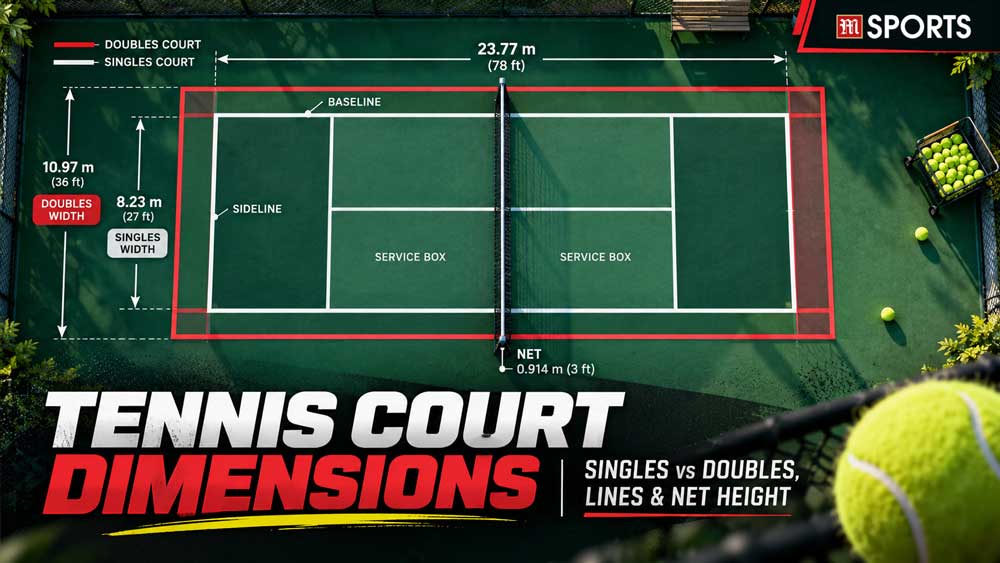
How big is a tennis court? A regulation court is 78 feet (23.77 m) long. Singles uses a width of 27 feet (8.23 m), while doubles uses 36 feet (10.97 m). Both play over the same net, which is 3 feet (0.914 m) high at the centre and 3 ft 6 in (1.07 m) at the posts.
The measurements are easy to memorise; the important part is knowing which lines count for a serve and which count once a rally begins. This guide uses the ITF’s 2026 Rules of Tennis (Rule 1 and Appendices IX–X) to explain the layout in feet and metres, including court-line calls, service-box examples and the extra space needed around a court.
Official Tennis Court Dimensions at a Glance
These are the standard adult, full-size measurements. The distances follow ITF Rule 1, with the service-box width calculated from the singles width.
| Measurement | Feet / inches | Metres |
|---|---|---|
| Full court length, both formats | 78 ft | 23.77 m |
| Singles court width | 27 ft | 8.23 m |
| Doubles court width | 36 ft | 10.97 m |
| Each doubles alley / tramline | 4 ft 6 in | 1.37 m |
| Net to each service line | 21 ft | 6.40 m |
| Each service box: length × width | 21 ft × 13 ft 6 in | 6.40 × about 4.11 m |
| Net to each baseline | 39 ft | about 11.89 m |
| Service line to baseline | 18 ft | about 5.49 m |
| Net height at centre | 3 ft | 0.914 m |
| Net height at posts | 3 ft 6 in | 1.07 m |
Singles vs Doubles: Which Lines Are In?
A court marked for doubles contains a narrower singles court inside it. The 4 ft 6 in (1.37 m) strip on each side between the inner and outer sidelines is the doubles alley, also called the tramline.
- Singles rally: the ball must first bounce within the two inner singles sidelines and the opponent’s baseline.
- Doubles rally: the outer doubles sidelines and opponent’s baseline define the legal landing area. The alleys count.
- Singles or doubles serve: the serve must land in the correct diagonally opposite service box, which ends at the singles sideline, not the outer doubles sideline.
Key distinction: A ball bouncing in the doubles alley is in during a doubles rally but out on a doubles serve. The area of a legal tennis serve does not widen just because four people are playing.
For an interesting court-layout comparison across racket sports, see our badminton court dimensions and boundary-line guide, where the singles and doubles service restrictions differ from tennis.
Tennis Court Diagram: How to Read the Markings
Use this reading order to identify a court without guessing which painted lines apply:
- Start at the outer rectangle: 78 × 36 ft, the doubles rally boundary.
- Find the inner sidelines: each lies 4 ft 6 in inside its doubles sideline, leaving a 27-ft-wide singles court.
- Locate the middle net: it divides the court into two 39-ft-long halves.
- Find the service lines: they sit 21 ft from the net, across the width between the singles sidelines.
- Follow the centre service line: it splits the space between each service line and net into the deuce and ad service boxes.
- Look at the short centre mark at each baseline: it separates the left and right serving positions; it is not a line that divides an ordinary rally.
Under the ITF official court plan (Appendix IX), court distances are measured to the outside of the painted lines. That detail matters when laying out or checking a court.
Every Tennis Court Line Explained
Baseline
The line at either end of the full court. It is the back boundary for singles and doubles rallies. When serving, a player starts behind this line and must not touch it with a foot during the service motion.
Singles sidelines
The two inner long-side lines make the 27-ft singles width. They also form the outer edges of the service boxes in both singles and doubles.
Doubles sidelines
The outer long-side lines make the 36-ft doubles width. They apply to doubles rallies but do not enlarge the service boxes.
Service lines
Each is parallel to the net, 21 ft (6.40 m) away, and runs between the singles sidelines. A serve landing beyond the service line toward the baseline is too long, even if it would be inside the court during a rally.
Centre service line
This line divides the service area into the left and right service courts. A ball touching the correct centre service line on the serve counts as in, because the line bounds the box. It does not restrict the path of later rally shots.
Centre mark
A 4-in (10-cm) mark at the midpoint of each baseline, extending into the court. The server must remain on the correct side of its imaginary extension during the service motion.
Tennis Service Boxes: The Rules That Surprise Beginners
Each full-size service box is 21 ft long and 13 ft 6 in wide. That is approximately 6.40 × 4.11 m. You serve from behind the baseline to the service box diagonally opposite your starting position, not straight ahead.
| Scenario | Call | Reason |
|---|---|---|
| Serve touches the correct service line | In | The line is part of the receiving service court. |
| Serve touches the correct centre service line | In | The boundary belongs to the correct service court. |
| Doubles serve lands in a side alley | Fault | The alley is outside the service box even in doubles. |
| Serve bounces between service line and baseline | Fault | Too long for a serve, although it could be in during a rally. |
| First bounce of a doubles rally touches outer sideline | In | That is the doubles rally boundary. |
| First bounce of a singles rally lands in a side alley | Out | It is beyond the singles sideline. |
Under ITF Rule 12, a ball touching a line counts as touching the court bounded by that line. Always ask: which line is the active boundary for this shot? For what happens to the score after a fault or a legal point, read our tennis scoring explained guide.
Is a Ball on the Line In? Five Practical Examples
- Singles groundstroke clips the singles sideline: in. The line belongs to the legal singles area.
- Doubles crosscourt shot bounces in the alley: in, provided the ball is otherwise a legal return. The alley counts after service.
- Doubles serve clips the outer doubles sideline: fault. That outer line does not bound a service box.
- Serve just touches the correct service-line paint: in. The ball need not land completely inside the painted rectangle.
- Rally ball lands on a centre service line: in if it is otherwise inside the applicable court. Centre service lines do not split legal rally territory into left and right halves.
Remember that these calls concern where the first bounce lands. A ball that flies outside a sideline can still be returned legally if it travels back and lands in the correct court, subject to the other rules of play.
Tennis Net Height, Net Posts and Singles Sticks
ITF Rule 1 sets two different net heights: 3 ft (0.914 m) at the centre, held down by a strap, and 3 ft 6 in (1.07 m) at the net posts. The centre is therefore lower than the supported ends by about 15.6 cm.
For doubles, each net-post centre is positioned 3 ft (0.914 m) beyond the doubles sideline. For singles with a dedicated singles net, the net posts are instead positioned 3 ft beyond the singles sidelines.
Most multi-use courts keep the doubles net installed. During singles play on that setup, singles sticks support the net at 3 ft 6 in, with their centres 3 ft outside the singles sidelines. This difference matters in official singles play and for distinguishing the net from permanent fixtures.
How Wide Should Tennis Court Lines Be?
Line width is part of the regulation layout, not just a design preference. Under ITF Rule 1:
- Centre service line and baseline centre mark: 2 in (5 cm) wide.
- Most other lines: between 1 and 2 in (2.5–5 cm) wide.
- Baselines: may be as wide as 4 in (10 cm).
- All lines: must be the same colour and clearly contrast with the playing surface.
Because measurements go to the outside of the lines, simply measuring between the centre points of thick painted boundaries can give the wrong court size.
How Much Space Do You Need for a Full Tennis Court?
The painted doubles rectangle takes up about 260.8 square metres (23.77 × 10.97 m). But this is not the total land or floor area needed. Players need room to move behind the baselines and outside the sidelines.
As guidance in Appendix X of the 2026 ITF rules, the suggested clearances are:
| Setting | Behind each baseline | Outside each sideline | Approximate total footprint |
|---|---|---|---|
| Recreational or club play | 18 ft (5.48 m) | 10 ft (3.05 m) | 114 × 56 ft (34.75 × 17.07 m) |
| International-competition guide | 21 ft (6.40 m) | 12 ft (3.66 m) | 120 × 60 ft (36.58 × 18.29 m) |
Those footprints are derived by adding clearance to the marked doubles court; they are not a universal construction approval or a substitute for local venue standards. For an indoor court, the ITF also gives a 9.0 m (29.6 ft) recommended minimum ceiling height at the net. Facility designers should verify governing competition requirements, surface specifications and local building rules before construction.
Do Children Play on Courts This Size?
Not always. The ITF permits smaller red and orange courts for 10-and-under competition. A red court can measure 36–42 ft long and 14–20 ft wide; an orange court can measure 58–60 ft long and 20–27 ft wide. Green-stage tennis uses the full-size court.
These are distinct junior formats in ITF Appendix VIII, rather than alternatives to the 78 × 27/36 ft standard for regular adult singles and doubles.
Mistakes to Avoid When Reading or Measuring a Court
- Calling a singles court shorter: both singles and doubles are 78 ft long.
- Serving into the doubles alley: the receiving service box always stops at the singles sideline.
- Assuming every painted line is a rally boundary: the centre service line and service line divide service courts, not the full rally area.
- Measuring to the middle of the paint: ITF dimensions are measured to the outer edges of lines.
- Using 3 ft as the net height everywhere: the posts and singles sticks support the net at 3 ft 6 in.
- Planning a facility around only 78 × 36 ft: safe run-off space is required in addition to the painted court.
Official Sources and Fact-Checking Notes
Last verified: 15 October 2026. All regulation measurements, post/stick positions and marking widths were checked against ITF 2026 Rules of Tennis: Rule 1 (The Court), Rule 12 (Ball Touches a Line), Rules 16–18 (Service and Foot Fault), Appendix VIII (10 and Under), Appendix IX (Court Plan) and Appendix X (Marking and Clearance Guidance).
The ITF tennis glossary independently explains common court markings and the different boundaries for singles, doubles and service. Calculated service-box widths, court areas and total facility footprints are labelled as derived or approximate; the measurements governing match play come from the official rulebook.
Frequently Asked Questions
A full-size tennis court is 78 ft (23.77 m) long. It is 27 ft (8.23 m) wide for singles and 36 ft (10.97 m) wide for doubles.
No. Both formats use the full 78-ft length. Doubles adds 4-ft-6-in alleys on both sides, making the court wider.
Each service line is 21 ft (6.40 m) from the net. The space between that line and the net is split into two service boxes.
No. A doubles serve must still land inside the diagonally opposite service box bounded by the singles sideline. The doubles alleys count during rallies, not as extra service area.
The net is 3 ft (0.914 m) high at the centre and 3 ft 6 in (1.07 m) at the net posts or singles sticks, as applicable.
A ball touching the relevant boundary line is in. A ball touching a doubles sideline is in during a doubles rally but does not make an otherwise wide doubles serve legal.
Each service box measures 21 ft by 13 ft 6 in (approximately 6.40 m by 4.11 m). Singles and doubles use the same service-box boundaries.
The ITF gives guideline clearances around the marked doubles court. These imply approximately 114 × 56 ft for recreational/club play or 120 × 60 ft for international-competition guidance; actual site requirements vary.
Yes. ITF red and orange courts are smaller for 10-and-under play, while green-stage tennis uses the standard full-size court.
