


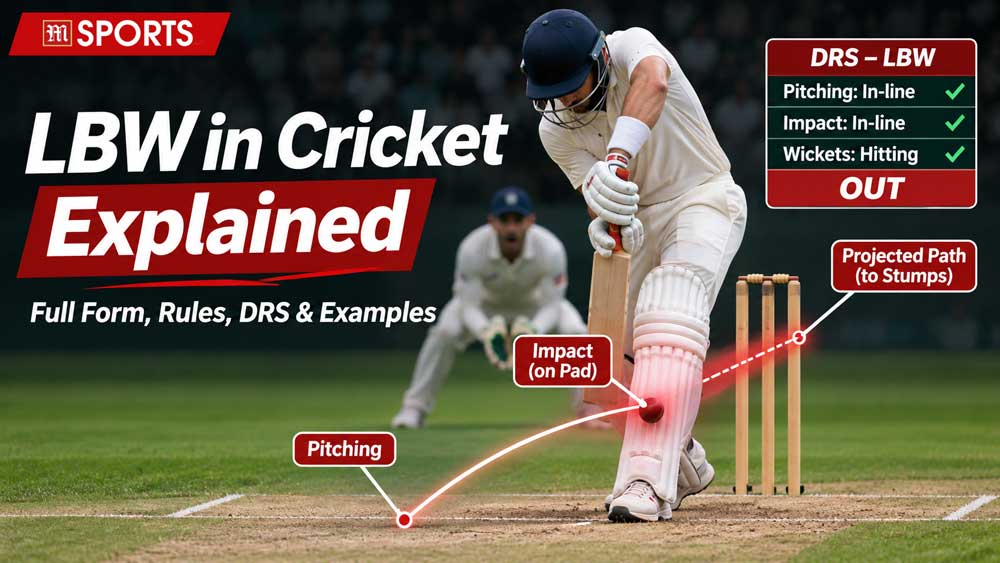
What is LBW in cricket? LBW means leg before wicket. A batter can be dismissed LBW when a legal delivery is stopped by their body before it hits the bat and, under the other conditions in Law 36, the ball would have hit the stumps. The rule is not limited to the leg: contact with another part of the batter’s person can also qualify.
This guide explains the five LBW conditions, why pitching outside leg stump rules out LBW, the difference between pitching, impact and hitting, and how the ICC’s Decision Review System (DRS) treats marginal decisions. It uses the MCC’s 2026 Laws of Cricket and the ICC’s October 2026 men’s Test playing conditions. Last fact-checked: 9 November 2026.
LBW Full Form and Meaning: Why Is It Called Leg Before Wicket?
LBW stands for leg before wicket, but the name is historical shorthand rather than a requirement that the ball literally strike the leg. Under MCC Law 36, the first interception can be by any part of the batter’s person, provided all the other conditions are met.
The purpose is to stop the batter from using their body to block a delivery that would otherwise hit the wicket, while protecting legitimate batting play through rules about where the ball lands and where it hits. A batter is not automatically out merely because the pad blocks a straight-looking delivery. The bowler’s side must appeal, and an umpire must judge the full sequence.
The governing text is MCC Law 36 (2026 edition). DRS is an additional review mechanism used only in competitions whose playing conditions provide it; it is not what defines LBW in ordinary club cricket.
The Five LBW Rules Every Decision Must Pass
Use this as a decision checklist. If any answer is No, the batter is not out LBW. These are simplified teaching questions based on Law 36.1.1–36.1.5, not a replacement for the official wording.
| Check | What the umpire asks | Result if it fails |
|---|---|---|
| 1. Fair delivery | Was the delivery not a No ball? | Not out LBW |
| 2. Where it landed | If the ball bounced, did it first land in line with the stumps or outside off rather than outside leg? | Not out LBW |
| 3. Bat before body? | Did the ball contact the batter’s person without first touching the bat? | Not out LBW |
| 4. Point of impact | Was the first body impact in line, or was it outside off when the batter made no genuine attempt to play with the bat? | Not out LBW |
| 5. Projected path | But for the body interception, would the ball have hit the wicket? | Not out LBW |
Important: A full-toss delivery does not have a pitching-location check, because it has not landed before striking the batter. The remaining conditions still apply. A ball contacting bat and body simultaneously is treated as having touched the bat first under Law 36.2.2.
LBW Diagram: Pitching vs Impact vs Hitting the Wickets
Television ball-tracking graphics separate three moments. The following decision strip is a schematic reading guide, not a representation of a particular delivery or a to-scale cricket pitch.
Where the ball first touches the ground. Outside leg = not out. Outside off can still qualify.
Where it first hits the batter’s person. In line usually qualifies; outside off depends on whether a genuine shot was attempted.
The projected path without the body. It must be going on to hit the wicket, subject to review protocols.
| Ball landing | Can LBW still be possible? | Why? |
|---|---|---|
| In line with the stumps | Yes | Go on to check first contact, impact and projected path. |
| Outside off stump | Yes | Landing outside off is permitted. |
| Outside leg stump | No | Law 36 rules this out, even if the delivery later turns back to hit the stumps. |
| Ball strikes on the full (no bounce) | Yes | No landing-location assessment is needed; the other conditions remain. |
Orientation tip: “Off” and “leg” depend on the batter’s stance and are not simply “left” and “right” on every broadcast camera angle. Our Cricket Field Positions guide explains off side and leg side with examples.
Impact Outside Off Stump: Why Playing a Shot Changes LBW
The first impact is the initial contact between ball and the batter’s body. An LBW can be given if the impact is in line with the wickets, including at a height above the bails when the projected path would still hit the wicket.
But if the ball first hits the batter outside the line of off stump, Law 36 draws an essential distinction:
- Genuine attempt to play the ball with the bat: an impact outside off stump means not out LBW, even if the projected ball would have hit the wicket.
- No genuine attempt to play with the bat: an impact outside off stump can still qualify for LBW, provided every other condition is satisfied.
- Impact outside leg stump: not out LBW; declining to play a shot does not remove that protection.
Example: A batter shoulders arms to a delivery that lands outside off, strikes their pad outside off, and is going on to hit middle stump. If the umpire judges that the batter made no genuine attempt to play the ball with the bat, LBW is possible. If the batter instead made a genuine defensive stroke and was hit outside off, the LBW appeal fails.
Would This Be LBW? Eight Ball-by-Ball Examples
All examples below are hypothetical teaching cases, not reconstructions of historical match decisions. Assume a valid appeal and that all unmentioned LBW requirements are met; for “Out,” assume the umpire is satisfied that the ball would hit the wicket.
| Scenario | Likely ruling | Decisive reason |
|---|---|---|
| 1. Legal ball lands in line, pad impact in line, going on to hit middle stump. | Out LBW | All five conditions are satisfied. |
| 2. Ball lands outside leg, spins back, strikes pad in line, would hit middle stump. | Not out | Landing outside leg rules out LBW. |
| 3. Ball lands outside off, strikes pad in line, would hit off stump. | Out LBW | Landing outside off is allowed. |
| 4. Batter genuinely attempts a shot; first impact is outside off; projected path hits stumps. | Not out | Genuine shot plus outside-off impact. |
| 5. Batter offers no genuine shot; impact outside off; ball would hit stumps. | Out LBW | Outside-off impact can qualify without a genuine shot. |
| 6. Ball takes an inside edge before striking pad. | Not out | Bat touched the ball before body. |
| 7. Front-foot No ball strikes pad in line and would hit the stumps. | Not out | A No ball cannot result in LBW. |
| 8. Full toss hits pad in line, no bat first, and its continued path would hit stumps. | Out LBW | A delivery need not bounce before an LBW. |
How DRS Reviews an LBW Appeal
The Decision Review System (DRS) lets match officials use approved technology to help reconsider an on-field decision. Under the ICC’s DRS explanation, an umpire can request a review and a player can request one when competition rules allow it.
The ICC Men’s Test Match Playing Conditions, October 2026, Appendix D, paragraph 3.4 set out this basic sequence for LBW:
- Fair delivery: check whether it was a No ball.
- Bat before pad: check whether the ball touched the bat before the body; replays and available audio evidence can assist the third umpire.
- Landing: if it pitched, ball-tracking assesses In Line, Outside Off or Outside Leg.
- Impact: assess the ball’s first contact with the batter relative to the impact zone, including the umpire’s judgment about whether a genuine shot was attempted.
- Wicket: determine whether the projected ball is Hitting, Missing or Umpire’s Call under the competition’s protocol.
DRS does not ask only whether the ball was clipping a stump. A review can end at an earlier check—for example, if the delivery was a No ball or the ball landed outside leg.
Umpire's Call Explained: Why the Original LBW Decision Sometimes Stands
Umpire’s Call applies when ball-tracking indicates a marginal judgment under the ICC’s specified impact or wicket zones. It recognises that the technology’s boundary category is not enough by itself to overturn the original on-field decision.
| On-field call | DRS shows | Outcome |
|---|---|---|
| Not out | Otherwise eligible delivery; ball only marginally clipping wicket (Wicket: Umpire’s Call) | Not out stands |
| Out | Otherwise eligible delivery; ball only marginally clipping wicket (Wicket: Umpire’s Call) | Out stands |
| Not out | All other checks qualify; Wicket: Hitting and Impact: In Line | May be overturned to Out, subject to protocol exceptions |
| Out | Wicket: Missing, with no other dismissal | Overturned to Not out |
It is not a separate Law 36 verdict. Umpire’s Call is a review category, which is why the same marginal wicket projection can leave either an on-field Out or Not out decision unchanged. The ICC’s October 2026 Test protocol also says a review unchanged solely because of Umpire’s Call does not count as an unsuccessful player review against that innings’ allowance.
Advanced caveat: The ICC Test protocol has special ball-tracking limits for very distant first impacts. Even where a tracking system shows “Hitting,” certain impact-distance combinations can leave an original Not out decision standing. The exact thresholds appear in Appendix D, paragraph 3.4.6.4; do not treat a broadcast projection as an unconditional law of physics.
LBW vs Bowled, Run Out and Stumped: What Is Different?
All four are dismissals, but they answer different questions. An LBW concerns a delivery intercepted by the batter’s person that would otherwise have hit the wicket. Bowled generally requires the delivered ball to break the wicket; run out involves a batter being outside their ground when the wicket is fairly broken; and stumped has its own specific wicketkeeper and batter-position requirements.
That distinction also explains why batting position and movement can create misleading television angles. For orientation, review the cricket fielding positions and off-side/leg-side map. For another rule that affects what counts as a valid delivery but is not an LBW rule, see our T20 vs ODI Powerplay rules guide, including no-ball penalties for illegal fields.
Did the LBW Rule Change in 2026?
The MCC’s 2017 Code, fourth edition (2026), came into effect on 1 October 2026. It includes updated wording across the Laws, including Law 36. For example, its wording now consistently uses terms such as a ball landing rather than earlier phrasing around pitching.
Do not mistake a wording change for a brand-new LBW test. The central requirements remain: fair delivery, legal landing position (if it lands), no bat before body, permissible impact and a projected path that would hit the wicket. The MCC described the 2026 edition as a broad refresh covering many areas, not a newly invented LBW dismissal. At international level, the ICC’s October 2026 playing conditions govern the additional DRS process for the relevant series.
Read the MCC’s 2026 Laws announcement and the ICC’s October 2026 playing-conditions update.
Common LBW Mistakes That Cause Confusion
- “It hit the pads, so it is LBW.” No. Pad contact alone is not enough.
- “Outside off means never LBW.” No. A ball may land outside off and still dismiss the batter; impact outside off requires checking whether a genuine shot was attempted.
- “A batter can be LBW on a No ball.” No. A No ball removes LBW as a possible dismissal.
- “The ball must strike below the knee.” No. Law 36 explicitly allows an impact above the bails if the projected path meets the wicket condition.
- “All stump-clipping reviews become Out.” No. Umpire’s Call can preserve the original decision.
- “The ball must bounce first.” No. A full toss can produce an LBW dismissal, assuming all applicable checks are satisfied.
- “Any no-shot pad outside off is always Out.” No. The remaining LBW requirements, including predicted wicket contact, still apply.
Official LBW Sources and Editorial Method
Rules in this article were checked against the MCC’s Law 36 (2026) and the ICC’s October 2026 men’s Test DRS protocol. The example decisions are clearly marked as illustrative rather than attributed to real match footage.
- MCC — Changes to the Laws of Cricket for 2026, Law 36 (page 11)
- MCC — Official Laws of Cricket library and latest editions
- ICC — Men’s Test Match Playing Conditions, October 2026 (Appendix D, paragraphs 3.4–3.6)
- ICC — Decision Review System overview
Scope: The MCC Laws explain when a batter is LBW; an individual tournament’s playing conditions control DRS availability and review details. Reviewed: 9 November 2026.
LBW in Cricket: Frequently Asked Questions
LBW means leg before wicket. It is a dismissal under MCC Law 36 when a legal ball meets the rules for landing, first contact, impact and projected contact with the wicket.
Yes. Landing outside off stump is allowed. The first pad/body impact and whether the batter made a genuine attempt to play a shot still matter.
No. If the ball first lands outside leg stump, the batter cannot be out LBW even if it turns toward the wicket.
Yes. If the batter makes no genuine attempt to play with the bat, first impact outside off stump can qualify for LBW if all other conditions are satisfied.
No, not if the ball touched the bat before hitting the batter’s body. Under Law 36.2.2, simultaneous bat-and-person contact is deemed to have touched the bat first.
Yes. The ball need not bounce. A full toss that first hits the batter’s person may result in LBW when all the remaining conditions are met.
Not on a No ball: Law 36 requires a fair delivery. In ICC limited-overs cricket, a free hit is the delivery following a qualifying No ball; on that free hit, the batter can be dismissed only in the ways permitted from a No ball, so LBW is also unavailable even if the free-hit delivery itself is otherwise legal. See the relevant competition’s playing conditions.
It is a category used for marginal impact or wicket projections in the ICC’s review process. It can leave either an original Out or Not out decision unchanged.
In the ICC October 2026 men’s Test protocol, a review unchanged solely because of Umpire’s Call does not count as an unsuccessful Player Review. Other competitions may have their own playing conditions.
Yes. Impact height alone does not decide the appeal. Even contact above the bails may qualify if the umpire is satisfied that the ball would otherwise have hit the wicket.
The MCC Law 36 dismissal principles apply generally, but use of DRS, available technology, and competition-specific review procedures may differ. Consult the relevant playing conditions.
You Might Also Be Interested in Reading
Continue with our cricket rules and match-reading guides:
