


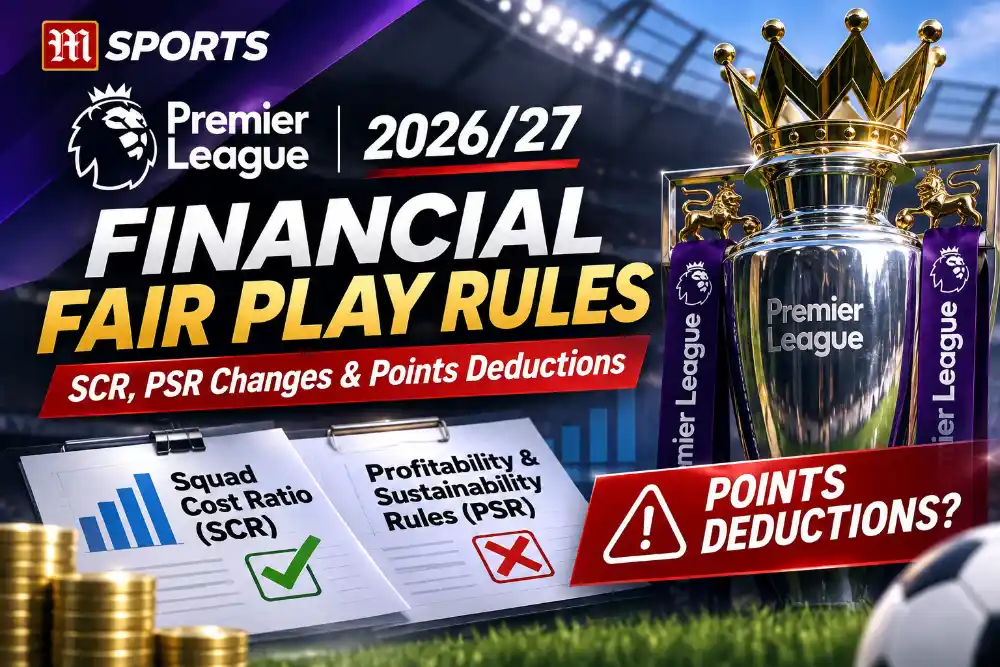
What are the Premier League Financial Fair Play rules in 2026/27? The Premier League now operates a Squad Cost Ratio (SCR) system that normally limits on-pitch expenditure to 85% of a club’s football-related revenue and net player-sale profit or loss, together with separate Sustainability and Systemic Resilience (SSR) checks on its financial health. These rules replaced the older Profitability and Sustainability Rules (PSR) from the start of the 2026/27 season.
The most important distinction for fans: spending above 85% does not automatically trigger a points deduction. The league provides a multi-year allowance, starting at 30 percentage points, and separates possible financial levies from sporting sanctions. This guide explains both thresholds with original examples, shows how transfers affect squad costs, and compares the Premier League system with UEFA’s 70% rule.
Rules checked: 12 November 2026. This is an explanatory guide, not a finding that any particular club has breached the rules. Primary source: Premier League’s official 2026 financial-system explanation.
Premier League Financial Rules 2026/27 at a Glance
| Question | 2026/27 answer |
|---|---|
| Official on-pitch spending framework | Squad Cost Ratio (SCR) |
| Green threshold | 85% of defined football-related revenue and net player-sale result |
| Initial multi-year spending allowance | 30 percentage points above green, subject to adjustment in later seasons |
| Initial red threshold | 115%, not permanently guaranteed |
| First 2026/27 in-season SCR compliance test | 1 March 2027 |
| New system for general financial resilience | SSR: working capital, liquidity and positive equity tests |
| Old PSR system | Replaced from 2026/27; historical breaches can still be investigated |
| Financial levies | Not payable for 2026/27 SCR breaches; levies first apply to breaches in 2027/28 |
| UEFA rule for clubs in Europe | Separate 70% squad-cost threshold |
Important: These are simplified reference figures. The governing rules and club-specific calculations determine the applicable denominator, thresholds and any sanction. The Premier League’s official guide sets out the assessment process.
What Is the Premier League's 85% Squad Cost Ratio Rule?
The Squad Cost Ratio compares the costs of building and running the senior playing squad with the club’s relevant football income. It is not a ceiling on how much money an owner can have, and it is not a fixed salary cap applying in pounds to all 20 clubs.
In practice, the official regulations define which revenues and expenses qualify, including accounting adjustments and transfer-related figures. For supporters, the simplified ratio answers the useful question: how much of a club’s football income is tied up in its playing squad?
Because clubs have different revenues, the same £150m annual squad cost could leave one club comfortably under its green threshold but another above it. The league’s system focuses on this relationship rather than applying one uniform transfer budget.
What counts as squad cost?
- Player wages and relevant bonuses.
- Head coach wages.
- Agent/intermediary costs within the regulatory calculation.
- Transfer-fee amortisation and relevant impairment charges, according to the rules.
Assistant coaches, administrative and commercial staff are not included in the SCR’s defined squad costs in the same way as players and the head coach. The Premier League says costs of women’s teams and youth academies are excluded from the SCR expense calculation, while their relevant income is included. That is designed to avoid discouraging investment in those areas.
What counts as football-related revenue?
The qualifying income can include commercial deals, matchday income, league distributions and revenue from football competitions. Relevant net profit or loss on player sales is included as well. A fee announced in a transfer headline is not necessarily the same as the accounting profit made from that sale.
Worked Example: How the 85% Rule Changes a Club's Budget
Imagine three fictional clubs each have a £200m qualifying income base after the relevant player-sale adjustment. These are illustrations, not reported finances for real Premier League teams.
The green threshold is £200m × 85% = £170m. If the club still has its full initial allowance, the red threshold is £200m × 115% = £230m.
| Fictional club | Squad costs | SCR | What it means |
|---|---|---|---|
| Club A | £150m | 75% | Under the 85% green threshold |
| Club B | £190m | 95% | Above green but below the initial 115% red threshold; later checks and allowance effects matter |
| Club C | £240m | 120% | Above the initial red threshold; a breach at the March compliance test can trigger sporting sanctions |
Why Club B is the interesting case: A 95% ratio is 10 percentage points above green, but it is not automatically a points-deduction offence while the applicable red threshold is 115%. If the overspend is confirmed through the required assessments, it can reduce the club’s next-season allowance. Levies for SCR breaches do not begin until the 2027/28 season.
Why Club C is different: If its applicable red line is 115% at the 1 March test, 120% sits beyond that limit. The league’s sporting-sanction mechanism is therefore relevant. The actual calculation uses approved financial information and the detailed rulebook—not this simplified table.
Green vs Red Threshold: When Is a Fine or Points Deduction Possible?
The league uses a green threshold and a red threshold for different purposes:
| Position | Outcome under the SCR framework |
|---|---|
| At or below green (85%) | SCR-compliant at the relevant test; no SCR sanction for that position. |
| Above green but below red | Further accounts checks; future allowance can fall. A financial levy may arise under the levy regime, which applies to breaches from 2027/28. |
| Above the applicable red threshold | Sporting sanctions, including a points deduction, apply under the in-season test and formula. |
There is no permanently fixed 115% safe zone. Every club initially receives a 30-percentage-point allowance, but this changes when confirmed excess spending feeds back into the following season. The allowance can fall to zero, leaving the red line at 85%.
For an SCR red-threshold breach, the Premier League describes a points-deduction formula starting with a six-point deduction, increasing by one point for each £6.5m spent above the red threshold. The specific sanction must be calculated under the full rules and can be subject to appeal. This is a separate mechanism from historical enforcement cases. For example, our earlier report on Haaland and Manchester City’s 115 financial charges concerns allegations under previous rules. The number of charges should not be confused with the new SCR system’s initial 115% red threshold.
How the Multi-Year 30% Allowance and Feedback Loop Work
The allowance is intended to make the system less rigid when a club invests ahead of future revenue or its finances fluctuate. But it is not a free pass to exceed 85% every year.
Example over two seasons:
- Season 1: A fictional club records a confirmed SCR of 100%. That is 15 percentage points above 85%.
- Season 2: Its initial 30-point allowance is reduced by 15 points, leaving 15 points of headroom and a 100% red threshold.
- If its Season 2 SCR is 101% at the relevant compliance test, it would now be over its 100% red threshold—even though 101% was below the original 115% figure.
This reduction is the Premier League’s negative feedback loop. A club that returns to compliance can restore a previously reduced allowance through a positive feedback loop, adding 10 percentage points at a time up to the 30-point maximum. Unused allowance is not carried forward as a growing cash reserve.
The takeaway: For future seasons, always ask what a club’s current red threshold is, not simply whether it is below 115%.
PSR vs SCR: What Changed in the 2026/27 Season?
Fans still search for Premier League FFP or Premier League PSR, but those terms are not interchangeable with the league’s current framework.
| Feature | Former PSR framework | SCR from 2026/27 |
|---|---|---|
| Main focus | Club profitability/losses with defined adjustments | Squad spending relative to qualifying revenue |
| Assessment period | Rolling three-year profitability assessment | Season-based spending controls and in-season monitoring |
| Main supporter question | How much can the club lose under the rules? | What share of qualifying revenue goes to the squad? |
| Spending above a threshold | Possible PSR investigation and sporting sanction | Green/red threshold system, feedback allowance, possible levies and sporting sanctions |
| Off-pitch investment | Handled through profitability framework and permitted adjustments | SCR focuses more directly on specified on-pitch costs; separate SSR tests guard overall resilience |
The old PSR no longer governs new-season compliance from 2026/27. However, the Premier League retains the power to investigate and enforce alleged PSR breaches relating to 2025/26 or earlier. That is why a future news story mentioning a PSR case would not necessarily contradict the introduction of SCR.
This financial reform is a different subject from referee and match regulations. For gameplay changes, read our Premier League 2026/27 rule changes guide.
How Much Does a Transfer Really Count Toward SCR?
A £50m signing does not necessarily add £50m to the club’s squad-cost ratio in the year the transfer happens. Football accounting normally spreads an eligible transfer fee across the player’s contract as amortisation, subject to the relevant regulatory rules.
Take a purely fictional signing:
| Item | Illustrative amount |
|---|---|
| Transfer fee | £50m |
| Contract term | Five years |
| Simple annual fee amortisation | £10m |
| Annual relevant salary | £8m |
| Illustrative combined annual cost before other items | £18m |
Bonuses, agent fees, impairments, contract changes and accounting restrictions can change the final figure, so £18m should not be treated as a full regulatory calculation.
What if the club sells a player?
A £40m transfer sale is not automatically a £40m accounting profit. If the departing player’s remaining registration value is £15m, a basic illustration would produce a £25m profit before related costs. The transfer can also remove future wages and amortisation. Both the profit/loss on player trading and future squad expenses may affect SCR, but not always in the way suggested by the public headline fee.
This is why two clubs with similar gross transfer spending can end a season with very different ratios.
When Are Clubs Checked? The 2026/27 SCR Timeline
The Premier League performs monitoring during the season, rather than relying exclusively on a post-season accounts review.
- October 2026: in-season monitoring during the first full SCR season.
- 1 March 2027: SCR compliance test after the winter transfer window; exceeding the applicable red threshold can trigger a sporting sanction during that season.
- June 2027: accounts confirmation test for clubs above the green threshold.
- October 2027: accounts confirmation true-up for relevant clubs, helping establish confirmed actual costs and any resulting effect on future allowance.
Transition detail: Although SCR is active in 2026/27, the Premier League says financial levies are only payable for breaches in 2027/28 and later seasons. Sporting sanctions under the current SCR regime are not deferred in the same way. Levies, when applicable, are finally determined after the season following the required accounts process, subject to the detailed offset provisions.
Clubs are entitled to challenge relevant decisions under the applicable appeals process. The final result depends on the facts and the official rules, not on a press estimate of a club’s transfer spending.
What Is Sustainability and Systemic Resilience (SSR)?
SCR measures on-pitch spending. SSR looks at whether the club can stay financially healthy. The Premier League introduced three separate tests to assess short-, medium- and long-term financial resilience.
| SSR test | What it examines | Official benchmark |
|---|---|---|
| Working Capital | Ability to meet cash obligations month by month | At least £12.5m in adjusted projected cash and qualifying working-capital funds for each calendar month |
| Liquidity | Ability to withstand major near-term financial shocks | Non-negative liquidity headroom after an £85m stress-test adjustment over the current and following season |
| Positive Equity | Longer-term debt and asset balance | Adjusted liabilities/assets ratio no higher than 90% in 2026/27, 85% in 2027/28 and 80% from 2028/29 |
The calculations include detailed definitions and adjustments. For example, the league’s liquidity model includes part of the squad’s market value in qualifying liquid assets; it is not simply a bank-balance test.
The main SSR assessment takes place on 7 July, with additional assessments possible after a call-in event. Newly promoted clubs have different initial timing for some tests. Where an SSR test is failed, the focus is initially on a satisfactory business plan and steps to restore compliance. Further monitoring, spending limits, contract-approval requirements or disciplinary measures can follow if necessary.
Premier League's 85% Rule vs UEFA's 70% Squad Cost Rule
Clubs competing in UEFA tournaments can face two different sets of squad-cost requirements: the domestic Premier League framework and UEFA’s financial-sustainability rules. Passing one does not automatically mean passing the other.
| Rule | Premier League SCR | UEFA Squad Cost Rule |
|---|---|---|
| Headline threshold | 85% green threshold, plus a variable multi-year allowance/red line | 70% defined limit |
| Who must follow it? | Premier League clubs | Clubs subject to UEFA competition financial monitoring |
| Timing | Season-based with March test | UEFA’s separate reporting and monitoring periods |
| Regulator | Premier League | UEFA |
For instance, an illustrative ratio of 78% is below the Premier League’s 85% green line but above UEFA’s 70% limit. That does not prove the club breached UEFA rules—the competitions use distinct regulatory definitions and calculations—but it shows why a European participant must budget for both systems.
UEFA’s current Article 94 squad-cost rule specifies the 70% ceiling. For a comparison with a different domestic approach, our LaLiga salary cap and 1:1 rule guide explains how registration capacity works in Spain.
What the New Rules Mean for Transfers and Club Strategy
The financial consequences can now be easier to understand if you follow four questions instead of looking at a headline transfer budget alone:
- What is the qualifying revenue base? A club with larger recurring income may sustain a larger annual squad cost while remaining below 85%.
- What does the squad cost each season? Existing wages, amortisation and agents’ costs matter alongside the new arrivals.
- How much allowance remains? A club may be under 115% but above its own reduced red threshold after an earlier confirmed overspend.
- Is the club also in Europe? UEFA’s separate 70% limit may be the tighter constraint.
There is also a reason to pay attention to contract renewals and player sales. Lowering annual wages, reducing future amortisation or creating qualifying sale profit can change the ratio even without a spectacular incoming signing.
The biggest mistake is assuming a rich owner can simply deposit money and ignore these controls. The system uses specified revenues, costs and financial-health tests, so funding availability and regulatory capacity are different questions.
Five Misconceptions About Premier League Financial Fair Play
| Common claim | More accurate explanation |
|---|---|
| “A club over 85% immediately loses points.” | Not necessarily. The applicable red threshold and prescribed tests determine sporting sanctions. |
| “Every club can always spend 115%.” | 115% is the initial red threshold. The allowance can shrink after confirmed overspending. |
| “PSR is still the main 2026/27 rule.” | SCR and SSR replaced PSR for 2026/27 onward, though prior-season PSR enforcement can continue. |
| “A £100m transfer adds £100m to one year’s squad costs.” | Annual amortisation and other qualifying costs are used in the regulatory calculation. |
| “If a Premier League club passes 85%, UEFA must approve it.” | UEFA applies a separate 70% squad-cost rule to clubs subject to its monitoring. |
Premier League Financial Fair Play 2026/27: Frequently Asked Questions
Yes, for new-season compliance. SCR and SSR replaced PSR from the start of 2026/27. The league can still investigate and enforce PSR breaches relating to 2025/26 and earlier periods.
Squad Cost Ratio. It compares defined on-pitch squad costs with qualifying football revenue and net player-sale profit or loss. The standard green threshold is 85%.
Clubs initially receive 30 percentage points of additional multi-year allowance beyond the 85% green threshold. That makes the initial red threshold 115%, but a club’s allowance can be reduced after confirmed excess spending.
Not automatically. A 90% ratio exceeds the green threshold but may remain below the club’s applicable red threshold. The club can face accounts checks and future allowance consequences; sporting sanctions depend on a red-threshold breach under the rules.
The Premier League describes a formula beginning at six points for a red-threshold breach, with an additional point per £6.5m spent beyond that threshold. The exact deduction is determined by the official formula and can be challenged through the appeals process.
Under the league’s transition arrangement, SCR levies are payable only for breaches in 2027/28 onward. That does not postpone the possibility of a sporting sanction for a red-threshold breach in 2026/27.
For the 2026/27 season, the key in-season test falls on 1 March 2027, followed by accounts confirmation checks for relevant clubs in June and October.
The Premier League says income related to youth academies and women’s teams is included in the revenue calculation, but their costs are excluded from SCR squad expenditure. SSR provides separate financial-health safeguards.
They must consider both the Premier League’s domestic SCR framework and UEFA’s separate 70% squad-cost rule. The two calculations and reporting periods are not identical.
The Bottom Line: What Fans Should Watch in 2026/27
The key change in Premier League financial fair play is not simply that an old £-loss test has become a new percentage. The league now measures on-pitch spending against revenue, tracks the position during the season and uses a green/red-threshold system with an allowance that can change from year to year. SSR separately checks whether clubs can withstand financial stress.
Before concluding a club is “breaking FFP”, look for its actual applicable threshold, whether an official compliance test has taken place, whether the claim relates to SCR, SSR, an old PSR case or UEFA rules, and what the league has formally decided. Headline transfer fees alone cannot answer those questions.
You Might Also Be Interested in Reading
- Premier League 2026/27 Rule Changes: 5 New Rules That Could Change Matches
- How Does the LaLiga Salary Cap Work? Squad Cost Limit & 1:1 Rule Explained
- Brighton vs Arsenal 2026/27: Can Brighton End Arsenal’s Perfect Start?
- Bundesliga Promoted Clubs 2026/27: Different Paths to the Top Flight
- Ederson: A Brazilian Evolution from Man City to Fenerbahce
