


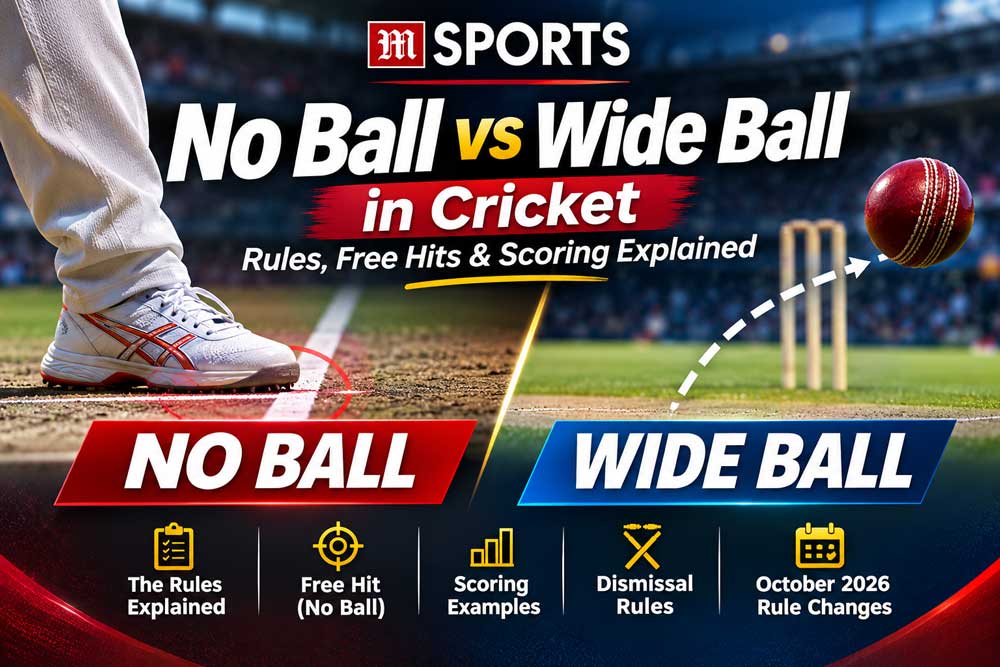
What is the difference between a No ball and a Wide in cricket? Both are illegal deliveries that usually award the batting team at least one extra run and do not count among the six valid balls of an over. A No ball normally concerns an illegal bowling action, delivery or fielding infringement; a Wide concerns a delivery too far from the striker to play with a normal cricket stroke, or the specified over-head-height delivery.
The biggest practical distinction in international limited-overs cricket is that a No ball is followed by a free hit, while a Wide does not by itself create a new free hit. The scoring and permitted dismissals are also different. This guide uses the MCC 2026 Laws of Cricket (in force since 1 October 2026) and separates them from ICC ODI/T20I playing conditions. Fact-checked: 11 November 2026.
No Ball vs Wide Ball: Rules at a Glance
The table is a practical summary of MCC Laws 21 and 22, with the free-hit row referring specifically to ICC limited-overs playing conditions rather than the universal Laws of Cricket.
| Question | No ball | Wide |
|---|---|---|
| What usually causes it? | Illegal foot position, delivery action, ball path or certain fielding infringements | Ball outside normal batting reach; or a qualifying over-head-height delivery |
| Automatic penalty | 1 run | 1 run |
| Does it count as one of the six balls? | No | No |
| Who gets runs off the bat? | Batter gets the runs made from the bat; the No-ball penalty is an extra | A ball touched by bat or striker generally cannot remain a Wide |
| Extra runs without bat | Can be recorded as byes or leg byes, as applicable, in addition to No-ball penalty | Runs from the delivery are scored as Wides, including the one-run penalty |
| Next ball a free hit? | Yes in ICC ODIs and T20Is, according to the playing conditions | No, not merely for bowling a Wide |
| Can batter be stumped? | No | Yes, if the stumping conditions are met |
| Can batter be run out? | Yes | Yes |
Important: If a delivery is both outside the striker’s reach and a No ball, the No-ball call overrides the Wide. The scorecard does not record both for the same delivery.
What Is a No Ball in Cricket?
A No ball is a delivery ruled unfair under MCC Law 21 or other applicable laws and playing conditions. It is more than simply overstepping the front crease. Common causes include:
- Front-foot or back-foot infringement: the bowler fails the legal delivery-foot requirements.
- Illegal bowling action or mode: for example, a prohibited throw or an unannounced change in bowling mode.
- Invalid bounce or landing: under Law 21.7, a ball that bounces more than once or rolls before the popping crease, or lands off the prescribed pitch before passing the striker’s wicket.
- Dangerous or unfair deliveries: subject to the specific applicable rules, such as unfair dangerous full tosses or repeat dangerous short-pitched deliveries.
- Fielding infringements: such as certain wicketkeeper-position and field-placement breaches. In ICC limited-overs cricket, a Powerplay fielding restriction breach can cause a No ball.
The umpire normally signals No ball with one arm extended horizontally. The ball does not become dead merely because No ball is called; play can continue unless another provision makes it dead.
For an example of an illegal field that creates a No ball in a limited-overs match, see our T20 and ODI Powerplay rules explained. For why a batter cannot be out LBW from a No ball, read the LBW rules and examples guide.
What Is a Wide Ball in Cricket?
Under MCC Law 22, a Wide is judged by whether the ball is sufficiently within the striker’s reach to be hit with a normal cricket stroke, while considering the striker’s position and a normal batting stance. Under Law 22.1.3 (2026), a delivery that lands and then passes above the head height of a striker standing upright at the popping crease is also considered Wide.
Not every ball that passes outside the off stump is Wide. A legal ball can be outside the stumps and still be reachable with a normal shot. Equally, a batter cannot always force a Wide call just by shifting away from the delivery. MCC Law 22.4 addresses batter movement, and relevant ICC ODI/T20I playing conditions have their own guidance for moving batters.
If the ball touches the striker’s bat or person in the way described by Law 22.3, a Wide call is revoked. A delivery declared a No ball also overrides Wide. The normal umpire signal for Wide is both arms extended horizontally.
2026 nuance: The MCC’s new over-head-height Wide wording does not mean every short ball is automatically legal. A delivery can still be judged a No ball under separate dangerous-bowling provisions; the precise match conditions matter.
What Changed in the 2026 Cricket Laws?
The 2017 Code, fourth edition (2026) took effect on 1 October 2026. Its important adjustment for this topic is that a delivery that lands and passes above standing head height is treated as a Wide under Law 22.1.3, rather than being covered by the former No-ball wording for that situation. This does not remove other No-ball safety provisions.
Separately, the ICC confirmed new international playing conditions for series starting on or after 1 October 2026. One ODI/T20I clarification concerns the leg-side Wide rule, assessed with reference to the batter’s leg position at delivery instead of simply where the batter finishes moving. This is an ICC limited-overs playing-condition refinement, not a reason to assume that every amateur match uses identical Wide guidelines.
Check MCC’s official Laws library and ICC’s 1 October 2026 playing-conditions announcement when applying these rulings to an actual tournament.
When Does a No Ball Give a Free Hit?
Under ICC ODI and T20I playing conditions, the delivery immediately after a No ball is a free hit. On a free hit, the striker generally cannot be dismissed in the usual caught, bowled, LBW or stumped ways; the dismissal possibilities are those permitted from a No ball. The MCC’s core Laws do not themselves prescribe a universal free hit for every form of cricket.
- Ball 1: No ball. Add the No-ball penalty and any runs; this delivery is invalid for counting the over.
- Ball 2: Free hit. If it is a legal delivery, the free hit is used and the over advances by one ball.
- Ball 2 is also a Wide or No ball? It is not a valid ball. The following delivery remains a free hit under the ICC limited-overs sequence.
Example: A bowler oversteps, then bowls a Wide on the resulting free hit. Both balls add their relevant extras, neither counts toward the six valid balls, and the next ball is still a free hit. By contrast, an ordinary Wide that did not occur during a free-hit sequence does not automatically create a free hit.
How Are No Balls and Wides Scored? Eight Worked Examples
The examples below are hypothetical teaching cases under the stated MCC Laws, with ICC free-hit rules noted separately. They illustrate the scorer’s split between batter runs and extras.
| Delivery or situation | How runs are recorded | Counts as valid ball? | Next ball free hit in ICC ODI/T20I? |
|---|---|---|---|
| 1. Front-foot No ball hit for four | 5 total: 4 batter runs + 1 No-ball extra | No | Yes |
| 2. No ball missed by keeper, runs to boundary for four byes | 5 total: 1 No-ball extra + 4 byes | No | Yes |
| 3. Wide passes keeper and reaches boundary | 5 Wides: one-run penalty + boundary allowance | No | No, unless continuing a prior free hit |
| 4. Wide; batters complete two runs | 3 Wides: 1 penalty + 2 completed runs | No | No, unless continuing a prior free hit |
| 5. Ball initially looks wide but touches batter’s bat and goes for four | 4 batter runs, not Wides | Yes, assuming no other infringement | No |
| 6. Ball is both an overstepping No ball and too far away to reach | Record the No ball (not an additional Wide) | No | Yes |
| 7. Ball bounces and passes above upright head height under MCC 2026 Law 22.1.3 | Wide, unless another infringement overrides it | No | No by itself |
| 8. Legal ball, batter hits a four | 4 batter runs, no extras | Yes | No |
Why the distinction matters: A No ball hit for four does not give the batter five runs; it gives them four, while the team gets five. A Wide missed to the boundary, by contrast, can be recorded entirely under Wides. The distinction is relevant when reading batting figures, bowling analysis and match totals.
For how innings totals and overs affect standings, see our cricket Net Run Rate calculator and the DLS rain-target guide.
Can You Get Out on a No Ball or a Wide?
| Dismissal | No ball | Wide |
|---|---|---|
| Bowled | No | No |
| Caught | No | No |
| LBW | No | No |
| Stumped | No | Yes |
| Hit wicket | No | Yes |
| Run out | Yes | Yes |
| Obstructing the field | Yes | Yes |
| Hit the ball twice | Yes | No |
These are the dismissal categories permitted by MCC Law 21.17 for a No ball and Law 22.9 for a Wide. Permission in the table does not mean a dismissal automatically happens; the separate conditions for that dismissal must still be satisfied. In ICC limited-overs play, a free hit also restricts the available dismissal methods.
See our LBW guide for the full legal-delivery test and why an LBW appeal fails after a No-ball call.
Why a Six-Ball Over Can Contain Eight Deliveries
A standard over requires six valid deliveries, not necessarily six times the bowler releases the ball. Consider this illustrative eight-delivery sequence:
| Actual delivery | Result | Valid-ball count after delivery |
|---|---|---|
| 1 | 1 run | 1 |
| 2 | Wide (1 extra) | Still 1 |
| 3 | Dot ball | 2 |
| 4 | No ball hit for two (3 team runs) | Still 2 |
| 5 | Four | 3 |
| 6 | Single | 4 |
| 7 | Dot ball | 5 |
| 8 | Two | 6 |
Score from the over: the batters make 10 runs (1 + 0 + 2 + 4 + 1 + 0 + 2), and there are two extras (one Wide, one No ball), so the team scores 12. The over took eight actual deliveries because two did not count. In an ICC limited-overs match, delivery 5 would also be a free hit because delivery 4 was a No ball.
If you are calculating run rates, this is one reason overs should be read as valid balls rather than as a decimal number. Our NRR calculation guide explains six-ball over conversion.
Five No Ball vs Wide Mistakes to Avoid
- “Both always give a free hit.” False. In ICC ODIs/T20Is, a No ball triggers it; a normal Wide does not.
- “The batter gets all runs off a No ball.” False. The one-run penalty is an extra, even if the batter hits a boundary.
- “A Wide that reaches the rope scores only one.” False. It can score five Wides.
- “Any delivery outside off stump is Wide.” False. Reachability, batter movement, and applicable match conditions matter.
- “A No ball can also count as a Wide.” False. Law 21.12 makes No ball override Wide.
Official Sources and Editorial Notes
This explanation is based on the current MCC 2017 Code, fourth edition (2026) and identified ICC international playing conditions. It is not a substitute for the match-specific playing conditions used by domestic, school or recreational competitions.
- MCC — Official Laws of Cricket (2017 Code, fourth edition, 2026); especially Laws 17, 21 and 22
- MCC — 2026 Laws implementation and effective date
- ICC — October 2026 changes to international playing conditions
- ICC — T20I No-ball and free-hit explanation (historical reference; verify current series conditions)
Method: all scorecard sequences are constructed examples, not claims about specific matches. Last reviewed: 11 November 2026.
No Ball vs Wide Ball: Frequently Asked Questions
A No ball relates to an illegal delivery or other infringement, whereas a Wide generally relates to a ball outside normal batting reach or a qualifying over-head-height ball. Both normally add one penalty run and must be rebowled for the six-ball over count.
In ICC ODIs and T20Is, yes. The next delivery is a free hit. Free hits are not a universal feature of every cricket match governed only by the MCC Laws.
A Wide alone does not create a free hit. If a Wide is bowled while the batter is already facing a free hit, the next delivery remains a free hit under ICC limited-overs playing conditions.
No. MCC Law 21.12 says a No-ball call overrides Wide. The delivery is recorded as a No ball rather than receiving both penalties.
Neither counts as one of the six valid balls in the over. A bowler may therefore deliver seven, eight or more actual balls to complete a standard over.
Yes, if the conditions for stumping are met. Stumped is one of the dismissal types available on a Wide, but not on a No ball.
Under MCC Law 22.1.3 in the October 2026 Code, a delivery that lands and passes over the upright striker’s head height at the popping crease is considered a Wide. Dangerous-bowling and competition-specific rules can still affect other decisions.
If the ball passes the keeper and reaches the boundary without touching bat or striker, the team typically gets five Wides: the one-run penalty plus four for the boundary.
Seven team runs: six credited to the batter and one No-ball extra. The delivery does not count as valid; in ICC limited-overs matches, the next delivery is a free hit.
For a Wide, the umpire extends both arms horizontally. For a No ball, one arm is extended horizontally. The relevant signal can be repeated to the scorers when the ball is dead.
You Might Also Be Interested in Reading
Build your understanding of cricket decisions and scorecards with these M88Sports guides:
- LBW in Cricket Explained: Full Form, Rules, DRS & Examples
- Powerplay in Cricket: T20 vs ODI Rules, Overs & Fielding Limits
- Net Run Rate Calculator: Cricket NRR Formula & Examples
- Cricket Field Positions Explained: Diagram, Roles & T20 vs Test Setups
- DLS Method in Cricket Explained: Rain Targets & Examples
