


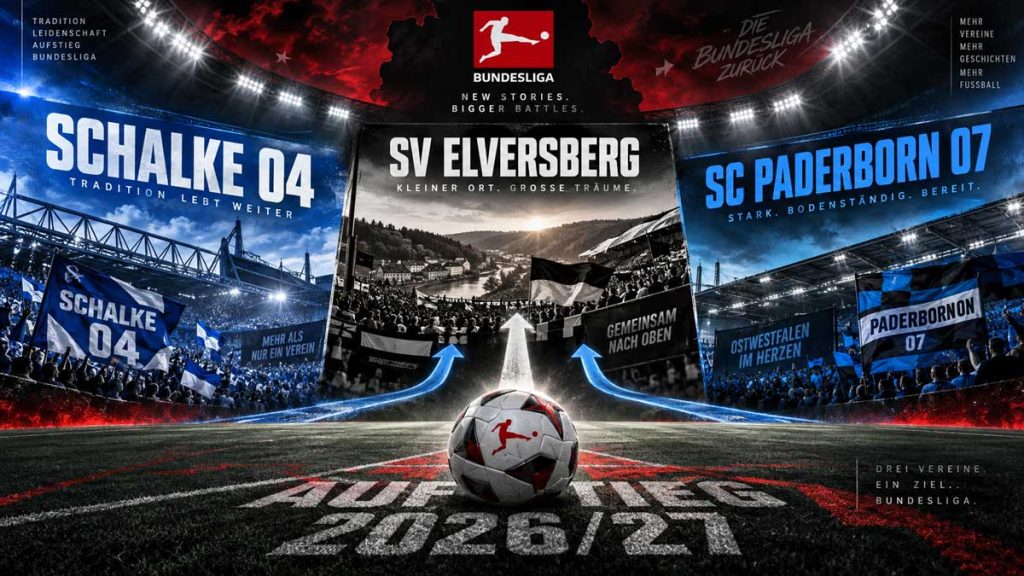
Three promoted clubs entered the 2026/27 Bundesliga, but they are not three versions of the same survival story. Schalke returned as a heavyweight rebuilding its place among Germany’s elite. Elversberg arrived as a first-time Bundesliga club from one of the league’s smallest communities. Paderborn came through the promotion play-off with a different challenge again: proving that a compact, modern club can establish itself after previous short stays in the top flight.
That contrast makes the Bundesliga promoted clubs 2026/27 more interesting than a simple “who will stay up?” discussion. Each club is testing a different model for surviving Germany’s top division — scale and experience, tactical fearlessness, and efficient structure.
Updated: September 16, 2026. This article will be refreshed as the season develops.
Bundesliga Promoted Clubs 2026/27 at a Glance
| Club | How they arrived | 2026/27 storyline |
|---|---|---|
| Schalke 04 | Bundesliga 2 champions | A traditional giant trying to turn promotion into stability |
| SV Elversberg | Bundesliga 2 runners-up | A first-time Bundesliga club refusing to abandon attacking football |
| SC Paderborn 07 | Promotion play-off winner | A structurally efficient club trying to make its latest top-flight return last |
Schalke won the 2025/26 Bundesliga 2 title, while Elversberg secured automatic promotion in second. Paderborn then earned the third Bundesliga place through the promotion/relegation play-off. Official Bundesliga coverage also notes that Elversberg became the 59th different club in Bundesliga history.
Why This Promoted Class Is Unusual
Promoted teams are often grouped together because they share the same immediate objective: collect enough points to avoid going straight back down. The 2026/27 trio is more useful to study separately.
Schalke have the fanbase, stadium, history and expectations of an established Bundesliga club. Elversberg are almost the opposite: they are making their first appearance at this level, with Bundesliga.com noting that the municipality of Spiesen-Elversberg has a population of only around 13,000. Paderborn sit somewhere between those extremes — not a giant, but no longer a novelty either.
There is also reason not to treat relegation as automatic. According to Bundesliga.com, only five of the 15 promoted clubs across the previous seven campaigns were relegated immediately. The last season in which every promoted side went straight back down was 2008/09.
That history does not guarantee survival for anybody. It does show why the more interesting question is not simply which club is biggest? It is which model translates best to the Bundesliga?
Schalke: The Scale-and-Experience Model
Calling Schalke a normal promoted club misses the point. The Royal Blues returned after three seasons in Bundesliga 2, where they had endured finishes of 10th and 14th before Miron Muslić helped transform them into 2025/26 champions.
The club’s advantage is obvious: Schalke already understand the pressure, attention and matchday scale of Bundesliga football. They are not trying to introduce themselves to the division. They are trying to prove that their period outside it is over.
What Schalke are doing differently
The early signs suggest a team more comfortable winning through control and resilience than through constant attacking risk. Bundesliga.com described Schalke’s start as being built around defensive resilience and experience. Their 3-1 win over Union Berlin delivered the first league victory of their return.
That approach matters. Newly promoted teams can be punished when they try to recreate second-division dominance against technically stronger opponents. Schalke do not necessarily need to dominate possession every week. Their survival path can be built around limiting high-quality chances, managing difficult phases and using experienced players to turn close matches.
Veteran striker Edin Džeko also extended his stay through 2027 after helping the club win promotion. Even when he is not the entire attacking plan, that level of experience gives Schalke an option many promoted sides do not possess.
The question Schalke must answer
Can a club with Bundesliga-sized expectations accept the kind of pragmatic football often required of a newly promoted team? Schalke’s biggest challenge may be balancing ambition with patience. Survival is not glamorous, but establishing a stable first season would give the club something more valuable than a short burst of momentum: a platform.
Elversberg: The Fearless-Football Model
If Schalke are familiar, Elversberg are one of the Bundesliga’s most unusual stories. Their promotion was the first in club history, making them the 59th team to play in Germany’s top flight.
The temptation for a first-time Bundesliga club would be to become cautious immediately. Elversberg have shown the opposite instinct.
They did not wait for permission to attack
Elversberg opened their Bundesliga campaign with victories over Bayer Leverkusen and Borussia Mönchengladbach. They then took the lead against Bayern Munich before eventually losing 2-1, with Harry Kane scoring the second-half winner.
That three-match sequence matters more than the six points alone. It showed that Elversberg were willing to carry their attacking identity into matches against established Bundesliga opposition rather than simply defend the penalty area and hope.
Official Bundesliga analysis described their approach as fearless, attacking football. For promoted clubs, keeping the identity that won promotion can be powerful — but only if the structure behind it survives the jump in speed and quality.
Why Elversberg may be the season’s best tactical case study
Elversberg cannot win an arms race with Bayern, Dortmund or the league’s richer clubs. Their route is different: coaching clarity, coordinated movement and players who understand exactly what the system asks them to do.
That makes their season worth following even beyond the relegation battle. If Elversberg remain competitive, they will offer another example of how tactical cohesion can reduce — though never erase — the financial gap in a major European league.
Paderborn: The Efficiency-and-Adaptation Model
Paderborn arrived with less noise than Schalke and less novelty than Elversberg, but that may be exactly why they are interesting.
The club finished third in the 2025/26 Bundesliga 2 promotion race and earned its place through the play-off. Their return is another test of a familiar question for smaller Bundesliga clubs: how much can smart recruitment, coaching continuity and structural efficiency compensate for a smaller budget?
Paderborn’s early 3-0 defeat against Borussia Dortmund demonstrated the danger of the step up. Bundesliga opponents can turn small positional errors into clear chances quickly, and difficult stretches can become decisive before promoted teams have time to adjust.
The lesson from Paderborn’s previous Bundesliga spells
Paderborn have been here before. Their task in 2026/27 is not merely reaching the Bundesliga; it is making the stay more durable than previous visits. That means adaptation may matter more than ideology.
Some weeks will reward aggressive pressing. Others may require a lower block, safer possession or more direct football. The clubs that survive are often the ones that discover a second way to win points when their preferred approach stops working.
Three Clubs, Three Different Bundesliga Survival Models
| Model | Club | Potential strength | Main risk |
|---|---|---|---|
| Scale + experience | Schalke | Established support, pressure-tested players, pragmatic game management | Expectations can rise faster than the squad develops |
| Tactical identity | Elversberg | Cohesion, bravery and clarity in possession | Open games can expose the quality gap |
| Efficiency + adaptation | Paderborn | Lean structure and flexibility | Less margin for error against deeper squads |
This is why comparing the three promoted teams only through league position can miss the bigger story. Their seasons are experiments in what a Bundesliga newcomer actually needs.
Schalke can ask whether institutional size still provides a meaningful safety net. Elversberg can test whether a clear attacking identity can survive the jump without being diluted. Paderborn can show whether efficient decision-making and adaptation are enough to create staying power.
What the Early 2026/27 Results Already Tell Us
It is still too early to treat September results as a season verdict, but the opening weeks have already challenged one common assumption: promoted teams do not have to spend months adjusting before they can trouble established Bundesliga clubs.
Elversberg beat Leverkusen and Gladbach before pushing Bayern. Schalke collected their first win against Union Berlin. Paderborn’s loss to Dortmund showed the other side of the equation — the division can punish teams quickly when control disappears.
The next phase will be more revealing than the novelty of the first few matchdays. Opponents will have more video, more tactical evidence and clearer ideas about how to attack each promoted side. The real test begins when surprise is no longer an advantage.
What to Track as the Season Develops
- Points against bottom-half rivals: Results against direct competitors often matter more to survival than memorable performances against title contenders.
- Goal difference: A team can collect occasional wins while still showing warning signs if heavy defeats become frequent.
- Home form: Promoted clubs usually need their home ground to become a reliable source of points.
- Tactical changes after the first international breaks: This is when coaches have more evidence about which second-division habits translate and which do not.
- January recruitment: The winter window can reveal whether a club trusts its promotion squad or believes the jump has exposed specific weaknesses.
We will update this page during the 2026/27 season as Schalke, Elversberg and Paderborn build a larger Bundesliga sample.
Frequently Asked Questions
Schalke 04, SV Elversberg and SC Paderborn 07 joined the Bundesliga for the 2026/27 season. Schalke were Bundesliga 2 champions, Elversberg finished second, and Paderborn earned promotion through the play-off.
Yes. The 2026/27 season is Elversberg’s first campaign in Germany’s top division. They became the 59th different club to appear in Bundesliga history.
Schalke returned after three seasons in Bundesliga 2. They had been relegated from the Bundesliga in 2022/23 before winning the second division in 2025/26.
No. Bundesliga.com reported before the 2026/27 season that only five of the 15 promoted clubs across the previous seven campaigns were immediately relegated.
The opening weeks produced encouraging moments for more than one promoted side. Elversberg won their first two matches before a narrow loss to Bayern, while Schalke recorded their first win against Union Berlin. The season remains too young for those results to define the full survival race.
