


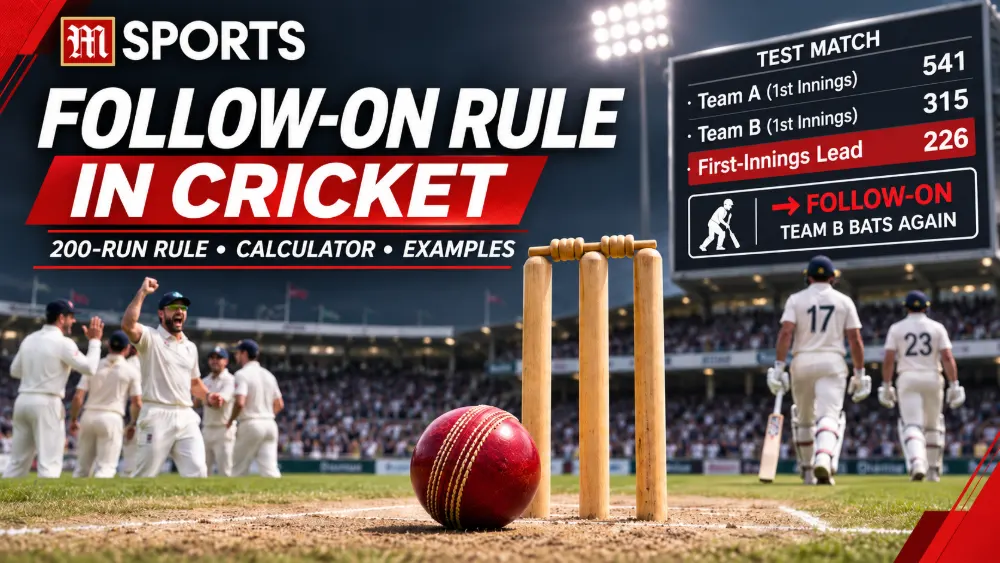
What is the follow-on in cricket? It is an option in a match where each team can bat twice. When the side batting first finishes the first innings of both sides with a large enough lead, its captain may require the opposition to bat again immediately. In a normal five-day Test, the required first-innings lead is at least 200 runs.
The follow-on changes the normal batting order from A–B–A–B to A–B–B–A. It is a choice, not an automatic penalty. This guide explains the thresholds, provides an interactive calculator, distinguishes rain delays from a lost opening day, and uses worked scores. Rules checked: 16 November 2026 against MCC’s 2026 Laws of Cricket, Law 14.
Follow-On Rules at a Glance: 200, 150, 100 and 75 Runs
MCC Law 14.1 sets the margin by the number of days scheduled for a two-innings-per-side match. For the normal first-day start, the rule is:
| Scheduled match length | Minimum first-innings lead | Example allowing a follow-on |
|---|---|---|
| 5 days or more (standard Test) | 200 runs | 450 vs 250 (lead 200) |
| 3 or 4 days | 150 runs | 350 vs 200 (lead 150) |
| 2 days | 100 runs | 280 vs 180 (lead 100) |
| 1 day, if each side can bat twice | 75 runs | 225 vs 150 (lead 75) |
Exactly the margin is enough. The phrase “at least” matters: 200 qualifies; 199 does not in a normal five-day Test. The figures use completed first innings, not the total at a live drinks break.
These are Laws of Cricket thresholds. Competition organisers can add playing conditions. For context on how other decisions are made in the longer format, see our LBW rules with examples and cricket field positions and Test setups.
Follow-On Calculator: Can a Team Enforce It?
Enter the two completed first-innings totals and match duration. If the first day or more is entirely lost, choose the first day on which play actually starts. The calculator shows the lead, the applicable minimum, and whether the follow-on option exists.
Use completed first-innings totals in a two-innings-per-side match. The widget checks eligibility under MCC 2026 Law 14; it cannot decide a captain’s strategy or override competition-specific playing conditions.
Calculator limitations: It assumes a properly constituted two-innings match in which Team A batted first and both first innings have been completed. Its answer establishes eligibility, not whether the captain will enforce the follow-on. It does not predict the result, evaluate revised competition regulations, or treat a partial first-day delay as a whole day lost.
How to Calculate the Follow-On: Formula and Six Score Examples
These are hypothetical teaching scorecards, not real match records.
| Match type and situation | First-innings totals (A / B) | Lead | Follow-on? |
|---|---|---|---|
| 5-day Test, normal start | 450 / 250 | 200 | Yes — exactly 200 |
| 5-day Test, normal start | 450 / 251 | 199 | No — one run short |
| 5-day Test, normal start | 525 / 220 | 305 | Yes — well above the margin |
| 4-day match, normal start | 350 / 200 | 150 | Yes — 150 is sufficient |
| 3-day match, normal start | 350 / 250 | 100 | No — 150 required |
| 2-day match, normal start | 280 / 180 | 100 | Yes — exactly 100 |
How many runs does Team B need to avoid the follow-on?
For a standard five-day Test, runs needed to avoid the follow-on = Team A’s first-innings total − 200 + 1, provided the first innings has not yet been completed. If A scores 480, B needs 281 to keep the deficit below 200; 280 leaves a 200-run deficit and permits the captain to enforce it. This is a useful in-innings target, but the formal option arises only after the relevant first innings are completed.
What If the First Day Is Washed Out? The 2026 Law 14.3 Exception
A common misunderstanding is that any rain delay changes the follow-on threshold. MCC Law 14.3 is narrower: if no play takes place on the first day of a multi-day match, use the number of days remaining from when play first starts. The first day with play counts as a full day, even if the first over begins late.
| Originally scheduled | First day with play | Days counted under Law 14 | Required lead |
|---|---|---|---|
| 5 days | Day 1 | 5 | 200 |
| 5 days | Day 2 | 4 | 150 |
| 5 days | Day 3 | 3 | 150 |
| 5 days | Day 4 | 2 | 100 |
| 4 days | Day 2 | 3 | 150 |
| 3 days | Day 2 | 2 | 100 |
| 2 days | Day 2 | 1 | 75 |
Worked rain example: A five-day Test loses its entire scheduled opening day. Play starts on day two and Team A later finishes on 480 while Team B is dismissed for 330. The lead is 150, so the follow-on is available under the four-day threshold. If play had begun for even one over on day one, a 150-run lead would not be enough in the same five-day Test.
Not the same as a rain-adjusted ODI: the follow-on is a two-innings rule; changing a one-innings match’s target after interruptions is a separate issue discussed in our DLS Method guide.
What Happens After a Follow-On Is Enforced?
Ordinarily, each team bats in turn. Enforcing the follow-on places the side that batted second straight back in. Compare the innings order:
| Innings | Normal match | With follow-on |
|---|---|---|
| 1st | Team A | Team A |
| 2nd | Team B | Team B |
| 3rd | Team A | Team B again |
| 4th, if needed | Team B | Team A, if needed |
Imagine Team A makes 480 and Team B is dismissed for 240 (lead 240). A enforces the follow-on, and B then scores 350 in its second innings. B has 590 total runs across both innings; A has 480 and now needs 111 to win, if time remains. If B had instead scored 200 in its second innings, it would have made only 440 overall, and A would win by an innings and 40 runs without batting again.
Law 14.2 requires the enforcing captain to notify the opposing captain and the umpires. Once notified, the decision cannot be changed. The option belongs to the side batting first and holding the qualifying first-innings lead; it is not automatically triggered by the scoreboard.
Why Do Captains Sometimes Refuse the Follow-On?
Qualifying for the follow-on does not mean it is always the best tactical decision. A captain weighs the time remaining, pitch, bowlers’ workload and the risk of having to chase last.
- Reasons to enforce: limited time left, fresh fast bowlers, favourable bowling conditions, or a chance to win without a second batting innings.
- Reasons to decline: bowlers need rest after a long innings, a rapidly changing pitch, or a chance to build a safer target and make the opponent bat fourth.
- Time versus control: enforcing can create more bowling time, but batting again can reduce the risk of an unexpected last-innings chase.
Follow-on versus declaration: the follow-on changes the other side’s batting order after both first innings; a declaration is a batting captain ending their own current innings under Law 15. They are different tactical tools. When watching a Test, also consider whether slips, short leg and close-in field placements indicate an attacking plan.
Can a Team Win After Being Asked to Follow On?
Yes. Following on is a major disadvantage, not an automatic defeat. Four famous Test victories after following on occurred in 1894, 1981, 2001 and 2023. A losing side can recover by posting a large second-innings total and then dismissing the opposition.
| Test | Comeback team | What happened |
|---|---|---|
| Sydney, 1894 | England | England defeated Australia by 10 runs after following on. |
| Headingley, 1981 | England | England beat Australia by 18 runs, helped by Ian Botham and Bob Willis. |
| Kolkata, 2001 | India | India defeated Australia by 171 runs after an extraordinary second-innings recovery. |
| Wellington, 2023 | New Zealand | New Zealand beat England by one run after being asked to follow on. |
The 2023 Wellington finish is especially instructive. England made 435/8 declared; New Zealand were all out for 209, a 226-run deficit. After the follow-on, New Zealand made 483 and bowled England out for 256, winning by one run. See the ICC’s match recap and ICC’s historical context.
Why it matters: a follow-on may speed up the result, but it cannot remove the possibility of a remarkable comeback. It is a choice involving both the rules and match strategy.
Common Follow-On Mistakes to Avoid
- “A 200-run lead always applies.” Not in shorter two-innings matches, and not always if the scheduled opening day is entirely lost.
- “At 200 runs ahead the follow-on happens automatically.” No. The captain must elect to enforce it.
- “A team can enforce it before the opponent’s first innings ends.” No. The option follows the completed first innings of each side.
- “If it rains on day three, the Test margin drops to 150.” Not under Law 14.3 if play took place on day one.
- “The follow-on applies in normal ODIs and T20Is.” No. Those are one-innings-per-side formats. For shorter-format scoring terminology, see No Ball vs Wide Ball explained and the NRR calculator.
Editorial basis: MCC’s 2017 Code, fourth edition (2026), Law 14; competition-specific regulations should be checked where applicable. This guide’s arithmetic examples are fictional unless a historical Test is explicitly identified. Last reviewed 16 November 2026.
Follow-On Rule: Frequently Asked Questions
In a two-innings-per-side match, if the side batting first has a sufficiently large lead after both teams complete their first innings, its captain can ask the side that batted second to bat again immediately.
Normally at least 200 runs in a five-day Test. If no play takes place on its first scheduled day, Law 14.3 can reduce the threshold according to the number of days remaining when play begins.
Yes, in a standard five-day Test with play on day one. A lead of 199 does not.
In a normal five-day Test, take the side batting first’s completed total, subtract 200, then add 1. For example, after 450, the other side must make at least 251 to avoid a 200-run deficit.
Yes. The follow-on is optional. A captain may prefer to bat again to rest bowlers or build a larger fourth-innings target for the opponent.
Not in ordinary ODI or T20 formats, because each team bats only once. Follow-on is a concept for matches where both sides can have two innings.
If no play takes place until day two, the applicable minimum becomes 150 runs because the match is treated as four days from the first day of play for Law 14.
Yes. New Zealand defeated England by one run at Wellington in February 2023 after being asked to follow on. India also beat Australia at Kolkata in 2001 after following on.
No. A declaration ends the declaring side’s current innings; enforcing the follow-on requires the other side to bat again right away after its first innings, once the qualifying lead exists.
You Might Also Be Interested in Reading
Explore the rules and calculations that help you follow Test cricket and limited-overs matches:
- LBW in Cricket Explained: Full Form, Rules, DRS & Examples
- Cricket Field Positions Explained: Diagram, Roles & Test Setups
- No Ball vs Wide Ball in Cricket: Rules, Free Hits & Scoring
- Net Run Rate Calculator: Formula & Examples
- DLS Method in Cricket Explained: Rain Targets & Examples
- Powerplay in Cricket: T20 vs ODI Fielding Rules
