


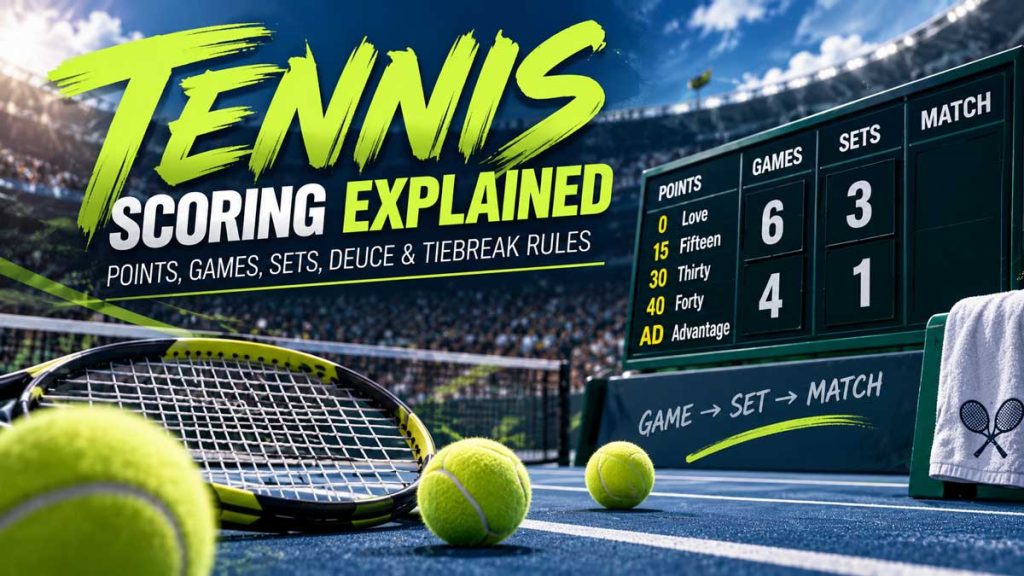
How does tennis scoring work? A standard game is scored love, 15, 30, 40, game. A player normally needs at least four points and a two-point margin to win a game. Six games usually win a set, again with a two-game margin, while a tiebreak is commonly used if the set reaches 6-6.
Tennis Scoring at a Glance
| Level | How it is scored | How you normally win |
|---|---|---|
| Point | A single rally | Opponent cannot make a legal return |
| Game | Love, 15, 30, 40 | At least 4 points, normally by 2 |
| Set | Games | Usually 6 games, by 2; tiebreak commonly at 6-6 |
| Tiebreak | 0, 1, 2, 3… | Usually first to 7, by 2 |
| Match | Sets | Usually best of 3; some formats use best of 5 |
This hierarchy is the easiest way to read a tennis scoreboard. A score such as 6-4, 3-6, 2-1, 30-15 tells you the completed set scores first, then the current set’s games, then the current game’s points.
Why Does Tennis Use Love, 15, 30 and 40?
Inside a standard game, tennis does not count points as 0, 1, 2 and 3. Instead, the traditional sequence is:
| 0 points | Love |
| 1 point | 15 |
| 2 points | 30 |
| 3 points | 40 |
| Next point, with the required margin | Game |
The server’s score is announced first. If the server has won two points and the receiver one, the score is 30-15. If both have two points, it is 30-all.
The historical origin of 15-30-40 is not known with complete certainty. Clock-face and medieval scoring explanations are often repeated, but readers should distinguish those theories from the modern rule itself: the official scoring sequence is love, 15, 30 and 40.
What Is Deuce and Advantage in Tennis?
When both sides reach 40, the score is deuce. Under standard advantage scoring, the game does not end with the next point.
The player who wins the next point has advantage. If that player wins again, the game is over. If the opponent wins the next point instead, the score returns to deuce. This can repeat until one side wins two consecutive points from deuce.
You may also hear Ad-In when the server has advantage and Ad-Out when the receiver has advantage.
How Do You Win a Set in Tennis?
A standard tiebreak set is normally won by the first player or team to reach six games with a two-game margin. Scores such as 6-0, 6-2 and 6-4 therefore complete the set.
At 5-5, winning only one more game is not enough: 6-5 is a lead, not normally the end of the set. If one side wins the next game, the set ends 7-5. If the score becomes 6-6, a tiebreak is commonly played.
An advantage set is different: there is no tiebreak at 6-6 and play continues until one side leads by two games. Competition rules determine which format applies.
How Does a Tennis Tiebreak Work?
A standard tiebreak uses ordinary numbers rather than 15, 30 and 40. It is normally won by the first player or team to reach seven points with a two-point margin.
That means 7-5 wins the tiebreak, but 7-6 does not. At 6-6, play continues until somebody leads by two: 8-6, 9-7, 10-8 and so on.
The player due to serve begins with one point on serve. The opponent then serves two points, after which service continues in blocks of two. Players change ends after every six tiebreak points.
The winner of a standard set tiebreak wins the set 7-6.
7-Point Tiebreak vs 10-Point Match Tiebreak
| Format | Target | Margin | Typical use |
|---|---|---|---|
| Standard tiebreak | 7 points | Win by 2 | Commonly decides a set at 6-6 |
| 10-point match tiebreak | 10 points | Win by 2 | Can replace a deciding set in some formats |
| Grand Slam deciding-set tiebreak | 10 points | Win by 2 | Played at 6-6 in the deciding set |
The four Grand Slams use a 10-point tiebreak at 6-6 in the deciding set. Other competitions can use different approved formats, so the event’s rules matter.
How Many Sets Do You Need to Win a Tennis Match?
In a best-of-three match, the first player or team to win two sets wins the match. If someone wins the opening two sets, no third set is played.
In a best-of-five match, the first to win three sets wins. Men’s singles at the four Grand Slams is the most familiar best-of-five format, while women’s Grand Slam singles is best of three.
Not every tennis competition uses identical scoring. Doubles, junior events, team competitions and experimental events may use no-ad games, match tiebreaks or shorter sets. That is why a good scoring guide explains the standard system first and treats event-specific formats as variations.
How to Read a Tennis Scoreboard: Worked Examples
Example 1: 30-15
The server has won two points in the current game; the receiver has won one.
Example 2: 6-4, 2-3
The player listed first won the opening set 6-4 but trails 2-3 in games in the second set.
Example 3: 7-6(7-4)
The set finished 7-6 after a tiebreak. The bracketed score shows that the tiebreak itself finished 7-4.
Example 4: 6-4, 3-6, 7-6
The players split the first two sets, and the deciding set was won 7-6. The exact deciding-tiebreak format depends on the competition.
What Is No-Ad Scoring?
No-ad scoring removes the repeated advantage cycle. When a game reaches deuce, a deciding point is used instead of requiring one player to win two consecutive points from 40-40.
This makes matches shorter and more predictable in duration. It is used in some doubles and alternative competition formats, but it should not be confused with traditional advantage scoring.
Common Tennis Scoring Terms
| Term | Meaning |
|---|---|
| Love | Zero points |
| All | An equal score, such as 30-all |
| Deuce | 40-40 under standard scoring |
| Advantage | The point after deuce; one more point can win the game |
| Game point | A point that can win the current game |
| Break point | A game point for the receiver |
| Set point | A point that can win the set |
| Match point | A point that can win the match |
| Tiebreak | A numerical points game used to decide a tied set or, in some formats, a match |
Official Sources and Method
This guide follows the standard scoring framework described in the ITF Rules of Tennis and explanatory material from major tennis authorities. Competition-specific rules can modify the standard format.
- International Tennis Federation — Rules and Regulations
- USTA — Tennis Scoring: Points, Sets & Games
- ATP Tour — Tennis Explained: Learn the Game
Last reviewed: September 2026.
Tennis Scoring FAQ
Love means zero in tennis scoring. Several explanations for the word’s historical origin exist, but the origin is not certain enough to treat one popular theory as established fact.
The modern scoring sequence is 15, 30 and 40. Historical theories attempt to explain why 40 replaced an expected 45, but there is no need to know the origin to score a match correctly.
40-40 is deuce. Under standard advantage scoring, one side must win two consecutive points from deuce: the first creates advantage and the second wins the game.
Normally no. A standard set requires a two-game margin. At 6-5, another game is played; the set can finish 7-5, or reach 6-6 and move to the applicable tiebreak format.
No under a standard seven-point tiebreak, because the winner must lead by two points. At 6-6 the tiebreak continues until someone establishes a two-point margin.
Points build a game, games build a set, and sets build a match. This points-to-games-to-sets hierarchy is the core structure of tennis scoring.
No. Standard scoring provides the foundation, but competitions can use approved variations such as no-ad games, match tiebreaks, shorter sets or different deciding-set formats.
The Bottom Line
Tennis scoring becomes much easier once you stop treating the scoreboard as one long number. Remember the hierarchy: points win games, games win sets, and sets win matches. Inside a standard game the sequence is love, 15, 30 and 40; at deuce you normally need two consecutive points; and at 6-6 a tiebreak commonly decides the set.
M88Sports will keep this reference updated when major governing bodies change widely used scoring formats.
