


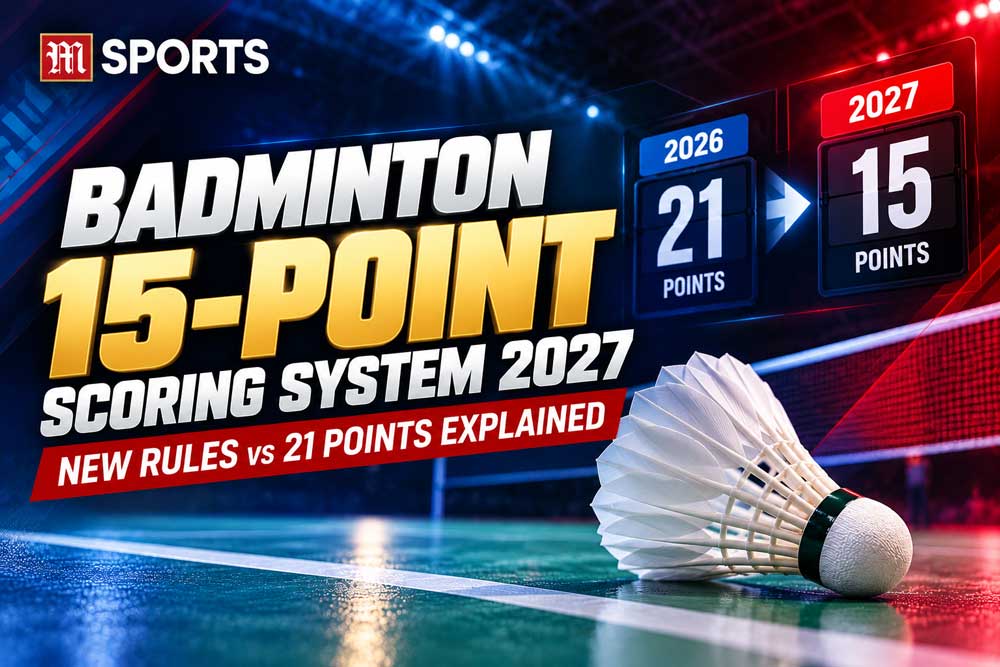
Badminton’s new 15-point scoring system takes effect on 4 January 2027. Under the BWF-approved 3×15 format, matches remain best of three games, with a point on every rally. The key differences from today’s 21-point games are the 15-point target, deuce at 14–14, an eventual 21–20 cap, and an interval at eight points.
This guide gives score-by-score examples so players, coaches and fans can see exactly when a game ends. It addresses scoring rather than repeating our separate serving-rules guide.
What Is the New Badminton 15-Point Scoring System?
Quick answer: Starting 4 January 2027, BWF’s approved standard will be best of three games to 15 points (3×15), replacing the usual 3×21. Every rally still earns a point. At 14–14, a side needs a two-point lead, but at 20–20, the next point wins: 21–20 is the highest possible game score.
BWF members approved the change at the 87th Annual General Meeting on 25 April 2026. The Japanese badminton association confirmed the implementation date in its official notice, which links to the BWF announcement. In October 2026 the standard remains 3×21 except for events using an authorized alternative format.
3×15 vs 3×21: The Complete Rule Comparison
| Rule | Current 3×21 (2026) | Approved 3×15 (2027) |
|---|---|---|
| Games to win a match | 2 of 3 | 2 of 3 |
| Normal target per game | 21 | 15 |
| Two-point lead begins at | 20–20 | 14–14 |
| Final deciding-point tie | 29–29 | 20–20 |
| Highest possible score | 30–29 | 21–20 |
| Mid-game interval, up to 60 sec | Leader reaches 11 | Leader reaches 8 |
| Third-game end change | A side first reaches 11 | A side first reaches 8 |
| Interval between games | Up to 120 sec | Up to 120 sec |
| Point on every rally | Yes | Yes |
Don’t confuse 3×15 with first-to-15-wins regardless of margin. A close game can go beyond 15, with a maximum of 21–20. The BWF alternative scoring appendix sets out the 14-all, 20-all, interval and end-change mechanics.
How to Win a 15-Point Game: Five Worked Examples
| Score | Is the game over? | Explanation |
|---|---|---|
| 15–11 | Yes | A side reached 15 with a clear lead. |
| 15–14 | No | After 14–14, one point ahead is insufficient. |
| 16–14 | Yes | Two-point lead after 14–14. |
| 19–18 | No | Play continues until a two-point gap or the cap. |
| 21–20 | Yes | At 20–20, whoever takes the next rally wins. |
Step-by-step deuce example
At 14–14, Player A wins a rally: 15–14, but the game continues. Player B wins the next rally: 15–15. A then wins twice: 16–15, then 17–15. A wins the game because the lead is now two points.
Cap example
If both players keep alternating points until 20–20, the next rally finishes the game at either 21–20 or 20–21, depending on whose score is listed first.
When Do Players Take Breaks and Change Ends?
The 2027 format shifts the up-to-60-second mid-game interval to when the leading score reaches 8, instead of 11 in the 21-point system. In a deciding third game, players also change ends when a side first reaches 8. Between games, the standard interval remains up to 120 seconds.
For example, at 8–5 in game one, the leading side has reached 8 and the mid-game interval applies. At 8–5 in game three, the same interval and the third-game change of ends apply. If an interval or end change is inadvertently missed, officials follow the applicable laws to correct it.
Does the New 15-Point System Change Serving Rules?
No fundamental change to the score-based choice of service court is created by shortening games. Players still score on every rally, and the side winning a rally serves next. A serving side with an even score serves from the right service court; with an odd score, from the left. Doubles service sequence remains governed by the applicable service laws.
This page focuses on game scores, deuce, caps and intervals. For legal service height, diagonal service boxes, singles positioning, doubles rotation and faults, see our separate badminton service rules explained guide. For which boundary lines count, see badminton court dimensions.
What Changes for Players, Coaches and Spectators?
Shorter games move high-pressure points earlier: a 13–13 score is near the finish under 3×15, whereas 13–13 leaves more distance to the target under 3×21. That can influence risk management, preparation and how quickly players respond to a poor start. But such tactical consequences are reasoned possibilities, not a guaranteed change in every match.
- Players: practice closing games at 13–13 and 14–14 rather than only late-game 19–19 scenarios.
- Coaches: plan around the interval at 8 points and the end change at 8 in game three.
- Viewers: remember that 15–14 is not a winning score after 14-all; the two-point rule still applies.
- Event organizers: check the specific event prospectus and transition rules rather than assuming every recreational or domestic tournament changes simultaneously.
The BWF says the reform aims for more consistent scheduling and potential benefits for player welfare; actual outcomes should be evaluated as the system is used.
Is This the Same as Badminton's Old 15-Point Scoring?
No. Older badminton scoring formats included versions where only the serving side could earn points. The approved 2027 3×15 remains rally-point scoring: whoever wins the rally gets the point. It also retains best-of-three games, a two-point winning-margin rule after 14-all and a hard cap at 21.
Likewise, 3×15 must not be confused with the different best-of-five games to 11 trial formats discussed in prior years. The approved reform is three games, 15 points per game, subject to extended scores where needed.
Official Sources and Update Policy
Last checked: 13 October 2026. Primary confirmation of approval and start date: Japan Badminton Association, 26 April 2026 (with official BWF announcement link). Technical scoring examples follow the BWF 3×15 other-scoring-system laws. For the current 3×21 comparison, consult the prevailing Laws of Badminton.
Before the January 2027 changeover, editors should recheck the latest published laws and tournament prospectuses for transitional or event-specific details. The 2027 rules are described as approved, not already universally active in October 2026.
Frequently Asked Questions
BWF approved 3×15 for implementation on 4 January 2027. Until then, 3×21 remains the standard except where another format is authorized.
Yes. After 14–14, a two-point lead wins unless the score reaches 20–20, in which case the next point decides the game.
21–20 is the maximum winning score under the 3×15 format.
No. The approved 2027 system is best of three games, usually to 15 points each.
An interval of up to 60 seconds occurs when the leading score first reaches eight points in a game.
No. Rally-point scoring remains, and serve choice still follows the serving side’s score. See the separate service-rules guide for full rotation and fault rules.
Not when the game reached 14–14. One side must go two points clear or take the deciding point at 20–20.
