


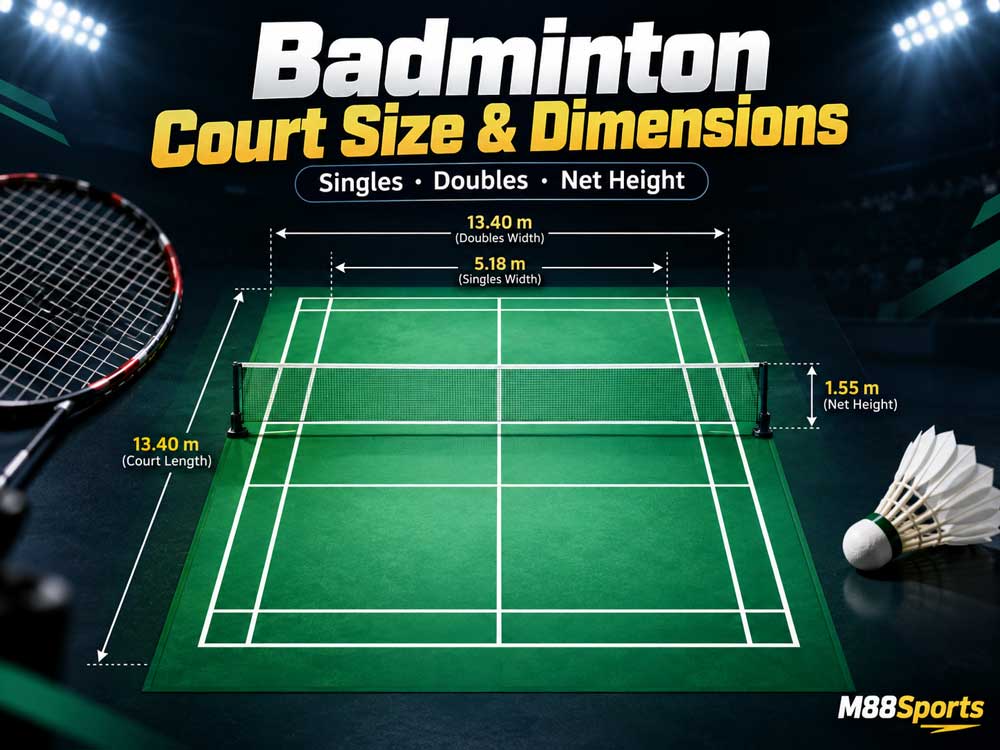
How big is a badminton court? The official full court measures 13.4 m long × 6.1 m wide (44 × 20 ft) for doubles. Singles uses the same length but only 5.18 m (17 ft) of width. Knowing the difference matters because the legal service box is not the same as the legal rally area.
This practical guide explains official BWF badminton court measurements in metres and feet, how singles and doubles lines work, net height, and real in-or-out situations. The measurements follow BWF Laws of Badminton, Law 1 and Diagram A.
Badminton Court Dimensions at a Glance
A regulation badminton court is 13.40 metres (44 feet) long. Its outer doubles sidelines are 6.10 metres (20 feet) apart, while the singles sidelines are 5.18 metres (17 feet) apart. Both formats use the same full court length.
| Measurement | Metres | Feet / inches |
|---|---|---|
| Full court length | 13.40 m | 44 ft |
| Doubles court width | 6.10 m | 20 ft |
| Singles court width | 5.18 m | 17 ft |
| Each doubles side alley | 0.46 m | about 1 ft 6 in |
| Net to short service line | 1.98 m | 6 ft 6 in |
| Back boundary to doubles long service line | 0.76 m | about 2 ft 6 in |
| Net height at centre | 1.524 m | 5 ft |
| Net height at doubles sidelines/posts | 1.55 m | about 5 ft 1 in |
| Line width | 0.04 m (40 mm) | about 1.6 in |
Quick rule: All the marked lines belong to the areas they define. If a shuttle touches a valid boundary line, it is in.
Singles vs Doubles: Which Court Lines Count?
The biggest misconception is that a singles court is shorter. It is not. Singles and doubles both use the full 13.40 m length once a rally has started. The difference is the width.
- Singles rally: the inner sidelines and the back boundary line are in.
- Doubles rally: the outer sidelines and the same back boundary line are in.
- Singles serve: the shuttle must land in the diagonally opposite service court, between the short service line and the back boundary, inside the singles sideline.
- Doubles serve: the diagonally opposite service box extends to the outer doubles sideline but stops at the doubles long service line, 0.76 m before the back boundary.
That is why players sometimes describe doubles serving as short and wide and singles serving as long and narrow. These descriptions apply to service boundaries, not the full rally boundaries.
Understanding Every Line on a Badminton Court
Back boundary line
The line at each end is the rear boundary for singles and doubles rallies. It is also the rear service boundary for singles.
Singles sidelines
The two inside vertical lines mark the court width in singles. A shuttle landing beyond them is out during singles, even if it would be in for doubles.
Doubles sidelines
The outer vertical lines mark the full 6.10 m width. They count in doubles rallies and doubles serves.
Short service line
Each short service line is 1.98 m from the net. A serve must cross into the opposite diagonal service area and may land on this line, but not short of it.
Centre line
The centre line divides the left and right service courts. It determines which diagonal service box is correct; it does not divide the court during normal rallies.
Doubles long service line
This is the line parallel to and 0.76 m inside each back boundary. It is the rear limit only for doubles serves. During doubles rallies, shots may land all the way to the back boundary.
A Simple Court-Line Decision Guide
| Situation | In or out? | Why |
|---|---|---|
| Singles rally lands on inner sideline | In | It is the singles boundary. |
| Singles rally lands in side alley beyond inner sideline | Out | The alley is doubles-only. |
| Doubles rally lands on outer sideline | In | The outer line marks doubles width. |
| Doubles serve lands beyond doubles long service line | Fault | It passes the rear service limit. |
| Doubles rally lands between doubles long service line and back boundary | In | The rear limit disappears after service. |
| Any valid serve lands on short service line | In | The line is part of its service area. |
Remember: A line is not always “in” merely because it is painted on the floor. It must be the boundary for the particular format and moment of play.
Badminton Net Height and Post Placement
Under the BWF Laws of Badminton, the top of the net is 1.524 m above the court at the centre and 1.55 m over the doubles sidelines. The posts themselves are 1.55 m tall.
Net posts are placed on the doubles sidelines even when singles is played. The net must cover the width of the court without gaps at the posts. Because the top cable is tensioned, the centre may be slightly lower than the ends; that difference is reflected in the official measurements.
For an accurate layout, measure the court and net from the finished playing surface, not from a nearby raised floor or mat edge.
How Much Floor Area Does a Badminton Court Need?
The marked doubles court occupies 81.74 square metres (13.4 × 6.1). The area inside the singles sidelines is about 69.41 square metres (13.4 × 5.18). These figures describe the painted playing rectangles, not the total floor area needed for a safe facility.
Real courts require extra unobstructed run-off around the sidelines and baselines, plus suitable overhead clearance, lighting and flooring. Do not build a hall based on the 13.4 × 6.1 m rectangle alone. Venue requirements vary by competition level and governing-body facility standards; check the requirements for your project before construction.
How to Read a Badminton Court Diagram
Start with the outer rectangle: that is the doubles rally court, 13.4 m by 6.1 m. Move inward 0.46 m on each side to find the singles sidelines. Locate the net across the centre, splitting the full length into two 6.7 m halves.
On each side of the net, the first horizontal marking is the short service line, 1.98 m from the net. Near each rear boundary is a second horizontal marking, the doubles long service line, 0.76 m before the back edge. The centre line divides each side into left and right diagonal service courts.
Common Badminton Court Mistakes to Avoid
- Using the back boundary for doubles serves: a doubles serve that goes past the doubles long service line is out, even if it lands inside the back boundary.
- Using the doubles sideline in singles: the side alley is out in singles.
- Thinking the service centre line splits rallies: it determines the diagonal serving box, not where players can hit after the return.
- Measuring the net to the wrong height: use 1.524 m at centre and 1.55 m at the doubles sidelines.
- Leaving no surrounding space: the painted court is only part of the playing facility.
If you are learning the sport for the first time, understanding the different line functions is often more useful than memorising all the measurements immediately.
Frequently Asked Questions
A standard doubles badminton court is 13.40 m long and 6.10 m wide (44 × 20 ft). Singles uses the same length and a width of 5.18 m (17 ft).
No. Both use the full 13.40 m length during rallies. Singles is narrower, using the inner sidelines.
The top of the net is 1.524 m at the centre and 1.55 m at the doubles sidelines.
Yes. A shuttle landing on a line is in when that line is the valid boundary for the format and phase of play.
It limits how far a doubles serve may travel. It is 0.76 m inside the back boundary and does not restrict ordinary doubles rally shots.
It is 1.98 m (6 ft 6 in) from the net on each side. The shuttle must land on or beyond it within the correct service court.
