


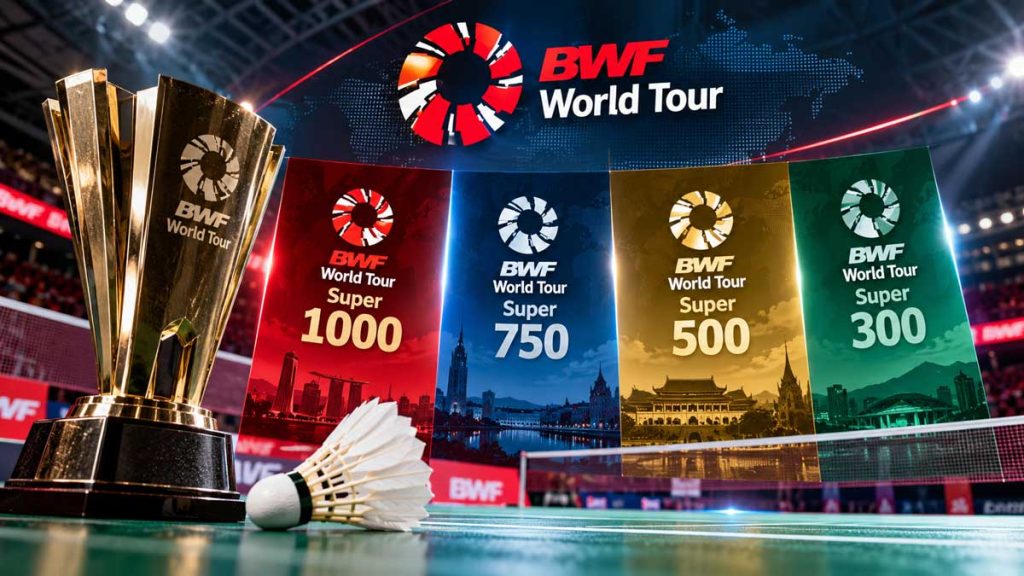
The BWF World Tour is badminton’s season-long circuit of international tournaments, but not every event carries the same weight. Super 1000, Super 750, Super 500 and Super 300 are different tournament levels, with higher tiers offering more ranking points and generally larger prize funds.
Understanding this hierarchy makes rankings, seedings and the race to the season-ending BWF World Tour Finals much easier to follow. If you are new to watching tournament play, start with our badminton service rules for singles and doubles to follow service order and faults during matches. This evergreen guide explains what each level means, how many ranking points players can earn, how World Tour ranking differs from World Ranking, and how qualification for the Finals works. For the upcoming match-format change, our 3×15 badminton scoring guide compares the approved 2027 rules with 21-point games.
Across these tournaments, competitors play on the same regulation court, but singles and doubles have different boundary and service lines. Our badminton court dimensions guide explains the markings and official measurements.
BWF World Tour levels at a glance
The hierarchy runs from the season-ending World Tour Finals at Level 1 through Super 1000, Super 750, Super 500 and Super 300 tournaments. BWF also sanctions Super 100 events below the main five-level structure.
| Level | Category | Winner’s ranking points | Role |
|---|---|---|---|
| Level 1 | World Tour Finals | Up to 12,000* | Season-ending event for qualified players and pairs |
| Level 2 | Super 1000 | 12,000 | Highest regular World Tour tier |
| Level 3 | Super 750 | 11,000 | Major elite-level tournaments |
| Level 4 | Super 500 | 9,200 | High-value World Tour events |
| Level 5 | Super 300 | 7,000 | Core World Tour events with fewer points than higher tiers |
| Level 6 | Super 100 | 5,500 | Tier below the main World Tour levels |
*World Tour Finals points depend on results across the group and knockout stages.
Super 1000 vs Super 750 vs Super 500 vs Super 300
The number in a tournament’s name identifies its category; it is not the number of ranking points awarded to the winner. A Super 1000 champion, for example, earns 12,000 ranking points rather than 1,000.
A Super 750 winner earns 11,000 points, a Super 500 winner 9,200 and a Super 300 winner 7,000. Over a full season, that difference makes deep runs at the biggest tournaments particularly valuable for world ranking, seeding and the World Tour race.
How many ranking points do players earn?
Points decrease according to both tournament level and finishing position. A player therefore does not need to win an event to collect significant ranking value; a semifinal or quarterfinal at a higher-level tournament can still be worth more than a similar finish at a lower tier.
| Level | Winner | Runner-up | Semifinal | Quarterfinal |
|---|---|---|---|---|
| Super 1000 | 12,000 | 10,200 | 8,400 | 6,600 |
| Super 750 | 11,000 | 9,350 | 7,700 | 6,050 |
| Super 500 | 9,200 | 7,800 | 6,420 | 5,040 |
| Super 300 | 7,000 | 5,950 | 4,900 | 3,850 |
| Super 100 | 5,500 | 4,680 | 3,850 | 3,030 |
This is also why counting titles alone can be misleading when comparing seasons. A player with several lower-tier titles may collect less ranking value than another player consistently reaching the closing rounds of Super 750 and Super 1000 events.
World Ranking vs World Tour Ranking: what’s the difference?
BWF World Ranking measures a player’s or pair’s broader international ranking using eligible results under the BWF ranking system. It affects areas including tournament entry and seeding.
BWF World Tour Ranking, often described as the Race to Finals, tracks the season-long results used to determine qualification for the BWF World Tour Finals.
The two are related, but they are not interchangeable. A player can hold a strong World Ranking while occupying a different position in the current World Tour race.
How do players qualify for the BWF World Tour Finals?
The season-ending Finals feature eight eligible players or pairs in each discipline: men’s singles, women’s singles, men’s doubles, women’s doubles and mixed doubles.
Qualification is not simply a matter of reading the raw top eight. A maximum of two players or pairs from the same BWF Member can qualify in one event. Regulations also provide special consideration for reigning World Champions in a non-Olympic year, or reigning Olympic champions in an Olympic year, subject to the applicable conditions.
For the live season-specific picture, including standings and players around the cutoff, see our BWF World Tour Finals 2026 qualification guide.
What happens if players are tied in the World Tour race?
BWF regulations include tie-breaking procedures for World Tour Finals qualification. When players or pairs finish level on World Tour Ranking points, participation across World Tour tournaments is considered first. Further tie-breaking criteria can then apply, including points earned during the latter part of the season.
That makes participation and late-season results important even when two contenders appear level on total points.
Does a higher BWF level mean more prize money?
Generally, higher World Tour tiers carry larger minimum prize-money requirements and greater ranking rewards. Exact purses, however, can vary by tournament and edition, so the current tournament prospectus is the best source for a specific event’s prize fund.
Prize money and ranking points are separate systems. Ranking points depend on tournament grade and finishing position, while cash earnings depend on the event’s prize distribution. Our badminton prize money guide explains how BWF tournament purses are divided across singles, doubles and finishing positions, with real 2026 examples.
For the earnings side of the sport, compare our guide to the highest-paid badminton players and career prize-money leaders.
Why tournament level matters for players
A tournament’s level affects ranking opportunity, potential prize money, field strength and often a player’s scheduling decisions. Higher tiers provide more points, but they also tend to attract deeper elite fields. Lakshya Sen’s 2026 All England runner-up run is a useful example of how a deep finish at an elite event can materially affect both ranking value and earnings; see our Lakshya Sen prize money and earnings breakdown for the player-level context.
A developing player may see a Super 300 as a major opportunity to collect points and climb the rankings, while an established contender may build much of the season around Super 750 and Super 1000 events. Scheduling, recovery and ranking needs therefore become part of the competitive strategy.
Why the World Tour system matters for fans
Once the hierarchy is clear, individual results become easier to put into context. Every title matters, but not every title carries identical ranking value.
The system also creates a season-long storyline: players chase tournament trophies while simultaneously building their World Ranking and accumulating the results needed to reach the World Tour Finals.
That is why the final months of a season can produce meaningful qualification battles before the Finals themselves even begin.
BWF World Tour FAQ
Super 1000 is the highest regular tournament tier. The season-ending BWF World Tour Finals is classified separately as Level 1.
No. Super 1000 is the tournament category. A winner receives 12,000 world-ranking points under the BWF points table.
Eight eligible players or pairs are invited in each of the five disciplines, subject to the applicable qualification rules and Member limits.
No. World Ranking is the broader international ranking system, while World Tour Ranking tracks the season-long race used for World Tour Finals qualification.
Yes. A Super 750 winner receives 11,000 ranking points compared with 9,200 for a Super 500 winner.
You Might Also Be Interested in Reading
- BWF World Tour Finals 2026 Qualification: Race to Finals Standings, Rules & Who Can Still Qualify
- Highest-Paid Badminton Players 2026: Who Has Earned the Most Prize Money?
- Richest Badminton Players in the World
- Richest Female Badminton Players in the World 2026
- Top 10 Badminton Matches of All Time: Legendary Showdowns
