


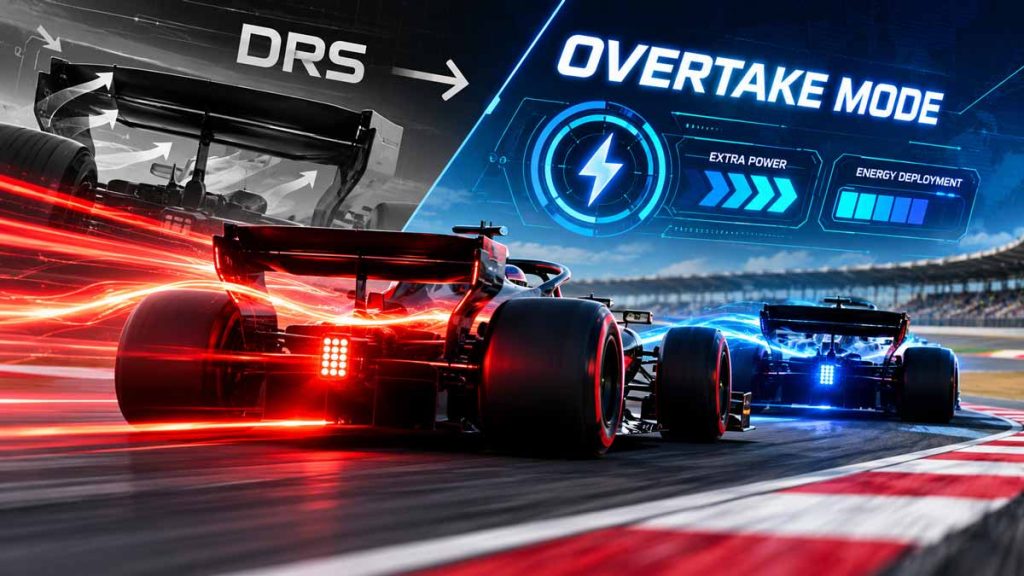
Formula 1’s DRS era is over. For 2026, F1 introduced a new overtaking system built around electrical energy rather than a rear-wing advantage reserved only for a chasing car.
The headline tool is Overtake Mode. When a driver is close enough to the car ahead at the detection point, the system gives the chasing car access to additional electrical energy on the following lap. But Overtake Mode is only one part of a much bigger change: the 2026 cars also use Active Aero, a Boost function and new Recharge strategies.
That can make the terminology confusing. This guide separates the systems, explains how Overtake Mode works, and shows why circuits with long straights — including Sepang — can make the new system especially important.
F1 2026 Overtake Mode at a glance
| Question | Answer |
|---|---|
| What replaced DRS? | Overtake Mode is the principal overtaking aid, while Active Aero separately reduces drag. |
| Who can use Overtake Mode? | A chasing driver who meets the required gap at the designated detection point. |
| What is the usual detection gap? | Less than one second behind the car ahead. |
| When can the advantage be used? | On the following lap after qualifying at the detection point. |
| What does it provide? | An additional electrical deployment profile plus up to 0.5 MJ of additional energy harvesting under the regulations. |
| Is Active Aero the new DRS? | No. Active Aero is available independently of the one-second overtaking condition at designated zones; Overtake Mode is the chasing-car overtaking aid. |
What is F1 Overtake Mode?
Overtake Mode is a 2026 power-unit function designed to give a following car an electrical advantage when it is sufficiently close to a rival.
Under the system, a driver who is within the permitted gap at the detection point gains access to the Overtake function on the following lap. Rather than simply opening a wing flap, the advantage comes through electrical energy and power deployment.
The system allows additional energy harvesting of up to 0.5 MJ and a different electrical power profile, helping the attacking car sustain higher power and speed further along a straight.
This is important because the normal electrical deployment of a 2026 car reduces as speed rises. Overtake Mode changes that deployment profile for the eligible chasing car, creating a potential speed difference at precisely the point where a pass may be developing.
Why did F1 replace DRS?
DRS had been part of Formula 1 since 2011. When an eligible driver reached a DRS zone, a flap in the rear wing opened, reducing aerodynamic drag and increasing straight-line speed.
The 2026 regulations changed the concept because the cars now use movable aerodynamic elements as part of their normal operation. Both front and rear wings can reduce drag in designated straight-line zones, so opening a rear wing can no longer serve as the exclusive advantage given to a chasing driver.
That separated two jobs that DRS previously combined: reducing drag is now handled by Active Aero, while helping a chasing car attack is handled primarily by Overtake Mode.
Overtake Mode vs DRS: what’s actually different?
| Old DRS | 2026 Overtake Mode |
|---|---|
| Aerodynamic overtaking aid | Electrical power and energy-based overtaking aid |
| Opened part of the rear wing | Changes available electrical deployment for an eligible attacker |
| Used in specified DRS zones | Eligibility is determined at a detection point and the advantage is available on the following lap |
| Chasing driver generally needed to be within one second | A detection-gap requirement still determines normal race eligibility |
| Reduced drag to increase speed | Helps sustain electrical power and speed for longer |
The biggest conceptual change is therefore not simply that F1 renamed DRS. The source of the overtaking advantage changed from aerodynamics to electrical energy deployment.
Active Aero is not the same as Overtake Mode
This is the distinction most likely to confuse new viewers.
The 2026 cars use movable front and rear wing elements. In designated straight-line sections, the wings can move into a lower-drag configuration. In corners, they return to the higher-downforce configuration needed for grip.
Unlike old race DRS, a driver does not need to be within one second of another car simply to use the normal Active Aero system. Its primary purpose is efficiency: reducing drag helps the new power units manage their much greater electrical demands.
Overtake Mode is different. It is the additional advantage granted to an eligible chasing car to help create a pass.
What is the F1 Boost button — and is it Overtake Mode?
No. Boost and Overtake Mode are related to electrical deployment, but they are not interchangeable terms.
The Boost function allows a driver to manually call on available electrical energy according to the permitted power-unit settings. A driver may use that stored energy tactically — for example to attack, defend, or deploy it where it produces the greatest lap-time benefit.
Overtake Mode, meanwhile, is conditional. The chasing car first has to satisfy the relevant detection-gap requirement to gain the additional overtaking allowance.
This creates a strategic question that did not exist in quite the same way with DRS: where should the driver spend the available electrical advantage?
How Recharge changes the battle
Electrical energy cannot be deployed indefinitely. The 2026 cars also need to recover energy, or Recharge, during a lap.
Energy can be recovered under braking and in other permitted operating conditions. Teams and drivers therefore have to consider not only where additional power is useful, but how their battery state will affect later parts of the lap.
That makes an overtaking battle more than a one-corner event. A driver may sacrifice performance in one section to improve the electrical situation for a later attack, while the defending car can use its own Boost deployment to make the pass more difficult.
Does the one-second rule still exist?
Yes, in normal race operation the familiar idea remains: Overtake Mode eligibility is determined by the gap between cars at a designated detection line.
The important difference is what happens after eligibility is earned. Previously, being within the threshold unlocked DRS use in the relevant zones. With the 2026 system, it unlocks the additional Overtake electrical allowance for the following lap.
That means viewers should pay attention not only to the gap approaching a straight, but also to the detection point that determines whether a driver will have the extra tool available on the next lap.
Why long straights matter more for Overtake Mode
The advantage becomes particularly interesting on circuits where cars spend a long time accelerating at high speed. The longer the straight, the more opportunity there is for a difference in electrical deployment to help the chasing car close the gap before braking.
But the pass still depends on much more than pressing a button. Corner exit, aerodynamic efficiency, battery state, tyre grip, positioning and the defending driver’s own energy use can all influence whether the attacker actually gets alongside.
Why Sepang could be a fascinating Overtake Mode test
Sepang International Circuit has two major straights ending in heavy braking zones, particularly the approaches to Turns 15 and 1. That combination makes it a natural place to study how Overtake Mode changes attack and defence. Malaysia’s tropical conditions can change that equation quickly, so our Sepang F1 weather guide explains how heat, rain and changing grip can affect the race.
An attacker may need to decide whether to commit electrical energy on the back straight toward Turn 15, preserve some for the main straight toward Turn 1, or use the threat of one move to set up another.
Our Sepang F1 2026 track guide breaks down those overtaking areas, the circuit’s fast sections and why the new-generation cars could behave differently from the machines that last raced there in 2017. For the complete October 2–4 timetable and what to watch across each session, see the Bahrain GP in Malaysia 2026 weekend guide.
For context on why Formula 1 is racing at Sepang in 2026 under the Bahrain Grand Prix name, see our explainer on why the Bahrain Grand Prix is being held in Malaysia.
What fans should watch during an Overtake Mode battle
- The detection gap: did the chasing car qualify for Overtake Mode?
- Corner exit: extra electrical power cannot fully rescue a poor launch onto the straight.
- Deployment timing: watch where the attacker begins to close rapidly.
- Defensive Boost: the leading driver may have stored energy available too.
- The next straight: spending energy now can affect the next attack or defence.
- Braking position: the electrical advantage still has to be converted into track position.
This is why the 2026 system can create a different viewing experience from DRS. The visible pass may happen at one braking zone, but the energy decisions that created it can begin much earlier in the lap.
F1 2026 Overtake Mode FAQ
Yes. The traditional DRS system is no longer used. Active Aero now handles drag reduction in designated zones, while Overtake Mode provides the conditional overtaking assistance for a chasing car.
An eligible chasing driver gains an additional electrical energy and deployment allowance after meeting the required gap at a detection point. The advantage is available on the following lap and can help the car sustain higher power and speed for longer.
Under normal race activation rules, the chasing car must be inside the prescribed detection gap, normally one second, at the designated detection line.
No. Active Aero changes front and rear wing configuration to reduce drag on designated straights and is not the conditional overtaking advantage. Overtake Mode provides additional electrical assistance to an eligible chasing car.
Boost lets a driver manually influence available electrical deployment for tactical purposes. Overtake Mode provides an additional allowance when the car has met the required chasing-car eligibility conditions.
A longer straight gives the electrical deployment difference more time to affect closing speed, which can help an attacker reach a braking zone close enough to attempt a pass.
