


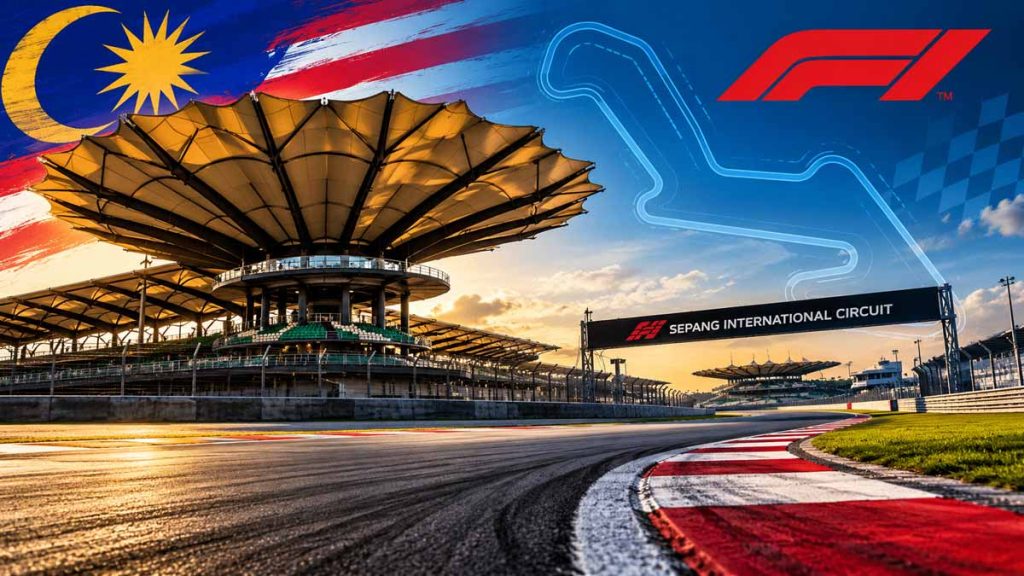
Formula 1 is returning to Sepang in 2026, but not in the way most fans expected. The 5.543-kilometre Sepang International Circuit will host the Formula 1 Gulf Air Bahrain Grand Prix in Malaysia from October 2–4, bringing F1 back to the Malaysian track for the first time since 2017.
The return is especially intriguing because Sepang will meet a very different generation of Formula 1 car. The 2026 rules introduced lighter cars, active aerodynamics, much greater electrical deployment and a new Overtake Mode in place of the old DRS overtaking system.
That combination could make Sepang an ideal test of the new regulations. Long straights reward efficiency and energy deployment, heavy braking zones create passing opportunities, fast direction changes demand aerodynamic stability, and Malaysia’s heat and sudden rain can turn strategy upside down.
This guide explains the circuit, the key overtaking areas and why the characteristics of the 2026 cars could make Formula 1’s return to Sepang very different from its last visit nine years ago.
Sepang F1 2026 at a glance
| Detail | 2026 Bahrain Grand Prix in Malaysia |
|---|---|
| Race weekend | October 2–4, 2026 |
| Circuit | Sepang International Circuit |
| Location | Sepang, Malaysia |
| Circuit length | 5.543 km |
| Race distance | 310.418 km |
| Race laps | 56 |
| Number of corners | 15 |
| First Formula 1 Grand Prix at Sepang | 1999 |
| Previous F1 race at Sepang | 2017 Malaysian Grand Prix |
| Official 2026 event name | Formula 1 Gulf Air Bahrain Grand Prix in Malaysia |
The unusual event name matters. Formula 1 has not simply reinstated the Malaysian Grand Prix. Malaysia is hosting the Bahrain Grand Prix at Sepang after the originally scheduled Bahrain race could not take place in April. For the full background, see our guide explaining why the Bahrain Grand Prix is being held in Malaysia.
Why is the Bahrain Grand Prix being held at Sepang?
The 2026 Bahrain and Saudi Arabian Grands Prix did not take place in their original April slots. Formula 1 and the FIA later announced that the Bahrain Grand Prix would be preserved by staging the event at Sepang International Circuit from October 2–4.
That creates an unusual entry in Formula 1 history: a Grand Prix carrying Bahrain’s event identity but raced in Malaysia.
For fans searching for the “Malaysia Grand Prix 2026” or “Sepang F1 2026,” this is the race they are looking for, even though the official title remains the Formula 1 Gulf Air Bahrain Grand Prix in Malaysia.
What makes Sepang such a complete Formula 1 circuit?
Sepang was one of the first modern circuits designed by Hermann Tilke, but its layout is very different from the stop-start character associated with some later purpose-built tracks.
The circuit mixes two long straights with slow hairpins, medium-speed corners and fast flowing changes of direction. Its width also gives drivers more freedom to choose alternative racing lines.
That creates an unusually broad engineering challenge. A car needs enough downforce to remain stable through the faster corners, but carrying too much drag can leave it vulnerable on the straights. Strong braking, traction and tyre management matter as well.
Sepang therefore exposes weaknesses that may be less obvious at circuits dominated by only one type of corner.
A lap of Sepang: the sections that matter most
Turns 1 and 2: braking, positioning and traction
The long run down the main straight ends at the opening right-hander. Turn 1 immediately feeds into the tighter Turn 2, creating a sequence where a driver can attack under braking but still needs to position the car correctly for the exit.
A compromised Turn 2 exit can hurt acceleration toward the next section, so winning the braking battle is only part of the job.
Turn 4: another braking opportunity
Turn 4 provides another slower corner after an acceleration zone. It can reward a driver who gets a strong launch from the preceding section and is confident enough to attack under braking.
Turns 5 and 6: Sepang’s high-speed test
The sweeping left-right sequence through Turns 5 and 6 is one of Sepang’s defining sections. Here the challenge shifts away from straight-line speed toward aerodynamic balance, commitment and the ability to change direction without unsettling the car.
This section should be particularly revealing for the more compact 2026 cars.
Turns 7 and 8: keeping momentum
The double-right sequence requires precision and a stable platform. A small mistake can compromise momentum into the following part of the lap.
Turn 15: the final hairpin
The long back straight ends at the final hairpin, making Turn 15 one of the circuit’s clearest passing opportunities. The exit is equally important because it launches the car onto the main straight and toward another major braking zone at Turn 1.
Where are the best overtaking opportunities at Sepang?
Turn 1 and Turn 15 should remain the two headline passing areas. Both follow long full-throttle sections and end in relatively slow corners where braking performance and positioning can make a substantial difference.
But overtaking in 2026 is more complicated than identifying old DRS zones. DRS is no longer the main overtaking tool. The new cars use active aerodynamics on designated straights, while an attacking driver within the required gap can gain access to Overtake Mode for additional electrical deployment.
Sepang’s long straights could make that especially important. Formula 1’s own explanation of the 2026 system notes that the speed advantage from Overtake Mode should become more effective on longer straights. For a full breakdown of the system, including Active Aero, Boost and the one-second eligibility rule, read our F1 2026 Overtake Mode explained guide.
That means a driver may have to think beyond a single braking point. Energy saved or deployed earlier in the lap could influence whether the car is in position to attack at Turn 15 or Turn 1.
Why the 2026 F1 cars could transform racing at Sepang
Comparing the 2026 race directly with Sepang’s previous Formula 1 era can be misleading because the cars now operate under a fundamentally different technical philosophy.
1. Active aerodynamics should suit Sepang’s long straights
The 2026 cars can change the configuration of their front and rear wings between higher-downforce Corner Mode and lower-drag Straight Mode in defined zones.
At Sepang, that creates an obvious benefit: teams can seek cornering performance for sections such as Turns 5 and 6 while reducing drag on the major straights.
The difficult part is finding a car balance that remains predictable when transitioning between those demands.
2. Electrical energy becomes part of the overtaking battle
The 2026 power units place much greater emphasis on electrical power. Drivers also have tools including Boost and Overtake Mode that affect how stored energy is deployed.
At a circuit with multiple acceleration zones and two major straights, energy management could influence both attacking and defending. A driver who uses too much electrical energy in one part of the lap may be exposed later.
3. Overtake Mode replaces the old DRS battle
In previous Formula 1 eras at Sepang, fans could largely identify overtaking assistance by looking at the DRS zones. In 2026, the aerodynamic and electrical systems have different roles.
Active aero reduces drag on designated straights for the cars generally, while Overtake Mode gives an eligible chasing driver an additional electrical advantage.
That could make the tactical setup to a pass more important than simply waiting for a rear wing to open.
4. Smaller, lighter cars may change the fast sections
The 2026 regulations reduced car dimensions and targeted a lower minimum weight compared with the previous generation. The intention was to create more agile machinery.
Sepang provides several places to test whether that philosophy translates into better racing, particularly through its faster direction changes and when drivers follow another car through the middle sector.
The Sepang setup compromise
A perfect Sepang setup does not exist because improving one part of the lap can create a weakness somewhere else.
| Car characteristic | Why it matters at Sepang |
|---|---|
| Low drag | Important on the long main and back straights |
| High-speed stability | Critical through fast sections such as Turns 5–6 |
| Braking stability | Needed for attacks and defence into Turns 1 and 15 |
| Traction | Strong exits matter after the slower corners |
| Tyre management | Heat and sustained cornering loads can punish tyres |
| Energy management | Electrical deployment can affect attack and defence across the lap |
The 2026 active-aero system helps reduce some of the traditional drag-versus-downforce compromise, but it does not eliminate setup choices. Mechanical grip, ride behaviour, tyre temperatures and energy usage still have to work across a very varied lap.
Malaysia’s biggest wildcard: heat, humidity and rain
Sepang’s tropical climate has always been part of its Formula 1 identity. High temperatures and humidity place additional demands on drivers and machinery, while heavy rain can arrive quickly.
For teams, that can complicate tyre preparation and cooling. For drivers, changing grip levels can transform braking points and racing lines within minutes.
Rain is particularly significant at Sepang because the circuit’s width creates multiple possible lines. In wet or drying conditions, the conventional racing line may not always offer the most grip.
Weather therefore has the potential to override almost every pre-race assumption about setup, tyre strategy and overtaking. Our Sepang F1 weather guide explains how Malaysia’s heat, humidity and tropical rain can affect tyres, cooling, wet-weather grip and race strategy.
What’s changed since F1 last raced at Sepang in 2017?
Formula 1’s previous Sepang race took place in 2017. Nine years later, the circuit may be familiar, but the championship arriving in Malaysia is not.
| 2017-era Formula 1 | 2026 Formula 1 |
|---|---|
| DRS used as the principal overtaking aid | Active aero plus electrical Overtake Mode |
| Less emphasis on electrical deployment | Much larger electrical contribution from the power unit |
| Larger cars than the new 2026 dimensions | Regulations designed around smaller, more agile cars |
| Different aerodynamic philosophy | Front and rear active aerodynamic elements |
| Sepang was the Malaysian Grand Prix | Sepang hosts the Bahrain Grand Prix in Malaysia |
For that reason, historical Sepang results can tell us about the circuit’s character, but they cannot reliably predict how the 2026 cars will race there.
2026 Bahrain Grand Prix in Malaysia schedule
All times below are local Malaysian time (MYT, UTC+8). The official timetable remains subject to change.
| Date | Session | Local time |
|---|---|---|
| Friday, October 2 | Practice 1 | 12:30–13:30 |
| Friday, October 2 | Practice 2 | 16:00–17:00 |
| Saturday, October 3 | Practice 3 | 12:30–13:30 |
| Saturday, October 3 | Qualifying | 16:00–17:00 |
| Sunday, October 4 | Race | 15:00 |
The Grand Prix is scheduled for 56 laps, or a maximum race duration under the applicable Formula 1 rules. For the complete race-week timetable, Malaysia start times and session-by-session preview, see our Bahrain GP in Malaysia 2026 weekend guide.
What should fans watch when the cars finally hit Sepang?
Practice will give the first meaningful evidence of how this generation of Formula 1 car behaves around Sepang. Rather than focusing only on headline lap times, several details should be revealing.
- Straight-line deployment: watch where cars gain or lose speed toward Turns 1 and 15.
- Turns 5–6: this should expose differences in aerodynamic balance and driver confidence.
- Following performance: Sepang will show whether cars can remain close through the faster sections before attacking on the straights.
- Tyre behaviour: Malaysia’s temperatures may produce different degradation patterns from recent races.
- Overtake Mode: the two long straights should provide a useful demonstration of how the new system changes attack and defence.
- Weather: even a short rain shower can completely change the competitive picture.
Those factors are why Sepang is more than a nostalgic return. It arrives at a useful moment for judging how Formula 1’s new technical era performs on one of the most varied circuits on the calendar.
Sepang F1 2026 FAQ
Yes. Formula 1 will race at Sepang International Circuit from October 2–4, 2026, marking the championship’s first race at the Malaysian circuit since 2017.
Not officially. The event is named the Formula 1 Gulf Air Bahrain Grand Prix in Malaysia. Malaysia is hosting the Bahrain Grand Prix at Sepang.
The Bahrain Grand Prix did not take place in its original April slot. Formula 1, the FIA and the relevant parties later agreed to preserve the event by staging it at Sepang in October.
The race weekend runs from October 2–4, with the Grand Prix scheduled to start at 15:00 local Malaysian time on Sunday, October 4.
Sepang is 5.543 kilometres long. The 2026 Grand Prix is scheduled for 56 laps and a race distance of 310.418 kilometres.
Turns 1 and 15 are the most obvious overtaking areas because both follow long straights and involve heavy braking. The 2026 Overtake Mode and electrical deployment could change how drivers prepare those attacks.
The old DRS system has been replaced. The 2026 cars use active aerodynamics in defined straight-line zones, while Overtake Mode provides eligible chasing drivers with an additional electrical advantage.
Before the 2026 return, Formula 1 last raced at Sepang in 2017, when the circuit hosted the Malaysian Grand Prix.
