


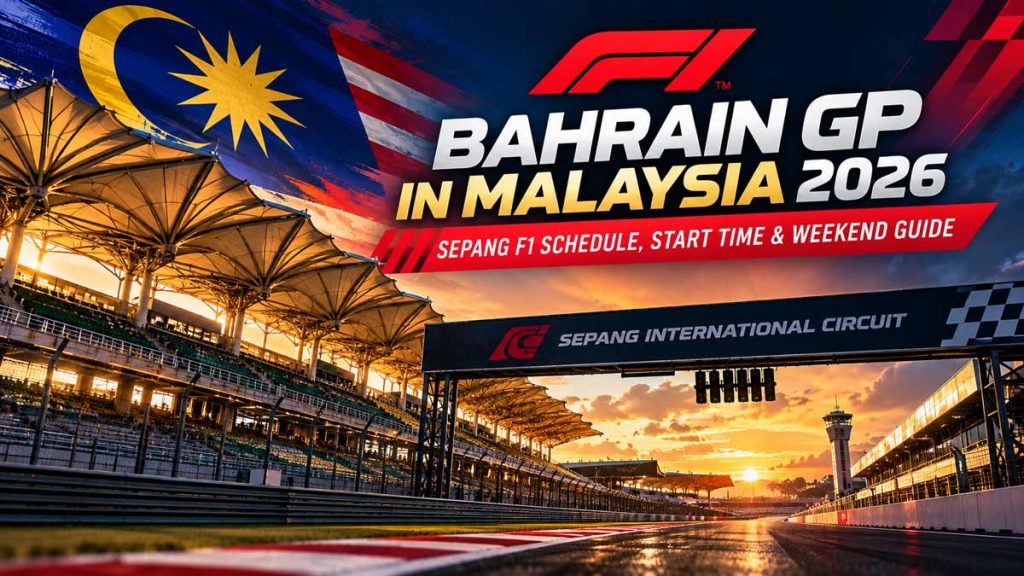
Formula 1 returns to Sepang from October 2-4, 2026, but this unusual race is officially the Formula 1 Gulf Air Bahrain Grand Prix in Malaysia. For Malaysian fans, the key number is 3:00 PM MYT on Sunday, October 4: that is when the 56-lap Grand Prix is scheduled to start.
This race-week guide brings the practical information together in one place: the full F1 timetable in Malaysia time, Sepang circuit facts, what to watch in practice and qualifying, and the track, weather and 2026-car factors that could shape Sunday.
Bahrain GP in Malaysia 2026 at a glance
| Event | Formula 1 Gulf Air Bahrain Grand Prix in Malaysia 2026 |
|---|---|
| Dates | October 2-4, 2026 |
| Circuit | Sepang International Circuit |
| Race start | Sunday, October 4 at 3:00 PM MYT |
| Laps | 56 |
| Circuit length | 5.543 km |
| Race distance | 310.398 km |
| Previous F1 race at Sepang | 2017 |
The event sits between Azerbaijan and Singapore on the 2026 Formula 1 calendar, creating a demanding run of races before the championship heads onward to the United States.
2026 Bahrain GP Malaysia schedule and start times
The timetable below uses Malaysia Time (MYT, UTC+8). Formula 1 notes that session times remain subject to change, so fans should check the official timetable again on race weekend.
| Date | F1 session | Malaysia time |
|---|---|---|
| Friday, October 2 | Free Practice 1 | 12:30 PM – 1:30 PM |
| Friday, October 2 | Free Practice 2 | 4:00 PM – 5:00 PM |
| Saturday, October 3 | Free Practice 3 | 12:30 PM – 1:30 PM |
| Saturday, October 3 | Qualifying | 4:00 PM – 5:00 PM |
| Sunday, October 4 | Grand Prix | 3:00 PM |
The Sunday race is scheduled for 56 laps or a maximum of 120 minutes under the published weekend timetable.
What time does the Sepang F1 race start in Malaysia?
The 2026 Bahrain Grand Prix in Malaysia is scheduled to start at 3:00 PM Malaysia Time on Sunday, October 4. The drivers’ parade is scheduled for 1:00 PM, with the national anthem shortly before the race.
That afternoon start matters at Sepang. Temperatures, track temperature and the possibility of tropical rain can all evolve quickly through the afternoon, so the conditions seen earlier in the weekend may not perfectly represent race conditions.
Our dedicated Sepang F1 weather guide explains how Malaysia’s heat, humidity and sudden rain can affect tyres, cooling and strategy.
Why is the Bahrain Grand Prix being held at Sepang?
This is not officially a revival of the Malaysian Grand Prix. Formula 1 and the FIA arranged for Malaysia to host the Bahrain Grand Prix at Sepang after the originally scheduled Bahrain event could not take place in April amid regional circumstances.
The result is an unusual event identity: Bahrain retains the Grand Prix while Sepang provides the circuit and Malaysia hosts the weekend. Formula 1 returns to the venue for the first time since 2017.
For the full background, read why the Bahrain Grand Prix is being held in Malaysia in 2026.
Sepang circuit: the numbers that matter
Sepang is a 5.543 km circuit built around long straights, heavy braking zones and fast direction changes. The width of the track gives drivers more freedom to choose different lines than at many modern circuits, while the combination of straights and high-speed corners makes car setup a compromise.
- 56 laps: the scheduled race distance.
- 310.398 km: total Grand Prix distance.
- Turns 5 and 6: a fast sequence that rewards stability and driver confidence.
- Turn 15: the final hairpin and one of the circuit’s major braking and passing areas.
- Long straights: straight-line efficiency and the 2026 overtaking systems can become important.
For corner-by-corner context and the main passing areas, see our Sepang F1 2026 track guide.
What to watch in Friday practice
Sepang has not hosted a Formula 1 Grand Prix since 2017, and the 2026 cars are fundamentally different from the machinery that raced here nine years earlier. That makes Friday particularly useful.
FP1 should reveal baseline setup choices. Teams need to understand ride behaviour, cooling requirements, braking stability and how the cars respond through Sepang’s faster corners.
FP2 is especially valuable for race preparation. Longer runs can provide the first meaningful picture of tyre degradation and whether teams can follow closely through the technical sections before attacking on the straights.
Rather than reading too much into the fastest single lap, watch for consistency over longer runs, tyre drop-off and which cars appear comfortable in both slow and fast corners.
What could decide qualifying?
Qualifying is scheduled for 4:00 PM MYT on Saturday. Sepang demands more than pure straight-line speed: drivers need confidence through the faster middle sector without sacrificing braking performance at the major overtaking zones.
Track evolution may also matter. A clean, rubbered-in circuit can improve rapidly, while even a brief shower can reset grip levels and make tyre timing critical.
The final sector creates another challenge. Drivers need to maximise the long run toward Turn 15, brake aggressively for the hairpin and still prioritise the exit because it leads directly onto the main straight.
How the 2026 F1 cars could change racing at Sepang
The return to Sepang coincides with Formula 1’s new-generation 2026 cars. One of the biggest changes for fans is that the familiar DRS system is gone. The regulations instead use new aerodynamic and electrical-energy concepts, including Active Aero and Overtake Mode.
That makes Sepang particularly interesting because its long straights and heavy braking zones provide natural opportunities to see how the new overtaking tools work when cars are fighting at race pace.
Our F1 2026 Overtake Mode explainer breaks down the one-second eligibility rule, Active Aero, Boost and why DRS disappeared.
Three race-day factors to watch
1. Weather changes
Sepang’s tropical climate can turn a straightforward dry race into a mixed-condition event quickly. A shower at one part of the circuit can also arrive before another section is fully wet, complicating tyre calls.
2. Tyre degradation
Heat and high-energy corners can increase thermal stress. Teams that preserve tyre performance without giving away too much pace may create more strategic flexibility later in a stint.
3. Overtaking efficiency
Sepang has genuine braking opportunities, but a driver still needs a strong exit and enough energy or straight-line performance to complete the move. The interaction between track position, tyre condition and the 2026 overtaking systems should be one of the weekend’s most useful technical storylines.
Where are the best overtaking opportunities at Sepang?
The most obvious passing chances come at the end of the circuit’s long straights. Turn 1 offers heavy braking after the main straight, while Turn 15 gives drivers another chance to attack before immediately beginning the next lap.
Sepang’s width also matters. Drivers can attempt alternative lines into braking zones, which can create switchbacks rather than making every battle depend on a single dive down the inside.
The detailed track guide covers these zones more closely, including how the new-generation cars could affect following and passing.
Why this Sepang weekend is unusual
The 2026 event combines several storylines that rarely occur at the same race. Formula 1 is returning to a circuit absent from the championship since 2017, the event carries Bahrain’s Grand Prix identity despite taking place in Malaysia, and teams are tackling Sepang with an entirely different generation of cars.
It also comes immediately after Azerbaijan and one week before Singapore. That places Sepang in a compressed sequence where teams must adapt quickly between very different circuits and conditions.
For fans, that makes the weekend more than a nostalgic return. It is effectively a new technical test at a familiar venue.
Bahrain GP in Malaysia 2026 FAQ
The event runs from Friday, October 2 through Sunday, October 4, 2026 at Sepang International Circuit.
The Grand Prix is scheduled to start at 3:00 PM Malaysia Time on Sunday, October 4, 2026.
Qualifying is scheduled for 4:00 PM Malaysia Time on Saturday, October 3.
No. The official event is the Formula 1 Gulf Air Bahrain Grand Prix in Malaysia 2026. Malaysia is hosting the Bahrain Grand Prix at Sepang.
The race is scheduled for 56 laps of the 5.543 km Sepang International Circuit, for a total race distance of 310.398 km.
Formula 1 last raced at Sepang in 2017, when Max Verstappen won the Malaysian Grand Prix.
You Might Also Be Interested in Reading
- Sepang F1 2026 Track Guide: Why the New F1 Cars Could Change the Race
- Sepang F1 Weather Guide: How Malaysia’s Heat, Humidity & Rain Can Change the Race
- Why Is the Bahrain Grand Prix Being Held in Malaysia? F1’s 2026 Sepang Move Explained
- F1 2026 Overtake Mode Explained: How It Works, Rules & Why DRS Is Gone
