


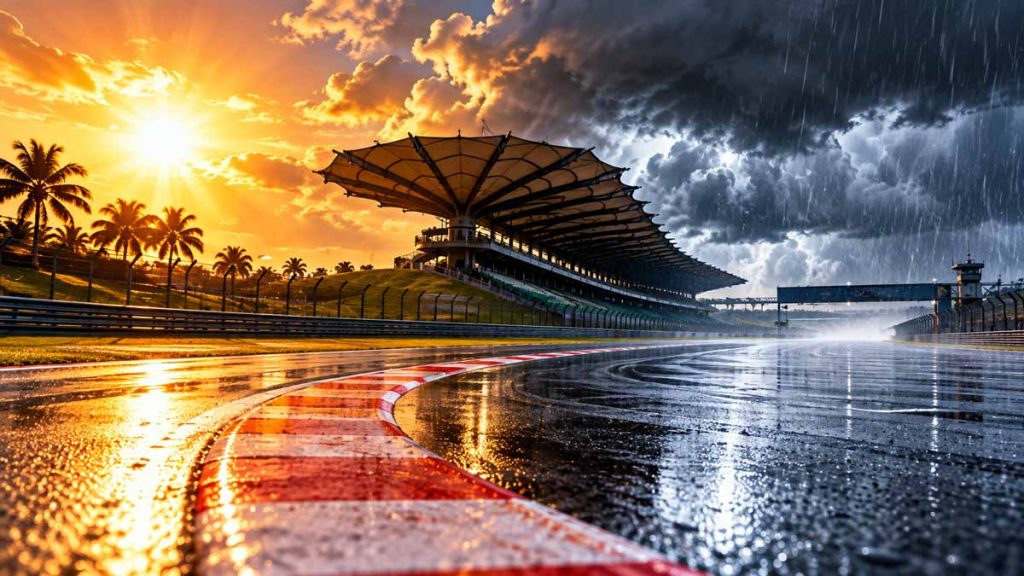
Sepang’s biggest Formula 1 wildcard may not be a corner, a tyre compound or even Overtake Mode. It is the weather. Malaysia’s combination of heat, humidity and sudden tropical rain has historically made Sepang one of the championship’s most difficult circuits to predict.
That matters even more when Formula 1 returns in October 2026. High track temperatures can increase thermal stress, fast corners load the tyres heavily, and a sudden downpour can turn a dry strategy into an intermediate- or wet-tyre decision within minutes.
This guide explains why Sepang weather is so demanding, how rain changes the circuit, what happens to tyres and cooling in extreme heat, and the race-strategy decisions fans should watch.
Why is Sepang weather so important in Formula 1?
Sepang sits in a tropical climate where high temperatures and humidity combine with the possibility of intense rain. Historically, Formula 1 teams have had to prepare for conditions ranging from extremely hot dry running to heavy thunderstorms during the same race weekend.
The weather affects almost every performance area: tyre temperatures, brake and power-unit cooling, driver workload, aerodynamic choices, track grip and pit-stop strategy.
It also creates a forecasting problem. Rain can be intense and localised, meaning one section of the circuit may become wet before another. Teams therefore cannot treat a simple “chance of rain” forecast as enough information.
Heat: why Sepang can punish F1 tyres
High ambient and track temperatures have historically made Sepang demanding on tyres. The circuit also combines fast corners with sustained lateral loads, meaning the rubber is being stressed mechanically while already operating in hot conditions.
When a tyre becomes too hot, grip can fall and degradation can accelerate. Drivers may then have to manage pace, change how aggressively they attack corners, or alter the way they follow another car.
The challenge is not identical across every generation of Formula 1 tyre, so historical stint lengths should not be treated as a prediction for 2026. What history does establish is that Sepang combines several characteristics that can make tyre-temperature control important.
Why Sepang’s fast corners add to the tyre challenge
The middle of the Sepang lap includes quick direction changes and longer loaded corners. These sections put sustained energy through the tyres rather than giving them an easy sequence of slow corners and straights.
Turns 5 and 6 are particularly useful for understanding car balance and tyre confidence. A driver who is fighting overheating or reduced grip may be less willing to carry speed through the sequence.
For a full breakdown of the layout, braking zones and fastest sections, see our Sepang F1 2026 track guide.
Humidity affects more than the drivers
Malaysia’s humidity is an obvious physical challenge for drivers, who race in protective clothing inside extremely hot cockpits. But the wider thermal challenge also matters to the cars.
Teams need adequate cooling for components while trying to avoid unnecessary aerodynamic drag. Opening up cooling can protect reliability but may carry a performance cost, creating another setup compromise.
For drivers, heat and humidity make hydration and physical preparation important across a 56-lap Grand Prix. Concentration becomes particularly valuable late in the race, when tyre condition and changing weather may already be making the car harder to manage.
What happens when it rains at Sepang?
A tropical downpour can change Sepang very quickly. Grip falls, braking distances increase and standing water can create an aquaplaning risk. Visibility also becomes a major issue when cars throw spray into the air.
Sepang’s width can make wet-weather racing especially interesting because drivers have room to search for grip away from the conventional dry racing line. Rubber deposited during dry running can become slippery when wet, so an alternative line may sometimes offer better traction.
The circuit can also dry quickly once rain stops because of Malaysia’s heat. That creates another strategic problem: the best tyre at the start of a wet period may no longer be the best tyre several laps later.
The crucial decision: slicks, intermediates or full wets?
Mixed conditions create one of Formula 1’s hardest strategy calls: the crossover point.
| Condition | Typical strategic question |
|---|---|
| Light rain / damp track | Can slick tyres survive until the rain stops, or is an intermediate already faster? |
| Consistent wet surface | When does the intermediate become clearly faster than the slick? |
| Heavy rain / standing water | Are full wet tyres required, and can racing continue safely? |
| Drying circuit | How early can a driver switch back to slicks without losing too much time? |
| Localised rain | Is a tyre change worth it when only part of the lap is wet? |
A perfectly timed stop can gain large amounts of time. A stop one lap too early or too late can do the opposite. That is why weather radar, driver feedback and sector-by-sector conditions become so important at Sepang.
Why localised rain makes Sepang difficult to read
One of the unusual challenges associated with Malaysian storms is that rainfall does not always arrive uniformly across the entire circuit.
A driver can report rain while another part of the track remains comparatively dry. That complicates the pit wall’s decision because changing to wet-weather tyres for only a small portion of the lap can cost time everywhere else.
The first cars reaching a shower effectively become weather sensors for the rest of the field. Radio messages, onboard cameras, sector times and radar information all help teams decide whether the rain is intensifying or passing quickly.
How rain could change overtaking in 2026
Wet conditions can reshape the overtaking picture. Braking zones become longer, traction becomes less predictable and drivers may choose very different lines through the same corner.
The 2026 cars also place much greater emphasis on electrical deployment. In dry conditions, Sepang’s long straights should make F1’s new Overtake Mode particularly interesting. In rain, however, usable grip and traction may become the limiting factors rather than simply available electrical power.
A driver with extra deployment still needs to put that power onto the road. Poor traction out of the preceding corner can erase much of the theoretical advantage before the braking zone arrives.
Could rain cause a Safety Car or red flag?
Yes. Heavy Formula 1 rain is not only a question of lap time. Standing water, aquaplaning and poor visibility can reach a point where normal racing becomes unsafe.
Sepang has historical precedent for major weather disruption. The 2009 Malaysian Grand Prix was stopped early amid torrential rain and fading light, while other Malaysian race weekends have also been affected by intense downpours.
Modern race control decisions depend on the conditions at the time, so historical examples cannot tell us whether a specific 2026 shower would trigger a Safety Car, suspension or red flag. They do show why severe-weather procedures are relevant at this circuit.
Why an October Sepang race is especially interesting
Formula 1 returns to Sepang from October 2–4, 2026. The unusual event is officially the Bahrain Grand Prix in Malaysia rather than a conventional Malaysian Grand Prix. For session times, the 3:00 PM MYT race start and a full race-week preview, see our Bahrain GP in Malaysia 2026 schedule and weekend guide.
Race-week forecast update (September 29): Malaysia’s official MetMalaysia forecast now covers the full October 2–4 weekend. Sepang is forecast around 24–25°C minimums and 33°C maximums. Friday currently carries thunderstorms/rain in the morning with no rain forecast for the afternoon; Saturday and Sunday currently show morning rain with no rain forecast for the afternoon. Because the F1 sessions run into the afternoon — including the 3:00 PM Sunday race — the present outlook is more favourable than a simple “wet weekend” label suggests, but tropical forecasts can still change quickly.
That timing puts Formula 1 back at Sepang during a part of the year when tropical weather remains an important variable. This is now a genuine race-week forecast rather than only a climate-based assessment, so we will treat the official MetMalaysia outlook as the baseline while still allowing for short-notice changes.
For the story behind the unusual race identity and relocation, read our explainer on why the Bahrain Grand Prix is being held in Malaysia.
What to watch during the 2026 Sepang race weekend
- Track temperature: unusually high temperatures can influence tyre behaviour and degradation.
- Long-run tyre performance: Friday practice should provide the first useful evidence of how the 2026 compounds behave at Sepang.
- Cooling choices: teams must balance thermal protection against aerodynamic performance.
- Storm timing: rain arriving during qualifying or the race can radically change strategy.
- Crossover laps: watch which teams identify the slick-to-intermediate and intermediate-to-slick transitions fastest.
- Different grip lines: drivers may search away from the normal racing line in wet conditions.
- Weather updates: race-week forecasts matter much more than long-range assumptions.
Sepang F1 weather FAQ
Rain has historically been a major feature of Formula 1 weekends at Sepang, including very heavy tropical downpours. Whether the 2026 race itself will be wet cannot be known until reliable race-week forecasts are available.
Sepang combines high temperatures with fast corners and significant tyre loading. Those factors can increase thermal stress and make tyre management important, although the exact 2026 behaviour will depend on the compounds and conditions used that weekend.
Localised tropical rain can affect one area more strongly than another. That makes driver reports, radar and sector conditions particularly valuable when teams decide whether to change tyres.
Severe rain can create standing water, aquaplaning and visibility problems. If conditions become unsafe, race control can use the Safety Car, suspend running or red-flag the session under the applicable procedures.
As of September 29, MetMalaysia’s Sepang forecast shows rain or thunderstorms mainly in the morning across October 2–4, with no rain currently forecast for the afternoon periods. The Sunday race starts at 3:00 PM MYT, so the current official outlook does not point to a wet race, but tropical forecasts can change and should be rechecked before the start.
The Formula 1 Bahrain Grand Prix in Malaysia is scheduled at Sepang International Circuit from October 2–4, 2026.
